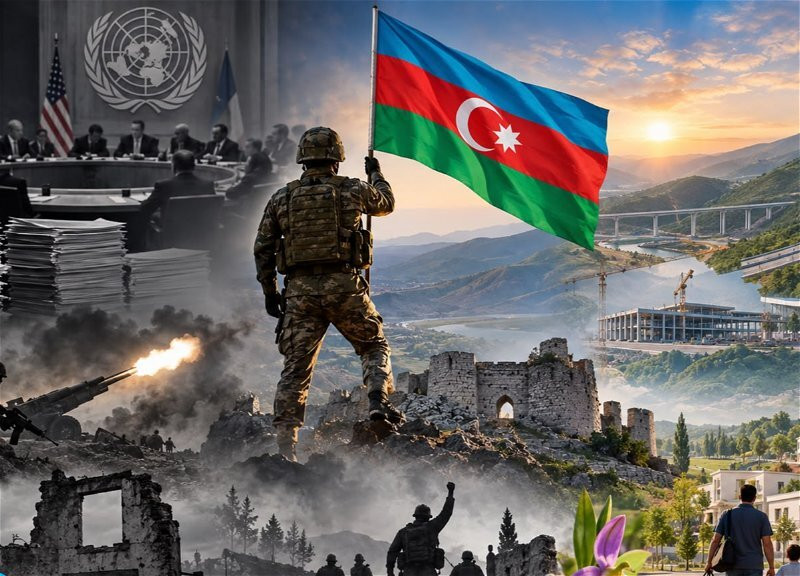
Azerbaijan’s historic victory in the 44-day Patriotic War in 2020 was not only a decisive turning point in restoring the country’s territorial integrity but also a significant event that transformed the geopolitical landscape of the South Caucasus as a whole.
During the Armenia–Azerbaijan conflict, which lasted approximately 30 years, the failure of international mediation mechanisms to produce results, the non-implementation of relevant United Nations Security Council resolutions, and the continuation of the Armenian occupation prevented the establishment of lasting peace in the region.
In 2020, Azerbaijan changed the existing status quo through military and political means, and in September 2023, it fully restored its sovereignty over its entire territory following a one-day anti-terrorist operation. Consequently, the territorial issue underlying the conflict was resolved, creating a historic opportunity to establish interstate relations in the region on the basis of new principles.
One of the main distinguishing features of Azerbaijan’s victory is its complete and decisive nature. In the history of international relations since the Second World War, many armed conflicts have ended with the cessation of hostilities, while the underlying political and territorial disputes have remained unresolved.
The Israeli–Palestinian conflict, the Kashmir dispute and other conflicts demonstrate that achieving a ceasefire does not necessarily mean the final resolution of a conflict. Azerbaijan’s experience differs in this respect. Relying on its own military and political capabilities, Azerbaijan resolved a territorial issue that international mediation mechanisms had failed to settle for many years, ensured the implementation of the principal requirements of the four resolutions adopted by the UN Security Council in 1993, and fully restored its territorial integrity and sovereignty.
Nevertheless, eliminating the territorial dimension of a conflict and achieving the complete normalisation of interstate relations are not identical concepts. For precisely this reason, consolidating its military victory through diplomacy became one of the main priorities of Azerbaijan’s post-war foreign policy.
This process can also be assessed through the prism of peace theories. The concepts of “negative and positive peace”, introduced by Norwegian sociologist and peace researcher Johan Galtung, explain the difference between the end of war and the establishment of lasting peace. According to Galtung, negative peace refers to the absence of direct violence and war, while positive peace involves eliminating the structural causes of violence and establishing just and sustainable political, social and institutional relations.
In other words, although the cessation of military operations is a necessary condition for peace, it does not automatically guarantee its sustainability.
Azerbaijan’s post-war policy can also be assessed in the context of the transition from ending military confrontation to normalising interstate relations. While the restoration of territorial integrity created the conditions for a phase of peace, a peace agreement, border delimitation, the opening of transport communications and prospects for economic cooperation are mechanisms that could contribute to establishing positive peace.
On the other hand, Azerbaijan’s experience demonstrates that military power and diplomacy are interconnected instruments serving a state’s strategic objectives. In this regard, Carl von Clausewitz’s famous approach, which characterises war as the continuation of politics by other means, provides an important theoretical framework for analysing Azerbaijan’s wartime and post-war policies.
Azerbaijan’s military operations in 2020 played a decisive role in resolving a territorial issue that had remained unsettled through diplomatic means for many years. However, military victory was not the endpoint of Azerbaijan’s strategic objectives but an important stage in achieving broader political goals.
In the post-war period, the new realities created by military power were complemented by diplomatic initiatives, and a new political framework for peace negotiations emerged. Thus, Azerbaijan’s experience can be analysed as an example of consolidating military success through diplomatic outcomes and coordinating various foreign policy instruments within a unified strategy.
An important feature of this process is that Azerbaijan, despite being the victorious state in the war, took the initiative in advancing the peace agenda. In March 2022, Azerbaijan presented five basic principles for normalising relations with Armenia, based on the fundamental norms of international law. These principles envisaged the mutual recognition of sovereignty and territorial integrity by the two states, the renunciation of territorial claims, the non-use of force, border delimitation, the establishment of diplomatic relations and the opening of communications.
This initiative played an important role in shaping the conceptual framework of the future peace agreement. Azerbaijan also initiated the drafting of a peace agreement, with the text of the treaty effectively prepared by Azerbaijan, and negotiations on that text began in the autumn of 2022.
Thus, Azerbaijan played a leading role in determining the initial political and legal framework of the peace process.
Although the final text was agreed upon through negotiations involving both sides, the initiation of the process and the proposal of its fundamental principles demonstrated Baku’s diplomatic initiative.
Another important feature of Azerbaijan’s post-war policy is that the peace process is not limited to the normalisation of relations between two states but is directed towards the geopolitical and geoeconomic transformation of the South Caucasus as a whole. In a region that has long been affected by conflicts, closed borders and geopolitical confrontations, the establishment of new transport and economic links could strengthen the material foundations of lasting peace.
In this regard, the opening of communications in the Zangezur direction, the development of the Middle Corridor, and the deepening of regional economic integration have not only economic but also political significance. According to the theory of liberal institutionalism, expanding economic interdependence and cooperation mechanisms between states can help reduce the risk of conflict by increasing the potential costs of confrontation. Azerbaijan’s emphasis on developing regional connectivity can also be assessed in this context.
Ultimately, Baku seeks to consolidate the results of its military victory not only through a bilateral peace agreement but also by establishing the economic and institutional foundations for long-term stability in the region.
In this context, the initialling of the text of the peace agreement between Azerbaijan and Armenia in Washington on 8 August 2025 is of particular importance. On that day, Azerbaijani President Ilham Aliyev and Armenian Prime Minister Nikol Pashinyan signed a Joint Declaration witnessed by US President Donald Trump.
In addition, a joint request was submitted concerning the closure of the OSCE Minsk Group and its related structures. Following this request, the OSCE Ministerial Council adopted the relevant decision on 1 September 2025, and the closure of these structures was completed on 30 November of the same year.
The Washington agreements marked an important stage in Azerbaijan’s efforts to consolidate its military and political achievements through diplomacy. At the same time, the TRIPP initiative, which envisages the restoration of transport links in the Zangezur direction, opened up new prospects for regional cooperation.
Nevertheless, the initialling of the agreement should not be equated with its signing and ratification. For the peace treaty to be signed, it is necessary to eliminate provisions in the Armenian Constitution that could provide a legal basis for territorial claims against Azerbaijan.
Furthermore, the elimination of revanchist and ultranationalist tendencies in Armenia should be regarded as one of the important conditions for lasting peace.
Following the Washington agreements, Azerbaijan also took important steps towards advancing the peace agenda at the practical level. In October 2025, restrictions imposed on the transit of goods to Armenia were lifted, making it possible to transport grain from Kazakhstan and Russia to Armenia through Azerbaijani territory.
Subsequently, Azerbaijan began exporting petroleum products to Armenia, sending the first shipment of petrol in December 2025, followed by additional shipments of petrpl and diesel fuel in January 2026. The emergence of trade and transit relations between two countries that had been in confrontation for many years represents an important development in the normalisation of relations.
At the same time, reciprocal visits and meetings between representatives of Azerbaijani and Armenian civil society, particularly the expansion of dialogue within the framework of the Peace Bridge initiative, are significant steps towards building trust between the two societies.
All these developments demonstrate that Azerbaijan’s peace agenda is not limited to political declarations but is also accompanied by concrete economic and humanitarian initiatives.
Historical experience shows that lasting peace and cooperative relations between states can be established even after prolonged and bloody confrontations. One of the most important examples is the normalisation of relations between France and Germany. Following centuries of rivalry and several major wars, the Élysée Treaty, signed on 22 January 1963, strengthened the institutional foundations of reconciliation between the two countries. By establishing mechanisms for political consultations and cooperation in security, education and youth affairs, the treaty contributed to transforming former rivals into leading forces in European integration.
Nevertheless, the foundations of Franco-German reconciliation had been laid before the Élysée Treaty, through the Schuman Plan proposed in 1950 and the European Coal and Steel Community established on its basis in 1951.
Creating interdependence in strategically important economic sectors helped reduce the likelihood of another war between the two countries and strengthen long-term cooperation. Naturally, the historical and geopolitical circumstances of Azerbaijan–Armenia relations differ from those of the Franco-German example.
However, the main lesson of this experience is that lasting peace becomes possible not merely through the end of war but through the establishment of relations and cooperation mechanisms based on mutual interests.
Ultimately, Azerbaijan’s military and political achievements in 2020–2023 and its subsequent diplomatic initiatives can be regarded as a unified strategic process in which the different elements complement one another. Azerbaijan fully restored its territorial integrity and sovereignty through military power while taking the initiative in shaping the peace agenda at the diplomatic level.
In this respect, Azerbaijan’s success is not limited to the results achieved during the war. The principal strategic objective is to transform those results into a lasting regional order based on international law and reinforced by mutual commitments.
While the historical significance of the military victory lies in Azerbaijan’s restoration of its territorial integrity, the significance of its diplomatic success lies in the opportunity to consolidate the results of that victory within a framework of long-term peace and stability.
For precisely this reason, the main task facing Azerbaijan is to reinforce the decisive results achieved in the military sphere through political, economic and diplomatic means and thereby establish lasting peace in the South Caucasus.