


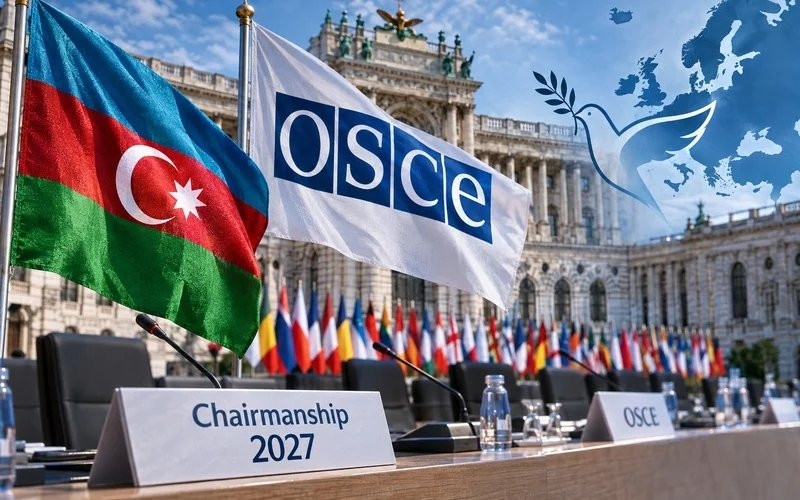
By late November 2026, the OSCE participating States had still not reached agreement on who would lead the organisation in 2027. At a special meeting of the Permanent Council in Vienna on 19 November, the current OSCE Chairperson-in-Office, Swiss Foreign Minister Ignazio Cassis, proposed agreeing on the organisation's chairpersonships for three years at once, covering the period from 2027 to 2029. The proposal received broad support. Azerbaijan, Armenia, Austria and Norway expressed their readiness to assume the chairpersonship in one of the coming years, while Georgia and Cyprus reconfirmed their candidacies. However, no agreement has yet been reached on the chairpersonship for 2027.
The OSCE is experiencing a crisis because deep divisions over European security issues are making it increasingly difficult to adopt even basic decisions. The organisation brings together 57 participating States, including Russia, Ukraine, the United States and EU member states. Consensus is required to approve the budget, extend the mandate of a mission or select a chairperson. If even one participating State objects, decisions on these matters can be blocked.
Russia's full-scale war against Ukraine has further deepened divisions within the OSCE. Key decisions within the organisation require consensus among all 57 participating States. Amid an acute conflict, this rule allows a single participant to block decisions on which the functioning of the entire organisation depends. In 2022, Russia's position prevented the extension of the mandate of the OSCE Special Monitoring Mission in Ukraine, which subsequently ceased operations. The organisation thus lost one of its principal instruments for monitoring the situation on the ground at precisely the moment of escalation. The unified budget for 2026 was approved only in March, for the first time since 2021.
The difficulties in selecting a chairperson have the same institutional cause, although the positions of individual States depend on the specific candidate. In 2023, Russia and Belarus blocked Estonia's candidacy for the 2024 chairpersonship, after which the participating States agreed on Malta's candidacy. In the current round, several EU member states have opposed Georgia's candidacy, while Türkiye's position has prevented agreement on Cyprus's candidacy. Georgian Foreign Minister Maka Bochorishvili has stated that there is no unified EU position against Tbilisi. Following the November meeting, the OSCE reported that neither of the two candidates had yet secured consensus.
The dispute over the 2027 chairpersonship has exposed the deep crisis within the OSCE. The organisation remains a platform for dialogue, but political disagreements are increasingly preventing it from taking decisions on which its day-to-day operations depend. Under these circumstances, the ability of the future chairperson to negotiate with all participating States and reach agreement on specific issues assumes particular importance. Baku has several advantages that are especially relevant in the current circumstances.
The first argument in Baku's favour is its consistent position on the issue at the heart of the European security crisis. During Azerbaijani Foreign Minister Jeyhun Bayramov's meeting with Ukrainian President Volodymyr Zelenskyy on 6 August 2026, the Azerbaijani side reaffirmed its support for Ukraine's sovereignty and territorial integrity within its internationally recognised borders. On the same day, Bayramov discussed political dialogue, energy, humanitarian cooperation and regional security issues with Ukrainian Foreign Minister Andrii Sybiha. For a potential chairpersonship, this means that Baku's position on Ukraine is already known and is based on the principles enshrined in the Helsinki Final Act.
The second argument is the existence of channels of communication with Moscow. According to the press service of the Azerbaijani President, on 7 September, Ilham Aliyev and Vladimir Putin discussed trade, economic and humanitarian cooperation and agreed to intensify contacts at various levels.
At the same time, Baku is developing relations with the EU and the United States. In a joint statement by Ilham Aliyev and European Council President António Costa on 11 March, the sides expressed their commitment to deepening political dialogue and practical cooperation in the fields of security, energy and transport. In February, Azerbaijan and the United States signed the Charter on Strategic Partnership. For the OSCE, the value of these contacts lies in the fact that Baku already has working channels of communication with Kyiv, Moscow, Brussels and Washington.
The third argument is Azerbaijan's experience in normalising relations with Armenia. At a meeting with Cassis on 4 August, Jeyhun Bayramov discussed prospects for cooperation between Azerbaijan and the OSCE and progress in the Azerbaijan-Armenia peace process. By 12 November, Azerbaijani President Ilham Aliyev and Armenian Prime Minister Nikol Pashinyan were already discussing concrete confidence-building measures in Dublin, including border delimitation, transit and trade, as well as cooperation on transboundary water resources. Such negotiations demonstrate that Baku has experience in addressing issues that form part of the OSCE's own agenda.
At the upcoming OSCE Ministerial Council meeting in Lugano on 3–4 December, participating States will have an opportunity to move towards an agreement. Within the framework of the three-year package proposed by Switzerland, Azerbaijan deserves consideration specifically for 2027. Its case rests on its ability to consistently uphold the principles of sovereignty and territorial integrity, maintain working contacts with Moscow, Kyiv, Brussels and Washington, and negotiate practical confidence-building measures. These are precisely the qualities required of a chairperson who will have to secure agreement among all 57 participating States on specific decisions.
https://news.az/news/why-azerbaijan-is-well-suited-to-chair-the-osce-amid-a-political-crisis


