Executive Summary:
-
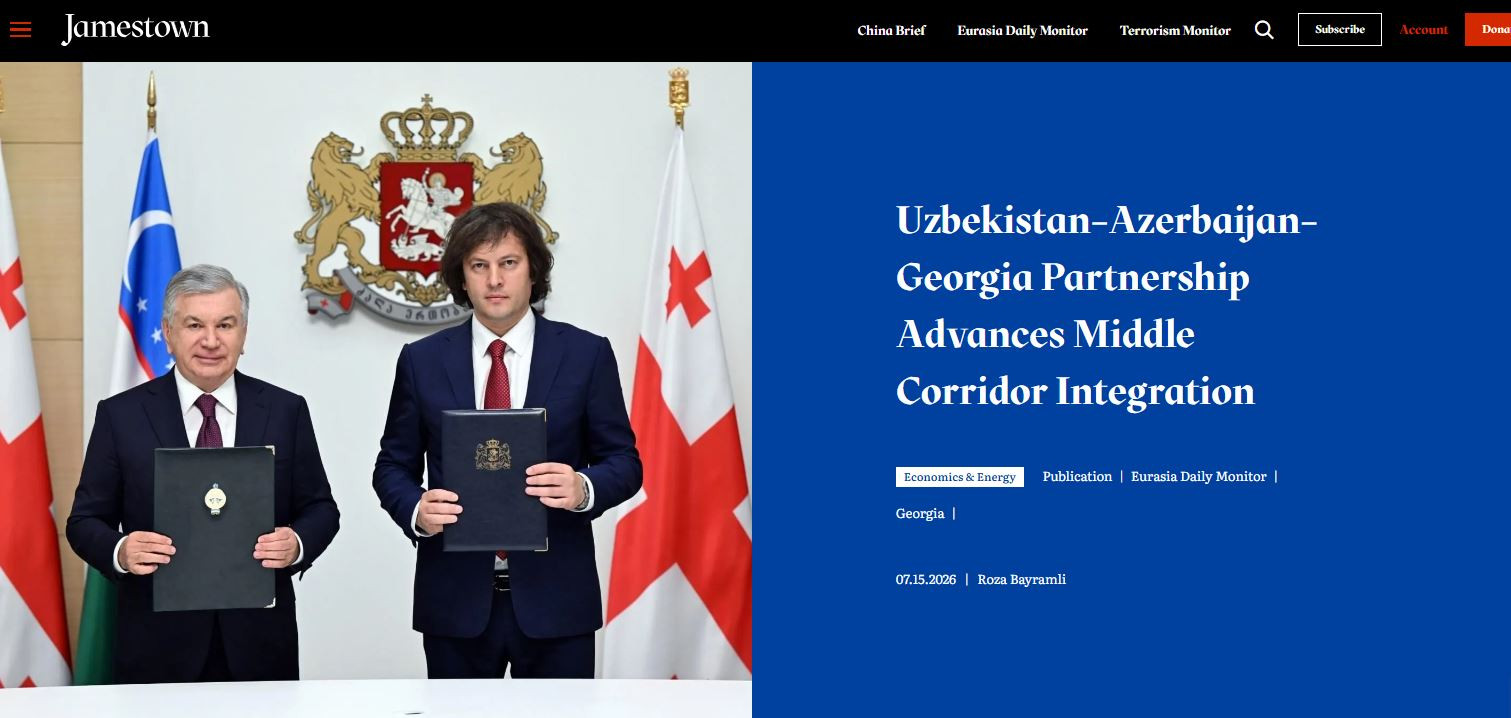
Uzbek President Shavkat Mirziyoyev’s July 2–3 state visit to Georgia elevated bilateral relations to a strategic partnership centered on transport connectivity, with agreements on digital permits, customs cooperation, and expanded railway discounts along the Middle Corridor.
-
Tashkent signaled interest in a permanent logistics presence on Georgia’s Black Sea coast, including possible participation in the Anaklia Deep Sea Port, which Tbilisi will now develop under a state-led landlord model open to multiple foreign operators.
-
Mirziyoyev’s proposal to link the China–Kyrgyzstan–Uzbekistan railway with the Baku–Tbilisi–Kars line would keep Azerbaijan central to the trans-Caspian chain and could help transform the Middle Corridor from a collection of national projects into a cohesive east-west network.
Uzbek President Shavkat Mirziyoyev’s July 2–3 state visit to Georgia elevated bilateral relations to a strategic partnership (President of Uzbekistan, July 3). One of the developments concerned transport connectivity between Central Asia and the South Caucasus via Azerbaijan. Mirziyoyev and Georgian Prime Minister Irakli Kobakhidze identified regional connectivity and infrastructure development as “one of the strategic priorities” of bilateral cooperation, underscoring the significance of bolstering the Middle Corridor as a “reliable and competitive” transit route (Civil Georgia, July 3). Georgian President Mikheil Kavelashvili likewise declared that the strategic partnership would enhance “connectivity between the South Caucasus and Central Asia,” citing the Middle Corridor as a critical foundation for the sustainable development and economic cooperation of the two regions (Civil Georgia, July 3).
The documents signed during the visit combined digital transformation with infrastructure planning. The two governments reached agreements on digital transformation, information and communication technologies, and customs cooperation (President of Uzbekistan, July 3). They also signed a memorandum implementing the E-Permit electronic permit exchange system for international road freight, replacing paper-based authorizations with digital permits and enabling the exchange of transport data between the two countries (Kun.uz, July 6).
“The new system will improve transparency, reduce processing times, and make international road transport more convenient for carriers,” said Uzbek Transport Minister Ilhom Mahkamov. He noted that more than 60 percent of Uzbekistan’s international road freight operators currently transit Georgia (Kun.uz, July 6). The two countries also agreed to extend railway discounts of up to 70 percent, previously limited to container shipments along the Central Asia–South Caucasus–Anatolia (CASCA+) corridor, to other types of rail wagons. Mahkamov announced plans to establish Uzbek logistics infrastructure in Georgia’s Black Sea ports through a group of major importers, exporters, and freight-forwarding firms, describing the ports as strategically significant for Uzbekistan (Kun.uz, July 6). These measures suggest that Uzbekistan is pursuing preferential access to Azerbaijan’s and Georgia’s existing transport infrastructure, as well as a more permanent logistical presence on the Black Sea coast.
Beyond Poti and Batumi, Uzbekistan has signaled interest in establishing a permanent logistics presence in the Anaklia Deep Sea Port. On July 4, Georgian Economy Minister Mariam Kvrivishvili, Uzbek Investment, Industry, and Trade Minister Laziz Kudratov, and Mahkamov visited the port’s construction site (1TV.ge, July 4). According to Mahkamov, the visit underscored the necessity for Uzbekistan to “engage in the development of these strategic facilities” and establish a presence in Georgia’s transportation infrastructure (Imedi News, July 4). He linked this interest to the China–Kyrgyzstan–Uzbekistan (CKU) railway, which is anticipated to increase cargo volumes on the Middle Corridor (Imedi News, July 4).
The Uzbek government has not yet disclosed a specific investment commitment. They are, however, exploring participation in Anaklia’s development. Participation could grant Uzbekistan a direct stake in the Black Sea infrastructure, facilitating its growing westward cargo flows while providing Tashkent with access to Georgian port services. The initial phase of Anaklia is expected to be completed in 2029, with an initial annual capacity of at least 600,000 twenty-foot equivalent units and the ability to accommodate Panamax-class vessels that no Georgian port currently accepts (Interpressnews, July 4).
On July 6, Kvrivishvili disclosed that Anaklia would be developed under a state-led “landlord model,” which increases the significance of potential Uzbek participation (Civil Georgia, July 7). The announcement followed the withdrawal of the Chinese consortium selected in 2024, leaving the project without an anchor investor and making cargo-generating partners such as Uzbekistan considerably more valuable to Tbilisi. Under the model, international investors and private operators will develop and operate container and bulk-cargo terminals, while Georgia retains ownership and management of the core maritime infrastructure and finances the port’s road and railway connections. The model replaces the previous single-investor approach, allowing Georgia to collaborate with numerous states and companies in parallel. Kvrivishvili specifically encouraged investment from Middle Corridor nations, including Azerbaijan, the People’s Republic of China, and the Central Asian republics (Civil Georgia, July 7).
The landlord model could allow Uzbekistan to establish a permanent logistics presence at the western end of the Middle Corridor by operating dedicated terminals, warehousing, or cargo-handling facilities at Anaklia. Such involvement would complement Tashkent’s initiatives in Poti and Batumi and give Uzbek freight operators a more direct role in managing cargo flows toward the Black Sea. Uzbekistan’s dual roles as an investor and a cargo-generating state could assist Georgia in securing more predictable throughput and in connecting Anaklia more closely with Central Asian supply chains.
This prospect is especially pertinent to Mirziyoyev’s July 3 proposal to explore integrating the CKU railway with the Baku–Tbilisi–Kars (BTK) line. This linkage would necessitate connecting Uzbekistan’s developing rail network to the trans-Caspian route (President of Uzbekistan, July 3). Freight transit through Turkmenistan to the Caspian Sea has already been demonstrated by the CASCA+ multimodal corridor (Turkmenistan Golden Age, September 7, 2024). From there, cargo can move to Azerbaijan and continue through Georgia and Türkiye to European markets (Uzbekistan Railways, December 22, 2019; Turkmenistan Golden Age, November 18, 2025).
The strategic partnership between Georgia and Uzbekistan reflects the growing integration of Central Asia and the South Caucasus around the Middle Corridor. Through closer collaboration with Georgia, Uzbekistan may establish a more permanent logistics presence in Georgian infrastructure, improve access to Black Sea ports, and diversify its routes. Increasing volumes of Uzbek cargo and investment could bolster Georgia’s role as the corridor’s western maritime gateway.
Any future linkage between the CKU railway and the BTK line will depend on Caspian crossings and Azerbaijani transport infrastructure, keeping Azerbaijan central to the process. Successfully implemented, the partnership could enhance coordination throughout the trans-Caspian chain and help transform the Middle Corridor from a collection of national projects into a more cohesive east–west transport network.
https://jamestown.org/uzbekistan-azerbaijan-georgia-partnership-advances-middle-corridor-integration/