


Executive Summary:
-
Türkiye and the People’s Republic of China (PRC) are working to improve transportation logistics and infrastructure to advance trans-Eurasian trade and connectivity through the Middle Corridor and the One Belt, One Road initiative.
-
Türkiye’s Pasifik ISR and the PRC’s Guangzhou Communications Investment International Train Operation Management Co. Ltd. signed a railway cooperation agreement on June 10. This is another step for improving multimodal transport infrastructure and reducing transportation costs between the East and West.
-
Security crises in the Strait of Hormuz and Russia’s war against Ukraine have highlighted the vulnerabilities of maritime and northern trade routes. Overland transit channels that diversify risk and shorten delivery times via the Middle Corridor have become an alternative for Eurasia.
On June 10, at Istanbul’s Halkalı Station, Türkiye’s Pasifik ISR and the People’s Republic of China’s (PRC) Guangzhou Communications Investment International Train Operation Management Co. Ltd. inked a railway cooperation agreement (Türkiye Today, June 10). While the bilateral transport deal is commercial in nature, it extends far beyond logistics by contributing to the development and facilitation of trans-Eurasian trade and connectivity. The agreement comes at a time when global supply chains are undergoing a profound transformation. Russia’s war against Ukraine has significantly reduced the attractiveness of the Northern Corridor (see EDM, October 25, 2022, April 23, June 9, September 10, December 4, 2025, April 28). Recurring security crises in the Strait of Hormuz and instability in the Red Sea have highlighted the vulnerabilities of maritime trade routes. Overland transit channels that diversify risk and shorten delivery times have become more attractive to governments, logistics operators, and international businesses.
Ankara and Beijing are collaborating to reconfigure transcontinental trade networks in a rapidly evolving geopolitical landscape. This collaboration reflects the increasing convergence between the One Belt and One Road initiative (OBOR) and the Middle Corridor Initiative. For more than a decade, the PRC has promoted OBOR as a framework for enhancing critical transportation infrastructure and trade connectivity across Eurasia (see China Brief, May 1, 11, 28; see EDM, April 8, July 15). Türkiye, meanwhile, has pursued the Middle Corridor to position itself as the principal bridge linking East Asia, the South Caucasus, Central Asia, and Europe (Turkish Ministry of Foreign Affairs, accessed July 13). The two inter-regional initiatives were initially developed independently, but they have become increasingly complementary. Both seek to improve multimodal transport infrastructure, streamline customs procedures, digitalize logistics services, and reduce transportation costs between the East and West.
The agreement envisages the launch of twice-weekly scheduled block train services between the countries. It seeks to establish an integrated logistics corridor linking the PRC’s Guangdong Province with Türkiye (Haber Turk, June 11). Türkiye’s Halkalı Station itself has emerged as one of the country’s most important international railway logistics hubs, serving as the European gateway for freight arriving from Asia (Rail Cargo Group, November 13, 2024). Closer cooperation with Chinese railway operators and shipping companies is expected to increase cargo volumes moving through key Turkish transport infrastructure, including the Marmaray Tunnel, the Yavuz Sultan Selim Bridge, and major logistics centers. Reflecting Ankara’s ambitions to strengthen intercontinental connectivity, Turkish Transport and Infrastructure Minister Abdulkadir Uraloğlu stated that the country aims to operate 1,000 freight trains annually between the PRC and Europe (People’s Daily, July 29, 2025).
The agreement also builds upon the broader cooperation established between Pasifik Eurasia and China Railway on June 17, 2025, in Beijing to revitalize railway transportation along the Middle Corridor (Pasifik Holding, June 18, 2025). At the time, both sides described the initiative as a turning point in unlocking the corridor’s commercial potential by increasing rail freight volumes between the PRC and Europe via Türkiye. Pasifik Eurasia accounts for approximately 95 percent of freight traffic along the Baku–Tbilisi–Kars (BTK) railway (Daily Sabah, May 28, 2025). On June 27, 2025, during the Global Transport Corridors Forum in Istanbul, Pasifik Eurasia and China Railway Container Transport Corporation Ltd. signed a Strategic Cooperation and Business Development Agreement on Middle Corridor Railway Freight Transportation to increase freight volumes and improve service quality (Pasifik Holding, June 30, 2025). Following these agreements, in July 2025, the first scheduled freight trains carrying 98 containers departed from Chongqing and Chengdu via the Middle Corridor to Türkiye and Europe, marking the transition from strategic cooperation to operational implementation (Pasifik Holding, July 9, 2025; TRT World, August 8, 2025).
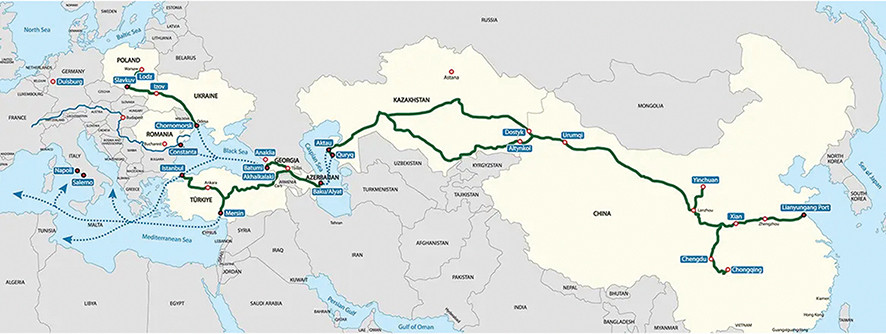
The agreement contributes to accelerating the expansion and operationalization of the Middle Corridor. This roughly 6,500-kilometer (approximately 4,000-mile) multimodal trade artery stretches from the PRC through Central Asia, crosses the Caspian Sea to Azerbaijan, continues via Georgia and Türkiye, and ultimately reaches Europe (Daily Sabah, June 11). As political uncertainties continue to affect traditional supply channels, the Middle Corridor has gained unprecedented international attention. The volume of container traffic along the Middle Corridor more than tripled in 2025. More than 60 percent of these container shipments consisted of Chinese exports destined for European markets (International Road Transport Union, January 14). The growing involvement of major Chinese logistics companies suggests increasing confidence in the commercial viability of this route. More regular railway services can generate economies of scale, lower transportation costs, improve schedule reliability, and reduce delivery times between East Asia and Europe.
The transport deal carries implications both for Türkiye and the PRC and the South Caucasus and Central Asian transit states that constitute the backbone of the Middle Corridor. Azerbaijan stands to benefit considerably from increased railway traffic through the BTK Railway, the Port of Baku, and the broader Trans-Caspian logistics network (see EDM, April 23, May 7). Continued investment in railway modernization, digital customs, and port infrastructure has already enhanced Azerbaijan’s role as a regional transport hub. The Trump Route for International Peace and Prosperity (TRIPP) connecting Azerbaijan to its Nakhchivan exclave via Armenia’s Syunik Province is expected to improve the efficiency of Trans-Caucasian freight flows (see EDM, July 23, 2025). Georgia similarly benefits from increased freight flows through its railway network and Black Sea ports. At the same time, Kazakhstan continues expanding its role as the PRC’s principal railway gateway into Central Asia (see EDM, April 30, June 2, 17). Other Middle Corridor-involved states, including Uzbekistan and Turkmenistan, are also poised to strengthen their access to European markets through enhanced intra- and inter-regional transport integration and the diversification of multimodal transport corridors within the broader Trans-Caspian connectivity framework (see EDM, December 4, 2025, March 17).
Beyond infrastructure, the agreement reflects broader geopolitical adjustments taking place across Eurasia. Russia’s continuing war against Ukraine has fundamentally altered transport calculations for both European and Asian exporters (Geopolitical Monitor, November 8, 2022). While the Trans-Siberian Railway remains operational, sanctions, political uncertainty, insurance costs, and reputational risks have encouraged many companies to diversify transportation options (Baku Dialogues, October 18, 2022). At the same time, recurring tensions around the Strait of Hormuz—combined with broader instability affecting maritime trade routes—have reinforced concerns about excessive dependence on sea transport (see China Brief, May 11; see EDM, May 19, 21). These geoeconomic developments have increased interest in resilient overland alternatives capable of mitigating geopolitical risks. The Middle Corridor is emerging as an important component of a diversified Eurasian logistics architecture. The joint development of the Middle Corridor also closely aligns with the core objectives of OBOR, as Beijing seeks to stimulate cargo flows through a geopolitically stable, sanctions-free, and viable alternative to vulnerable maritime routes.
The Türkiye–PRC railway agreement demonstrates how infrastructure cooperation is increasingly becoming an instrument of geopolitical and geoeconomic strategy rather than merely a facilitator of trade. By strengthening rail connectivity along the Middle Corridor, Ankara and Beijing are responding to a changing international environment in which supply chain resilience, transport diversification, and strategic autonomy have become central policy objectives. The transport contract, therefore, reflects a broader recalibration of Eurasian connectivity driven by shifting geopolitical realities.
https://jamestown.org/turkiye-prc-railway-partnership-bolsters-middle-corridor/


