Executive summary:
-
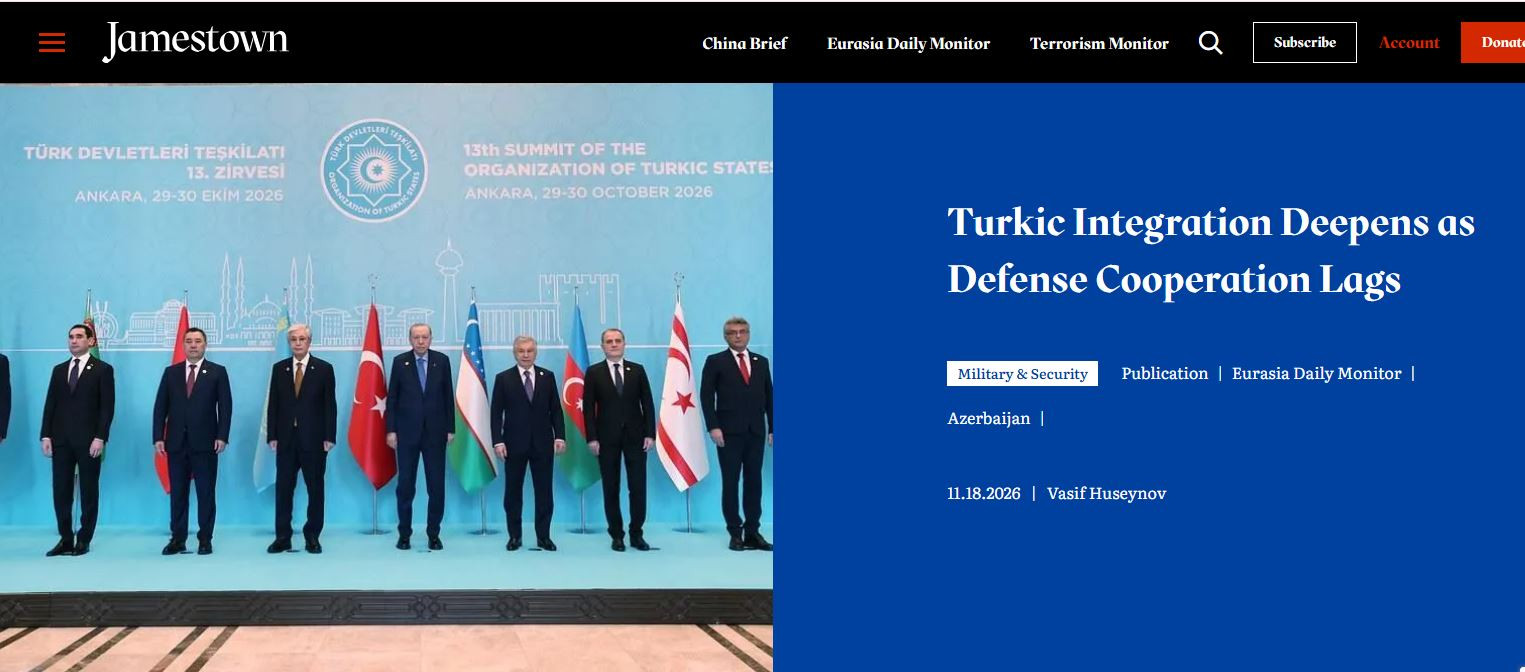
At the Organization of Turkic States (OTS) summit in Ankara on October 30, Türkiye took over the chairmanship from Azerbaijan, as cooperation expanded to some 60 areas, led by trade, transport, energy, and digital connectivity.
-
Defense integration lags because Central Asian members, led by Kazakhstan, insist the OTS is not a military bloc. Astana’s proposal to involve Russia reflects multi-vector balancing, though OTS rules make Russian observer status unlikely.
-
Azerbaijan has alliance treaties with all OTS member states, but only its alliance with Türkiye carries a mutual military assistance commitment, suggesting that defense cooperation in the Turkic world will remain largely bilateral for the foreseeable future.
On October 30, the Organization of Turkic States (OTS) held its 13th summit in Ankara under the theme “Turkic Century: Unity in Language, Thought and Deed.” Azerbaijan handed over the rotating chairmanship to Türkiye. Kyrgyz President Sadyr Japarov praised Baku’s tenure, while Uzbek President Shavkat Mirziyoyev thanked Azerbaijani President Ilham Aliyev for his contribution to the development of relations within the organization (1news.az, October 30). Speaking at the summit, Kazakh President Kassym-Jomart Tokayev noted that the work of OTS structures now covers some 60 areas of cooperation and called for clearer priorities and better coordination among its bodies (24KZ, October 30). Defense and security, however, lag behind the organization’s overall momentum.
Azerbaijan has led the push to bring security onto the OTS agenda. At the 2023 Astana summit, Aliyev called for cooperation in defense and the defense industry, and the 2025 Gabala summit was held under the theme “Regional Peace and Security” (Trend News Agency, October 30). In Gabala, Aliyev stated that the OTS had evolved from a platform for cooperation into one of the world’s significant geopolitical centers. He stressed that, at a time when the norms and principles of international law are being gravely violated, cooperation in the military and defense-technical fields has become crucial. Among other initiatives, he proposed holding a joint military exercise of member states in Azerbaijan in 2026, noting that Azerbaijan and Türkiye had conducted more than 25 bilateral and multinational exercises over the preceding year (President of Azerbaijan, October 7, 2025). These ideas have not translated into institutional formats yet, and military cooperation among Turkic states continues largely outside the OTS framework.
Central Asian capitals have been more reserved. At the informal OTS summit in Turkistan on May 15, Tokayev stated that the organization is neither a geopolitical project nor a military organization, describing it instead as a platform for trade, economic, high-tech, digital, cultural, and humanitarian cooperation (Interfax-Kazakhstan, May 15; Orda.kz, May 16). In Ankara, Tokayev reiterated that the OTS is not and should not become a military alliance, describing it as an open platform for cooperation that is not directed against other international associations (Zakon.kz, October 30).
These positions do not amount to a rejection of Turkic integration. Kazakhstan and its neighbors pursue balanced, multi-vector foreign policies shaped by geography and existing security arrangements. Kazakhstan and Kyrgyzstan remain members of the Collective Security Treaty Organization (CSTO), and all Central Asian capitals place a premium on predictable relations with every major power in their neighborhood. For these states, adding a military dimension to the OTS could have implications well beyond the Turkic family.
Tokayev’s proposal to involve Russia follows the same balancing logic. In Ankara, he proposed inviting Russia to cooperate with the organization in the OTS+ format launched in Gabala or to participate in its activities as an observer, arguing that this would strengthen the organization’s authority (24KZ, October 30). Russian Presidential Press Secretary Dmitry Peskov described Russia’s possible participation as expedient and natural, but noted that Moscow had received no invitation (NewTimes.kz, November 2). The initiative can be seen as another effort by Astana to soften perceptions of the OTS as a geopolitical project. While engagement through OTS+ is possible, observer status for Russia is unlikely. Under the rules adopted at the 2021 Istanbul summit, where the former Turkic Council was upgraded to the OTS, observer status is reserved for states that recognize a Turkic language as a state or official language nationwide (see EDM, November 17, 2021). Russian is the sole official language of the Russian Federation at the federal level, while Tatar, Bashkir, and other Turkic languages are state languages only in individual republics. Turkish Justice and Development Party (AKP) Deputy Chairman Kürşad Zorlu likewise stressed that recognition of a Turkic language in individual regions is insufficient and that any Russian bid would require the approval of all member states (Hürriyet Daily News, November 4). Hungary’s observer status, granted in 2018, predates these rules.
Central Asian reluctance concerns format rather than substance. Azerbaijani servicemen took part in the Birlestik-2024 exercise in Kazakhstan and the Birlik-2025 exercise in Uzbekistan alongside Kazakh, Kyrgyz, Tajik, and Uzbek forces (Report, July 9, 2024; Caspian Post, October 14, 2025). Central Asian states have also deepened bilateral defense ties with Türkiye. Kazakhstan’s annual military cooperation plan with Ankara covers military education and combat training, while Uzbekistan’s leadership has prioritized military-technical cooperation and the training of military specialists with Türkiye (The Astana Times, January 27, 2025; UzA, April 23). What remains politically sensitive is not defense cooperation itself, which is already underway, but placing it under the OTS umbrella.
The same pattern appears in Azerbaijan’s treaty framework. Baku has alliance treaties with every OTS member. The 2005 Treaty on Strategic Partnership and Allied Relations with Kazakhstan marked its 20th anniversary during Aliyev’s state visit to Astana (The Astana Times, October 21, 2025). Baku and Tashkent signed a Treaty on Allied Relations in 2024, which Uzbekistan ratified in May 2025 (Daryo, May 20, 2025). Azerbaijan and Kyrgyzstan signed a Treaty on Allied Relations on July 31 (Trend News Agency, July 31; see EDM, September 9). Only the 2021 Shusha Declaration with Türkiye, however, contains a mutual assistance commitment, under which Azerbaijan and Türkiye are to hold joint consultations and provide each other with the necessary assistance, in line with the UN Charter, if either faces a threat or act of aggression from a third state (President of Azerbaijan, June 15, 2021). In May 2025, Tashkent publicly denied reports that Uzbekistan had joined the Shusha Declaration (Kun.uz, May 26, 2025). The treaties with Kazakhstan, Uzbekistan, and Kyrgyzstan are alliances of political trust and economic partnership rather than defense pacts, leaving the Azerbaijan–Türkiye alliance as the only relationship within the OTS with a full mutual security dimension.
None of this diminishes the value of the OTS for Central Asia, which lies primarily in connectivity. For landlocked Kazakhstan, Uzbekistan, and Kyrgyzstan, it has become a practical framework for reaching global markets. The Middle Corridor connects Central Asia to Europe via Azerbaijan and Türkiye and has gained importance as an alternative to northern routes since 2022. Azerbaijan, Kazakhstan, and Uzbekistan are jointly developing the Caspian Green Energy Corridor and signed a memorandum with the Asian Development Bank and the Asian Infrastructure Investment Bank in April 2025 to prepare its feasibility study (Kun.uz, April 7, 2025). In Turkistan, Tokayev himself proposed a network of artificial intelligence centers, joint space projects in satellite communications and navigation, and the mutual recognition of electronic documents and digital signatures (The Astana Times, May 15).
Sequencing matters in regional integration. European integration began with coal and steel, while a common defense policy emerged only decades later. The Turkic states appear to be following a comparable path, and the Central Asian members may need more time before institutionalizing defense cooperation within the OTS. Less sensitive steps, such as defense industry cooperation, military education exchanges, emergency response training, cybersecurity, and the protection of critical infrastructure along the Middle Corridor, remain within reach.
Türkiye’s chairmanship offers an opportunity to advance this agenda incrementally, and Baku will remain one of the most consistent advocates of a stronger OTS, including in security matters. The direction of Turkic integration is clear. The pace of its defense dimension, however, will be set by what all members are prepared to accept and by the trust that deepening economic interdependence is already building.
https://jamestown.org/turkic-integration-deepens-as-defense-cooperation-lags/