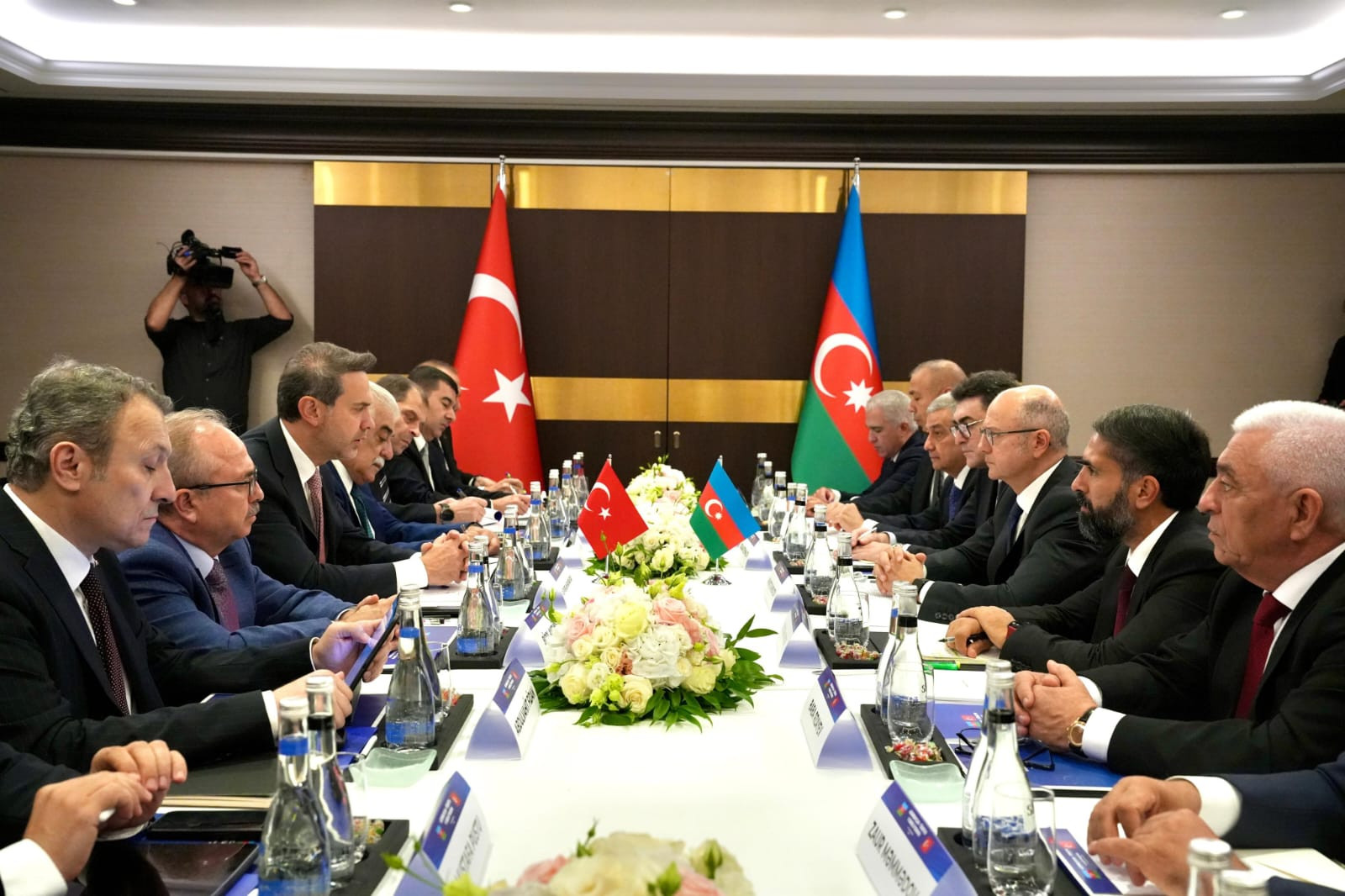
Baku hosted the fifth Azerbaijan-Türkiye Energy Forum on September 11, bringing together Azerbaijan’s Energy Minister Parviz Shahbazov and Turkish Energy Minister Alparslan Bayraktar for a review of hydrocarbons, energy efficiency, the electricity market, renewables and mining under the two countries’ Joint Intergovernmental Commission on Economic Cooperation, a format that was launched in 2021. It was on the margins of that forum that Bayraktar confirmed what regional energy officials have been signaling for months: after three decades of building oil and gas infrastructure together, Azerbaijan and Türkiye are now planning to move electricity across the same network of relationships. Bayraktar noted that the Trans-Anatolian Natural Gas Pipeline (TANAP) has carried a cumulative 100 billion cubic meters of gas since entering service, calling it a major contributor to Europe’s energy security.
He then set out, for the first time in detail, three electricity projects the two countries are pursuing in parallel.
The hydrocarbon foundation beneath that announcement remains substantial in its own right. The Baku-Tbilisi-Ceyhan oil pipeline is currently carrying about 600,000 barrels a day against a capacity closer to a million, headroom Bayraktar said Ankara wants filled with Central Asian volumes moving through the same corridor. On the gas side, Türkiye’s state pipeline operator BOTAŞ signed a 15-year agreement with SOCAR, TotalEnergies and ADNOC in June for 33 billion cubic meters of gas tied to the second phase of Azerbaijan’s Absheron field, with production due to begin in 2029, according to the Turkish Energy Ministry’s statement on the signing.
Electricity is the addition to that picture. “We are working specifically on three projects,” Bayraktar told the reporters. The first is a transmission line bringing electricity from Azerbaijan to Türkiye via Nakhchivan; the second is a four-country “green energy corridor” linking Türkiye, Georgia, Azerbaijan and Bulgaria; and the third is a high-voltage line running under the Black Sea to Europe. He described the Türkiye-Georgia-Azerbaijan-Bulgaria project in particular as “the TANAP of electricity,” and said the two governments hope to move it to the next stage soon, potentially through an intergovernmental agreement signed by the two presidents at the COP31 climate conference in Antalya.
The most geopolitically sensitive of the three is the Nakhchivan line, because Azerbaijan’s exclave has no land connection to the rest of the country, except through Armenian and Iranian territory.
Any electricity link that reaches both Nakhchivan and Türkiye points toward the same corridor now being rebuilt for rail traffic under the Trump Route for International Peace and Prosperity (TRIPP), the transit framework that the United States, Azerbaijan and Armenia agreed to in their August 8, 2025 Joint Declaration at the White House. President Ilham Aliyev gave a detailed public account yet of that corridor’s physical progress while in Tashkent on August 23, informing the third meeting of the Azerbaijani-Uzbek Supreme Interstate Council that the Horadiz-Aghband railroad on Azerbaijan’s mainland side is already largely complete and is set for completion next year, that construction inside Nakhchivan itself is already underway, and that on the Armenian side, work is expected to begin by early next year. He also said Baku is assembling an international consortium to help finance the Nakhchivan section.
None of that construction is designed to carry electricity. But it establishes, quite literally, the corridor along which the Nakhchivan-Türkiye transmission line would run. It also means that the project would be one of the first pieces of TRIPP-adjacent infrastructure whose purpose is neither symbolic nor purely commercial, but operational: to interconnect the two national power grids. A corridor negotiated in Washington specifically to end a conflict would in all likelihood become the route that keeps electricity flowing between Azerbaijan and one of its own regions. That is a different, and arguably stronger, form of American stake in the peace process than a declaration alone provides.
The other two projects carry less political weight but have more direct relevance on Europe.
The Türkiye-Georgia-Azerbaijan-Bulgaria corridor is explicitly designed to carry renewable generation rather than fossil-fuel electricity, positioning Baku as a producer of green power rather than only oil and gas. The Black Sea subsea cable is the most technically ambitious of the three, delivering Caspian-basin electricity directly into the European market, the electricity equivalent of what TANAP and the Trans-Adriatic Pipeline already do for gas, and a hedge against the same overland chokepoints that have periodically complicated Middle Corridor freight traffic.
According to Azerbaijan’s Energy Minister Parviz Shahbazov, the Azerbaijan-Georgia-Türkiye-Bulgaria corridor is also significant for linking into Europe’s energy system, and that work on a technical-economic feasibility study and a joint venture for the project is already under way. He has also said that Türkiye’s participation in a separate Caspian-Black Sea-Europe Green Energy Corridor, planned to be phased into operation starting in 2032, would be a natural extension of the two countries’ energy partnership.
Electricity also serves Baku and Ankara differently than oil or gas ever could. Hydrocarbon pipelines lock in a commodity that Europe’s own climate targets are designed to phase down; transmission lines let Azerbaijan monetize the wind, solar and hydro capacity it has been courting foreign investment to build, without depending on European gas demand staying high indefinitely. For Türkiye, it extends the hub ambitions already visible in Middle Corridor freight and TANAP transit into the power sector. Shahbazov also noted that Turkish companies' participation in Azerbaijan’s green energy projects has been growing, and said that artificial intelligence and digitalization in the energy transition should become one of the new priority areas of Azerbaijan-Türkiye energy cooperation.
Whether that ambition attracts financing is an important question in bilateral discussions. President Aliyev told German Chancellor Friedrich Merz’s government during his July 21 visit to Berlin that with TANAP and the Trans-Adriatic Pipeline already running at full capacity, any further gas deliveries to Germany depend on new interconnectors, and that financing for them from the European Investment Bank has largely dried up under the institution’s own green-transition mandates. A renewable-carrying electricity corridor, unlike a hydrocarbon pipeline, sits more comfortably inside the mandate European lenders have used to justify walking away from oil and gas projects.
Outlook
The emerging electricity architecture therefore suggests that the Middle Corridor is becoming more than a route for moving goods between Asia and Europe. Azerbaijan and Türkiye are gradually adding an energy layer to the corridor, moving from oil and gas to electricity and from conventional hydrocarbons to renewable power. For Brussels, this emerging architecture could provide additional momentum for diversifying Europe’s energy supplies and strengthening its energy security through the Caspian region. If the three projects now under discussion are brought to completion, the result would be a network in which Caspian energy resources reach Türkiye and Europe through multiple channels, while the Nakhchivan connection could give the Azerbaijan-Armenia peace framework a tangible economic and infrastructural dimension.