


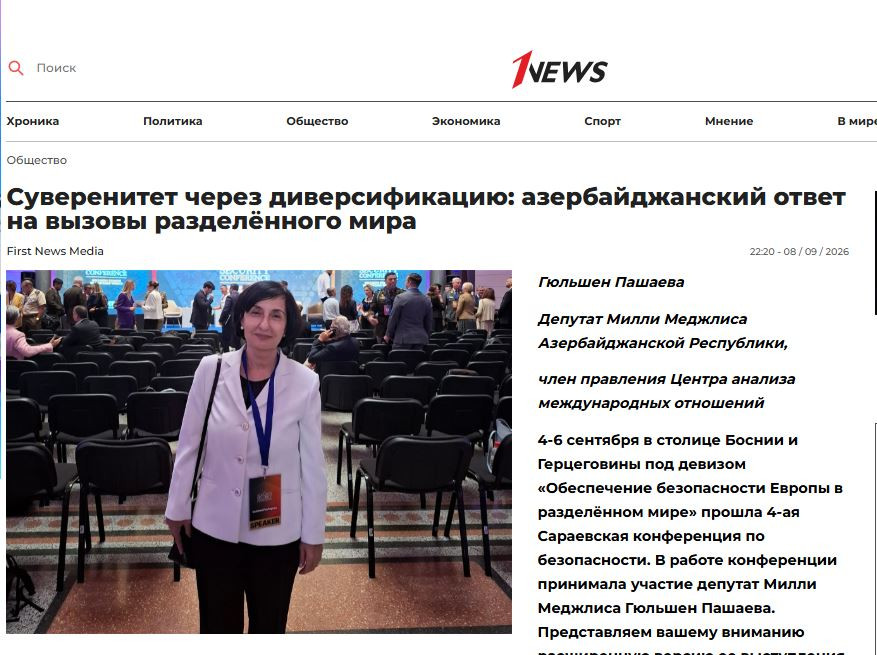
An expanded version of remarks delivered during the panel session “Creative Resilience: Lessons in Geopolitical Maneuvering on Europe’s Eastern Frontiers” at the 4th Sarajevo Security Conference held in the capital of Bosnia and Herzegovina under the theme “Securing Europe in a Divided World.”
Against the backdrop of growing turbulence in international relations, states are increasingly confronted with the challenge of identifying the most effective model for ensuring their security and sustainable development. In this context, Azerbaijan’s foreign policy of equidistance, often described as a strategy of maintaining equal distance from competing centers of power, has attracted considerable attention. Yet an important question arises: can such a model serve as an example for other countries, particularly those that do not possess comparable resources and geopolitical advantages?
In my opinion, Azerbaijan’s policy of equidistance is a viable strategy, but it is not necessarily a model that can be easily replicated by other states. Its success depends on a particular combination of geography, resources, strategic importance and diplomatic relations.
On the other hand, equidistance should be not be understood as complete neutrality or isolation. For many years, Azerbaijan has maintained relations with multiple competing powers and avoided formally aligning itself with a major security bloc, while simultaneously developing strong bilateral partnerships. However, this approach requires considerable diplomatic skill and, importantly, sufficient leverage to make other powers interested in maintaining good relations. So far, Azerbaijan has successfully combined cooperation with leading global powers and active participation in the Non-Aligned Movement, whose chairmanship from 2019 to 2023 became an important element of the country’s international positioning. At the same time, Azerbaijan has actively developed not only bilateral partnerships, but also trilateral formats within its region that have strengthened its international standing and expanded the space for independent maneuver.
At the same time, the resilience of Azerbaijan’s foreign policy model is often attributed solely to its role as a major producer and exporter of energy resources. As an important supplier and transit state, Azerbaijan enjoys additional opportunities to build mutually beneficial cooperation with both European and regional powers. The most illustrative example is the Southern Gas Corridor—a pipeline system extending approximately 3,500 kilometers and connecting the Caspian region with European markets. The implementation of this project has strengthened Azerbaijan’s position as an important contributor to European energy security and has created a long-term foundation for cooperation with the EU member states and the countries of Southeastern Europe.
However, reducing the country’s success solely to its energy resources would be an oversimplification. The history of international relations provides many examples of resource-rich countries that nevertheless faced serious challenges.
What matters more is that throughout the years Azerbaijan has invested in several mutually reinforcing areas at the same time: strong state institutions, national defence capabilities, economic development, transport connectivity, active diplomacy, and a broad network of international partnerships. It is this combination of factors, rather than any single asset, that has strengthened Azerbaijan’s resilience. A practical outcome of this strategy has been the restoration of Azerbaijan’s territorial integrity and the consolidation of the results of the Second Karabakh War through the international community’s recognition of Azerbaijan’s sovereignty and territorial integrity, as well as the support for the process of normalization of its relations with Armenia.
Particular attention should also be paid to the allied relationship between Azerbaijan and Türkiye, a member of NATO, which can be regarded as an important factor of regional stability and security. On the one hand, Azerbaijani-Turkish relations are built on a unique foundation of historical ties, cultural affinity, and national interests that cannot be easily replicated elsewhere. However, even the closest bilateral alliance is not the same as a multilateral collective defense system. These are different models, each with its own advantages and limitations. On the other hand, Azerbaijan’s strategic partnership with Türkiye has never meant limiting Azerbaijan’s close cooperation with other international actors. On the contrary, Azerbaijan’s approach has been based on maintaining broad and constructive relations with a wide range of partners. As is well known, Baku actively cooperates with Türkiye, the European Union, individual European states, Russia, the US, our neighbors in Central Asia, partners in the Middle East, and many others. Such diversification of partnerships is itself an important source of resilience.
Therefore, my broader conclusion, would be that, in today’s world increasingly characterized by polarization and fragmentation, the security of small and medium-sized states should not be reduced to a choice between joining a military alliance and remaining neutral. In reality, there is a wide spectrum of possible approaches. Some countries rely on primarily on collective defense institutions, others on strategic partnerships, and many on a combination of different instruments.
Therefore, the key question is not which specific model a state chooses. What matters far more is whether that model enables the country to preserve its sovereignty and strategic autonomy, strengthen its resilience, and maintain the freedom to make independent decisions in an increasingly complex international environment.
The question is not whether a country follows one model or another. The real question is whether that model enables the country to preserve sovereignty, strengthen its resilience, and maintain the freedom to make its own decisions in an increasingly complex international environment.
Ultimately, Azerbaijan’s experience suggests that the most viable strategy for states unable to join a major security bloc is not necessarily strict equidistance but rather strategic flexibility: maintaining relationships with multiple powers while developing particularly strong partnerships with states that can contribute to security. Whether this works depends on the state’s geography, economic importance, military capabilities and diplomatic leverage. Azerbaijan can pursue this strategy partly because of its unique circumstances, so other states should treat it as an example, to learn from rather than a template to copy.
To conclude, in today’s world, the geopolitical competition is not only about territory. It is about connection points. Azerbaijan’s positive indispensability is not a privilege. It is a responsibility. The responsibility to be a bridge. A bridge between East and West, between North and South. A bridge between traditional energy and the green transition.
Most importantly, Azerbaijan uses its unique position not to dictate terms. It uses it to create conditions. Conditions for trade, for dialogue, and for stability. I believe this is the main lesson of geopolitical maneuvering on Europe’s eastern frontiers in the 21st century.


