The international system today is marked by uncertainty and fluidity. Geopolitical rivalries sharpen across continents, global trade faces renewed frictions, climate pressures intensify, and security risks multiply in domains from cyber to energy infrastructure. In such an environment, international and regional organizations are being called upon to shoulder greater responsibility in fostering dialogue, building trust, and sustaining cooperation. Among them, the Shanghai Cooperation Organization (SCO) stands out as an increasingly influential platform, both for its sheer scale and its growing relevance to Eurasian geopolitics.
The SCO today encompasses 60 percent of Eurasia’s territory, 40 percent of the world’s population, and nearly a quarter of global GDP. Originally founded in 2001 by China, Russia, and four Central Asian states, it has since expanded to include India, Pakistan, and Iran. The organization is neither a NATO-style military alliance nor an EU-like economic bloc, but something in between. A flexible Eurasian forum that addresses terrorism, extremism, and cyber threats while also encouraging economic, cultural, and energy cooperation. Its stated mission—anchored in the so-called “Shanghai spirit”—is to promote trust, partnership, and regional stability while gradually advancing a multipolar world order.
For Azerbaijan, a country straddling Europe and Asia at the crossroads of multiple transit routes, the SCO represents both opportunity and necessity. Since becoming a “dialogue partner” in 2015, Baku has steadily deepened its engagement with the organization. President Ilham Aliyev has personally attended several SCO summits, including those in Samarkand (2022), Astana (2024), and this year in Tianjin, where he was again present at the invitation of President Xi Jinping. These repeated high-level invitations highlight Azerbaijan’s growing profile within the SCO and, more broadly, within Eurasia’s evolving political architecture. Baku’s foreign policy has long been guided by what officials call a multi-vector approach—a deliberate balancing of ties with both East and West. Engagement with the SCO fits neatly into this paradigm. Moving from dialogue partner to observer and eventually to full member would serve Azerbaijan’s interests across three key dimensions: security, diplomacy, and connectivity.
The South Caucasus is no stranger to conflict, instability, or external interference. Azerbaijan has fought wars to restore its territorial integrity, while continuing to face risks from extremism, terrorism, and cyber-attacks. Many of these threats are transnational in character. The SCO, with its mechanisms for intelligence-sharing and joint counter-terrorism efforts, provides a broader platform for addressing such challenges. For Baku, participation in SCO security frameworks allows it to align with major powers—China, Russia, India—while also working alongside Central Asian neighbors that face similar concerns about energy infrastructure security and extremist networks. Azerbaijan’s foreign policy has always resisted zero-sum choices. By engaging deeply with the SCO, Baku avoids the trap of being seen as leaning exclusively Westward or Eastward. Instead, it projects itself as a bridge, both by contributing to European energy security through the Southern Gas Corridor and by cooperating with China on BRI routes through the Middle Corridor.
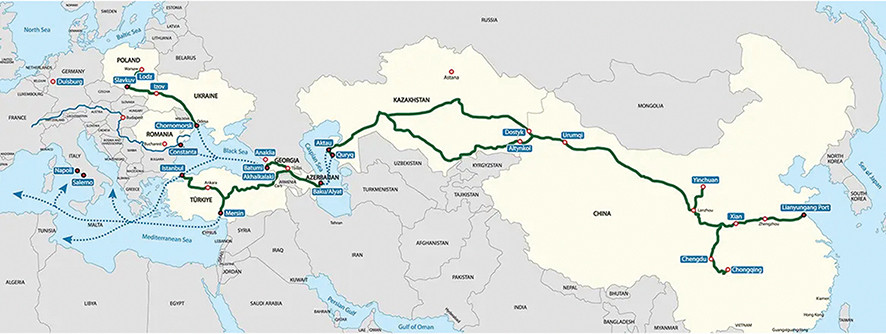
Economically, Azerbaijan’s value proposition to the SCO is clear, as it serves as a strategic transit hub. The Middle Corridor—the Trans-Caspian East–West route connecting China to Europe via Central Asia and the South Caucasus—has gained new importance as global supply chains diversify. Azerbaijan has invested heavily in its transport infrastructure, expanding the capacity of the Baku–Tbilisi–Kars railway from 1 million to 5 million tons per year and upgrading ports and highways. China’s own interest in the Middle Corridor is evident, as 2024 saw 287 freight trains run from China to Azerbaijan, carrying some 378,000 tons of goods (an 86 percent increase from the previous year). Azerbaijan’s participation in SCO economic initiatives can further accelerate such projects. It also strengthens Baku’s hand as it develops complementary North–South corridors linking Russia and India via Iran. Together, these routes position Azerbaijan as a true crossroads of Eurasian commerce.
It is impossible to discuss the SCO without highlighting China’s outsized influence. For Beijing, the SCO aligns perfectly with the geographic footprint of the Belt and Road Initiative. China’s trade with SCO members reached over $512 billion in 2024, underscoring its economic dominance within the bloc. Baku has cultivated a remarkably close partnership with Beijing within the framework of the SCO over the years. Subsequently, in 2024, Presidents Aliyev and Xi issued a joint declaration elevating bilateral ties to a strategic partnership during the SCO Summit held in Astana. Just a year later, during Aliyev’s state visit to China in April 2025, the two leaders signed a landmark agreement establishing a comprehensive strategic partnership—a rare status in Chinese diplomacy, reserved for countries with which Beijing seeks deep and enduring ties. Xi Jinping has openly lauded Azerbaijan’s importance to the Belt and Road, praising both its geography and the reliability of its leadership.
Trade has expanded rapidly between the two countries in recent years. Bilateral trade rose by more than 20 percent in 2024 to reach $3.74 billion, making China Azerbaijan’s fourth-largest partner. Machinery, electronics, and consumer goods flow from China, while Azerbaijan looks to increase exports of food, chemicals, and potentially even green energy to the Chinese market. Initiatives such as the establishment of Azerbaijan Trading Houses in Chinese cities such as Qingdao, Zhangjiajie, Xi’an, Nanjing, Chengdu, and Beijing aim to promote “Made in Azerbaijan” products to Chinese consumers.
Transit cooperation is particularly dynamic. With streamlined customs procedures and digital platforms in development, the Middle Corridor is poised to become even more attractive for Chinese exporters. And beyond trade, people-to-people links are strengthening. Since the 2023 visa-waiver agreement, Chinese tourist arrivals to Azerbaijan nearly doubled in 2024 and continued to surge in early 2025. Educational exchanges and cultural diplomacy further underpin this growing partnership.
Crucially, Azerbaijan’s SCO engagement and China partnership have not undermined its Western relationships. Baku continues to supply Europe with vital energy, while working with the EU on ambitious green energy projects, such as plans to export wind and solar power across the Black Sea. These initiatives enhance European energy security, while SCO ties open doors to Asian markets. This careful balancing act demonstrates Azerbaijan’s foreign policy sophistication. Rather than being pulled into the gravitational orbit of one bloc, Baku cultivates flexible partnerships across all major centers of power. That approach not only safeguards its sovereignty but also increases its relevance to everyone—from Brussels and Washington to Beijing and Moscow.
As President Ilham Aliyev attends the 2025 SCO Summit in Tianjin, it signals both intent and ambition. Upgrading from dialogue partner to observer would give Baku a stronger voice in shaping the SCO agenda, and eventual full membership would cement its place in Eurasia’s cooperative framework. For Azerbaijan, such steps are not about pivoting away from the West, but about broadening its portfolio of partnerships in a multipolar era. This is consistent with Azerbaijan’s broader trajectory. In recent years, Baku has held the rotating chairmanship of the 120-nation Non-Aligned Movement, hosted global climate negotiations like COP29, and played a visible role in energy and connectivity diplomacy. Its foreign policy is less about choosing sides and more about positioning itself as a connector, both geographically, politically, and economically.
In sum, Azerbaijan’s deepening engagement with the Shanghai Cooperation Organization illustrates both pragmatism and ambition in its foreign policy. By strengthening ties with the SCO and forging a comprehensive strategic partnership with China, Baku enhances its role as a key bridge between East and West. Its investments in transit infrastructure, growing trade, and participation in multilateral platforms underscore a strategy of connectivity and balance, rather than alignment with any single bloc. Attending the 2025 SCO Summit in Tianjin highlights Azerbaijan’s intent to move toward a stronger institutional role within the organization—an evolution consistent with its wider trajectory as a Non-Aligned Movement leader, COP29 host, and proactive energy and transport hub. Ultimately, Azerbaijan positions itself not as a passive player, but as an active connector shaping the multipolar Eurasian order.