Executive Summary:
-
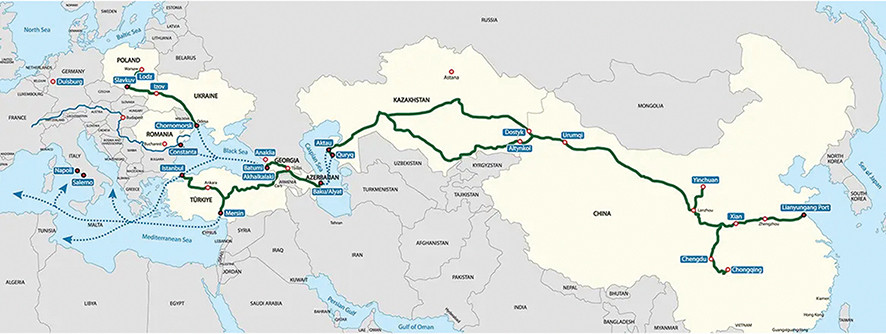
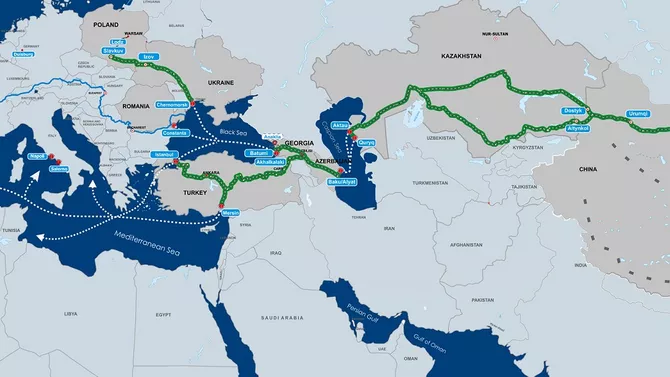
On May 8, KTZ Express and Pasifik Eurasia organized the transportation of a container train from Izmir in Türkiye to Chengxiang in the PRC via the Middle Corridor, passing through the ports of Baku in Azerbaijan and Aktau in Kazakhstan.
-
Growing coordination among regional states, railway operators, and international financial institutions reflects a broader effort to institutionalize the Middle Corridor through infrastructure modernization, multimodal integration, digital logistics systems, and cross-border transport cooperation.
-
The Middle Corridor is likely to emerge as one of the principal pillars of Eurasian connectivity linking Asia and Europe over the coming decade.
The Middle Corridor—also known as the Trans-Caspian International Transport Route (TITR)—is rapidly transforming from an alternative Eurasian transit route. It is becoming a geopolitical and economic platform connecting the People’s Republic of China (PRC), Central Asia, the South Caucasus, Türkiye, and Europe. On May 8, KTZ Express and Pasifik Eurasia organized the transportation of a container train from Izmir in Türkiye to Chengxiang in the PRC via the Middle Corridor, passing through the ports of Baku in Azerbaijan and Aktau in Kazakhstan (Transport Corridors, May 11). The train, consisting of 50 forty-foot containers loaded with household refrigerators, demonstrated the growing efficiency and commercial viability of the Trans-Caspian trade corridor for eastbound freight transportation. The shipment also marked the first backhaul container train to operate from Türkiye to the PRC via the Middle Corridor. The shipment highlighted the corridor’s increasingly multidirectional character and its long-term potential to facilitate the expansion of eastbound freight flows (Trend News Agency; Eurasian Star, May 8).
The core member states of the Middle Corridor, together with their international partners, are intensifying joint efforts to modernize and institutionalize the corridor through a broad range of initiatives and long-term infrastructure projects. Across the wider Caspian and Black Sea basins, governments, railway operators, logistics companies, and international financial institutions are accelerating cooperation in railway integration, digital logistics systems, infrastructure expansion, and multilateral coordination initiatives. These joint efforts aim to transform the corridor into a more efficient, resilient, and competitive Eurasian transport network.
One of the clearest political endorsements of the Middle Corridor came on March 12, during the XII Global Baku Forum. Azerbaijani President Ilham Aliyev reaffirmed Azerbaijan’s commitment to expanding the corridor and strengthening its role as a central transit and logistics hub connecting Asia and Europe (President of Azerbaijan, March 12). Speaking at the forum, Aliyev emphasized that Azerbaijan has been investing heavily in railway modernization, port infrastructure, Caspian shipping capacity, and regional transport connectivity to enhance the efficiency and competitiveness of the east–west transit route.
Lasting peace and normalization with Armenia could significantly expand regional trade and transportation opportunities linked to the broader Middle Corridor (AZERTAC, March 12). Particular attention has been devoted to the importance of Azerbaijan’s Zangezur Corridor within the framework of the Trump Route for International Peace and Prosperity (TRIPP). With an estimated transit capacity of 15 million tons, the 43-kilometer-long (27-mile-long) TRIPP through Armenia’s Syunik province is expected to generate approximately $3 billion annually through increased trade volumes (Report News Agency; Caspian News, March 12).
European engagement with the Middle Corridor also deepened considerably. On January 29, the European Union and Azerbaijan agreed to deepen cooperation on investment and connectivity projects within the broader framework of the European Union’s Global Gateway strategy (European Union, January 29). Under the deal, the European Union, Azerbaijan, and the European Bank for Reconstruction and Development (EBRD) agreed to launch a feasibility study for the Nakhchivan railway project to strengthen regional connectivity and economic integration. The railway is envisioned as part of the broader Trans-Caspian transit and transport network linking Europe with the wider Caspian region (APA, January 29).
In addition to political, institutional, and financial developments, the first quarter of 2026 saw several significant railway initiatives aimed at strengthening physical connectivity between the Caspian Basin and the Black Sea region. On January 27, Azerbaijan Railways and Turkish State Railways signed a memorandum of cooperation to strengthen bilateral rail connectivity. The agreement focuses on infrastructure development, traffic management, innovative joint initiatives, staff training, and information exchange (ADY, January 27).
On January 29, BTKI Railways and Georgian Railways agreed to launch joint operations on the Baku–Tbilisi–Kars railway line. The agreements defined the terms for the use of railway infrastructure along the Marneuli–Akhaltsikhe route and for the provision of terminal services at Akhaltsikhe station in Georgia (Transport Corridors, February 5).
Additional momentum followed on January 30, when Azerbaijan and Georgia launched the Poti–Baku Express Block Train (ADY, January 30). The block train is expected to operate regularly, substantially reducing transit times between the two ports, streamlining container logistics, and further enhancing the integration of the Black Sea–Caspian transport network. It is also expected to ease pressure on regional highways and contribute to environmental sustainability by reducing transport-related emissions along the South Caucasus segment of the Middle Corridor (Trend News Agency, January 30).
Kazakhstan also emerged as one of the principal drivers of Middle Corridor integration. On February 18, during a working meeting, Kazakhstan and Estonia pledged to strengthen railway cooperation and transit coordination along the Trans-Caucasian route, as rail freight volumes between the two countries increased 2.1-fold to 382,400 tons in 2025 (Rail Market, February 18). On February 19, Kazakhstan’s national railway company, Kazakhstan Temir Zholy (KTZ), tested rice exports from Kazakhstan to Antwerp via the Middle Corridor, utilizing both railway infrastructure and maritime shipping lines (APA, February 19; TRACECA, February 20).
On April 28, KTZ Express held talks in Astana with representatives of the Dallas-based AECOM to discuss prospects for cooperation in developing the Trans-Caspian trade route. The discussions focused on strengthening Kazakhstan’s transport and logistics infrastructure and attracting international investment under the Group of Seven’s (G7) Partnership for Global Infrastructure and Investment (PGI) initiative (KTZ Express, April 28). The American company presented its approach to supporting the development of a sustainable and competitive Trans-Caspian transport corridor, emphasizing infrastructure planning, engineering support, and supply chain optimization across the wider Caspian region.
From April 20–24, Astana hosted the 40th meeting of the Conference of General Directors of Railways of the Organization for Cooperation between Railways. This marked the organization’s 70th anniversary and bringing together more than 300 railway and transport officials from over 30 countries (Astana Times, April 24). Attended by Kazakhstan’s Prime Minister Olzhas Bektenov, the forum focused on freight coordination, infrastructure modernization, paperless logistics, intelligent transport systems, and workforce development. The discussions also highlighted Kazakhstan’s ambition to increase annual transit volumes to 100 million tons by 2035 through the construction of 5,000 kilometers (3,100 miles) of new railway lines over the next four years (Prime Minister of Kazakhstan, April 23).
On May 14, during talks in Astana, Kazakhstan President Kassym-Jomart Tokayev and Turkish President Recep Tayyip Erdoğan agreed to strengthen the potential of the Middle Corridor by implementing several joint transport and logistics projects. Speaking at a joint press conference following the negotiations, Tokayev described Kazakhstan and Türkiye as a “bridge firmly linking East and West” and emphasized the importance of maximizing their shared geostrategic advantages through deeper cooperation along the Trans-Caspian route (Trend News Agency, May 14). This commitment was built on earlier discussions held during the 8th meeting of the Joint Strategic Planning Group (JSPG) in Ankara on February 2, where Turkish Foreign Minister Hakan Fidan and his Kazakh counterpart Yermek Kosherbayev agreed to deepen cooperation on the development of the Middle Corridor (Trend News Agency, February 3).
The growing coordination among regional states, railway operators, and international financial institutions reflects a broader effort to institutionalize the corridor through infrastructure modernization, multimodal integration, digital logistics systems, and cross-border transport cooperation. At the same time, increasing European engagement, expanding collaboration among regional stakeholders, and the gradual integration of regional transport networks indicate that the corridor is evolving beyond its traditional transit function into a multidirectional trade and logistics ecosystem. As regional actors continue investing in railway connectivity, port infrastructure, and transport initiatives, the Middle Corridor is likely to emerge as one of the principal pillars of Eurasian connectivity linking Asia and Europe over the coming decade.
https://jamestown.org/regional-states-consolidate-the-resilience-of-the-middle-corridor-part-1/