Until recently, the Organization of Turkic States (OTS) could best be understood in terms of identity, language, culture, and economic collaboration. This is changing.
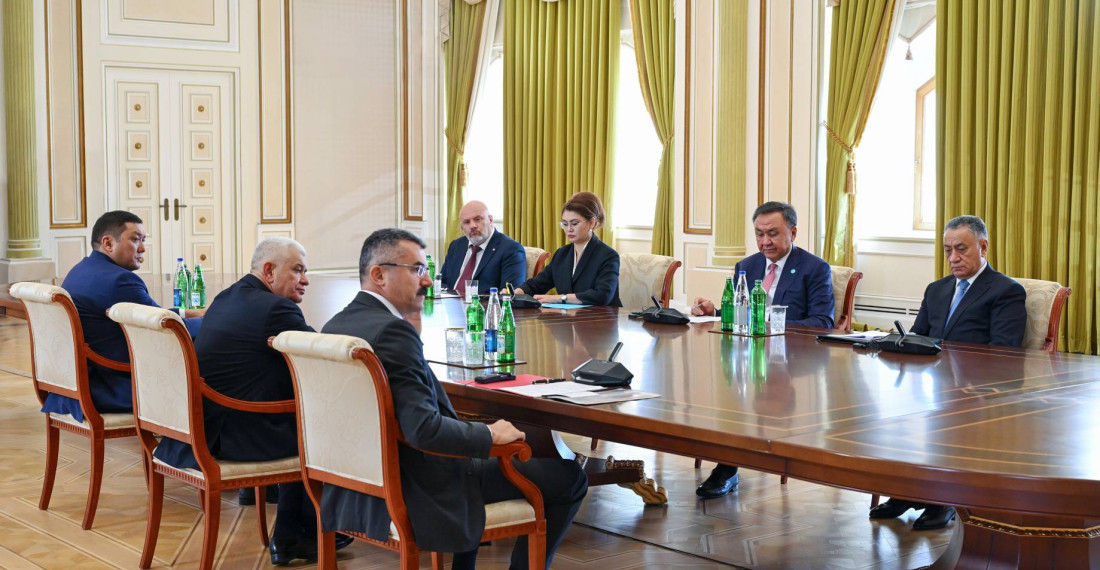
On September 17, Baku played host to the Fifth Meeting of the Secretaries of the Security Councils of the OTS countries. In his message to the meeting, the president of Azerbaijan, Ilham Aliyev, noted that cooperation among the Turkic peoples no longer consisted of political, economic, and cultural matters only but had gained a “long-term strategic nature.” More importantly, he referred to the consultations of the national security councils as a factor facilitating the emergence of a “common security architecture.”
Clearly, it does not mean that the OTS is evolving into a military organisation of the NATO kind: there is no commitment of collective defence similar to that of NATO’s Article 5, and there is no evidence of this desire on the part of all members of the organisation. Yet, the September meeting means something different: security collaboration within the Turkic context is becoming more regular and operational.
This process has been quite gradual. The OTS started organising meetings of national security council secretaries since 2022. As of September 2026, the mechanism had attained its fifth meeting. The organisation itself considers security cooperation to be an increasingly important area of interest in relation to both conventional and non-conventional threats. This includes such areas as terrorism, transnational organised crime, drug trafficking, extremism, hybrid threats, and critical infrastructure protection.
Recent trends have shown that this does not happen only in one institution. On September 10, the interior ministers of Azerbaijan, Kazakhstan, Kyrgyzstan, Türkiye and Uzbekistan held talks in Astana in order to enhance cooperation in law enforcement and public security. One day later, the prosecutors generals from the OTS member states convened in Turkistan to discuss ways of enhancing cooperation in issues of justice and security.
Perhaps the following could be even more telling. The second meeting of the heads of defence-industry institutions of OTS member states will be held from September 30 to October 2 in Baku. It will be followed by the OTS foreign ministers' meeting on October 29 and the 13th OTS summit in Türkiye on October 30. And this summit is going to be held amidst the process of developing the organization’s Strategy for 2027–2031, aimed at defining the priorities of the next institutional stage.
All this can be seen as the organisation getting an ever more elaborate set of institutions related to security councils, law enforcement agencies, defence industry, diplomacy, infrastructure and economic cooperation. Azerbaijan can be called one of the most active proponents of such evolution. In his speech at the OTS summit in Gabala in October 2025, President Aliyev suggested conducting joint military exercises of the OTS members in Azerbaijan in 2026. He also referred to the extensive military cooperation of Azerbaijan with Türkiye in the form of more than 25 bilateral and multinational exercises held with Ankara in the previous year.
The strategy for Baku is straightforward. Azerbaijan sits at the geographical point where Türkiye and Central Asia meet. The development of the Middle Corridor, closer cooperation through the Caspian Sea, and growing political ties between Azerbaijan, Kazakhstan, and Uzbekistan raise the significance of securing ports, railways, energy pipelines, cybersecurity systems, and maritime routes that link both halves of the Caspian Sea.
Thus, there is an inevitable security aspect to connectivity. As the Trans-Caspian network becomes economically more significant, cooperation in the fields of infrastructure security, cybersecurity, organised crime, border security, and crisis response grows ever more vital.
Finally, Turkey’s role is no less important. The country remains the strongest military force in the organisation and its sole member of NATO. Its growing military-industrial cooperation with Azerbaijan and the Central Asian countries allows for joint training, technology exchange, and defence production without forming any formal military alliance.
But for the Central Asian states, the emergence of an OTS security dimension should not be viewed either as a decision between Türkiye and Russia or the OTS and existing organisations. First of all, Kazakhstan, Kyrgyzstan, and Uzbekistan operate within the framework of the SCO along with China and Russia, whereas Kazakhstan and Kyrgyzstan continue to be actively involved in the Russia-led CSTO. The SCO even held its latest summit of leaders in Bishkek on September 1, attended by the heads of Russia, Kazakhstan and Uzbekistan.
And that makes the most appropriate interpretation a diversification, not geopolitical substitution. Traditionally, Central Asian governments have been more favourable towards overlapping partnerships that allow them to preserve their strategic independence. With the help of a more developed OTS, they gain yet another tool for cooperation without renouncing their already established cooperation with Moscow, Beijing, or other Western players.
This explains the importance of the limits of OTS security cooperation. Its five members – Azerbaijan, Kazakhstan, Kyrgyzstan, Türkiye, and Uzbekistan – have different security concerns and different relations with major powers. Turkmenistan, meanwhile, continues to stay an observer but not a full-fledged member of the organisation, as do Hungary and the Economic Cooperation Organization.
Thus, consensus on terrorism, organised crime, infrastructure protection or defence-industrial cooperation is much easier to achieve than an agreement on collective military commitments. Such a discrepancy might turn out to be an asset rather than a liability.
There is no need for the OTS to transform into yet another defence pact in order to achieve geopolitical importance. Strategic cooperation habits can gradually emerge via regular security officials' conferences, military exercises, defence-industrial cooperation, intelligence sharing, and hybrid threats coordination without imposing treaties which might be unacceptable to some members.
Institutional development of the organisation supports such a process. Founded in 2009, OTS currently works through heads-of-state and foreign ministers' councils, a secretariat and an increasing number of affiliated organisations. Its vision, Turkic World Vision 2040, strives at coordinating efforts of the members within their international obligations. That is why the September conference in Baku should be taken into account.
The most significant trend does not consist in establishing yet another military alliance. It consists in the gradual emergence of a security layer around an already emerging political, economic, and transportation network linking Türkiye, Azerbaijan, and Central Asia.
In light of the impending defense industry conference and the October summit, it seems clear that the OTS will have to be evaluated not only in terms of its identity organization, but also as a strategic coordination mechanism within the broader Turkic world. The shift from identity to security has not yet been completed. However, the institutional base becomes more apparent.
https://www.commonspace.eu/opinion/opinion-changing-organisation-turkic-states