Executive Summary:
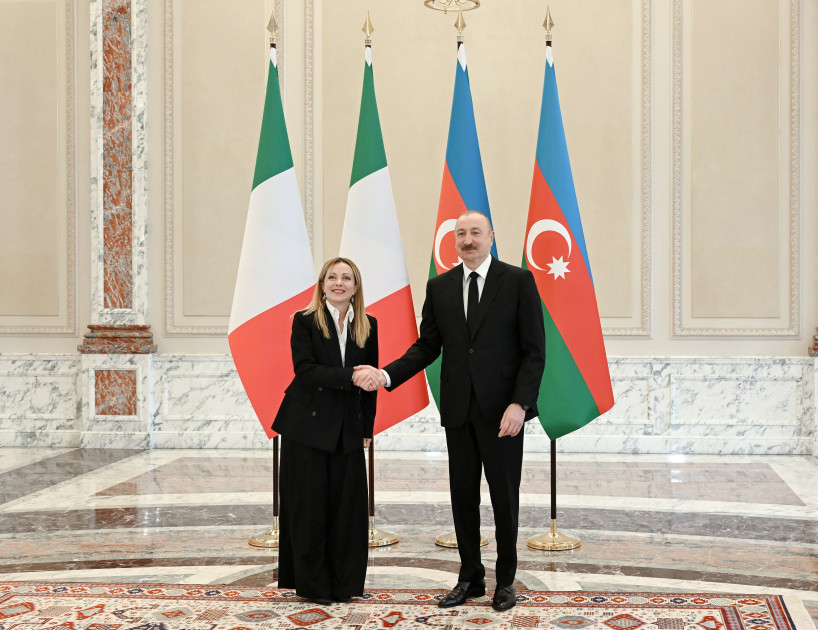
- Italian Prime Minister Giorgia Meloni visited Azerbaijan on May 4, holding talks with Azerbaijani President Ilham Aliyev in Baku that produced a roadmap for elevating their comprehensive strategic partnership across energy, defense, investment, and education.
- Meloni arrived in Baku directly from the European Political Community summit in Yerevan, a route that reinforces the progress of the Armenia–Azerbaijan normalization process and Italy’s positioning as Azerbaijan’s principal partner inside the European Union.
- The visit consolidated Azerbaijan’s role as a cornerstone of Italian energy security, with both leaders endorsing further expansion of the Trans-Adriatic Pipeline and committing to convert their bilateral relationship into a permanent political coordination mechanism.
On May 4, Italian Prime Minister Giorgia Meloni traveled to Baku for an official one-day visit and held substantive talks with Azerbaijani President Ilham Aliyev (President of Azerbaijan, May 4). It was the first visit to Azerbaijan by an Italian head of government in 13 years and produced a substantive package of commitments spanning energy, defense, infrastructure, and education. Meloni had flown directly from the European Political Community (EPC) summit in Yerevan, a sequence that Aliyev described as carrying “a very symbolic meaning” (President of Azerbaijan, May 4). Meloni reciprocated by emphasizing, “Italy views the important partnership it carries out with Azerbaijan as a long-term partnership and desires it to remain long-term hereafter.”
The architecture of Italy–Azerbaijan relations has been built incrementally over more than a decade. The two states signed their first declaration on strategic partnership in 2014 (President of Azerbaijan, July 14, 2014). In February 2020, during Aliyev’s state visit to Rome, the two governments concluded the “Joint Declaration on Strengthening the Multidimensional Strategic Partnership.” Baku presented the joint declaration as the first such document it had ever signed with a member of the European Union and the Group of Seven (G7) (see EDM, March 3, 2020). Italian President Sergio Mattarella’s official visit to Baku on September 30, 2025—his second to Azerbaijan—reaffirmed that framework and was crowned by the joint inauguration of the first campus of the Italy–Azerbaijan University, an institution now hosting more than 500 students that Aliyev described as a long-term investment in people-to-people ties (President of Azerbaijan, May 4).
Italy is Azerbaijan’s largest trading partner, and the economic ballast underpinning the political relationship is substantial. Approximately 130 Italian companies operate in Azerbaijan, and Italian firms have already implemented 23 projects in the Karabakh and East Zangezur economic regions. Aliyev said, “Italian companies have achieved great success” in Azerbaijan, expressing his hope that their number would grow further (President of Azerbaijan, May 4). Investment flows run in both directions. The State Oil Fund of Azerbaijan (SOFAZ) holds a portfolio in Italy of approximately $3 billion, including a 49 percent stake in a 402-megawatt Italian solar energy portfolio acquired in 2025—an indication that bilateral economic ties are extending from hydrocarbons into the renewable sector (SOFAZ, July 18, 2025; Azernews.az, January 13; President of Azerbaijan, May 4).
Less than a week after Meloni’s visit, Azerbaijan’s State Oil Company (SOCAR) announced the completion of the acquisition of 99.82 percent of the shares of Italiana Petroli (IP) from API Holding (Report.az, May 8). To translate this momentum into new commercial pipelines, the two leaders announced that an Italy–Azerbaijan business forum will be held in Baku in the second half of 2026 (President of Azerbaijan, May 4).
Energy remains the core of the bilateral agenda. Aliyev confirmed in Baku that Azerbaijan exported 25 billion cubic meters (bcm) of natural gas in 2025, of which 9.5 bcm were delivered to Italy, covering roughly 15 percent of Italy’s gas demand. Aliyev told the press, “For us, the Italian market is of primary importance for both oil and gas” (President of Azerbaijan, May 4). Both leaders endorsed continued expansion of the Trans-Adriatic Pipeline (TAP), the final segment of the Southern Gas Corridor that delivers Caspian gas through Türkiye, Greece, and Albania to southern Italy. Aliyev described it as “necessary” to increase exports. Meloni called Azerbaijani supplies “decisive for the energy security of Italy” since the start of Russia’s full-scale invasion of Ukraine in 2022. She articulated a strategic vision in which Azerbaijan strengthens its role as an energy hub between Europe and Asia, with Italy serving as “the privileged gateway to the European market” (President of Azerbaijan, May 4). The closure of the Strait of Hormuz amid the conflict in Iran has further sharpened Rome’s calculus, making Caspian molecules a key component of Italian and southern European energy supply.
Defense and military-industrial cooperation received a noticeable upgrade during the visit. The relationship in this domain has been anchored since 2020 by the agreement under which Azerbaijan acquired Leonardo S.p.A.’s M-346 Master trainer/light-attack aircraft, but the talks in Baku signaled an ambition to broaden the agenda well beyond that initial purchase (Caliber.az, June 9, 2023; President of Azerbaijan, May 4). Aliyev spoke of “joint projects” with Rome in the field of military-technological cooperation, noting that the two sides had discussed these opportunities in detail. Meloni pointed to Italian excellence in aerospace, maritime security, critical infrastructure protection, and advanced technologies as natural areas for joint work (President of Azerbaijan, May 4). The two leaders also agreed to convert the bilateral relationship into a “sort of permanent political coordination” mechanism, allowing Rome and Baku to jointly plan future priorities rather than on an ad hoc basis.
The regional and humanitarian dimensions of the visit reinforced the strategic logic underpinning these commitments. Meloni publicly endorsed the Armenia–Azerbaijan normalization process, and the agreements reached in Washington in August 2025 and described 2026 as a potentially crucial year for unlocking the South Caucasus’s potential. She also confirmed that Italy had temporarily relocated its embassy in Iran from Tehran to Baku following the outbreak of the Iran conflict in February 2026. She thanked the Azerbaijani authorities for ensuring the safe evacuation of Italian citizens from Iran (President of Azerbaijan, May 4).
Meloni’s visit also took place amid a deterioration in Baku’s relations with the European Parliament. On May 1, the Azerbaijani Parliament adopted a resolution suspending cooperation with the European Parliament “in all directions,” terminating its participation in the EU–Azerbaijan Parliamentary Cooperation Committee, and initiating withdrawal from the Euronest Parliamentary Assembly in response to a European Parliament resolution that recognized “support for the rights of Nagorno-Karabakh Armenians.” The Azerbaijani Foreign Ministry cited the European Parliament’s resolution’s “unfounded and biased provisions against our country” as the reason for the termination and withdrawal (European Parliament, April 28; Azerbaijani Ministry of Foreign Affairs; Report.az, May 1; Commonspace.eu, May 11). Baku has, however, drawn a clear distinction between the European Parliament and the European Commission, with which Azerbaijan continues to deepen its strategic and energy engagement. The Italian premier’s arrival in Baku just four days after the European Parliament adopted the resolution operationalized that distinction at the highest political level, illustrating that the executive-track relationship between Azerbaijan and key EU member states is advancing along its own logic.
The Baku summit marks an upgrade rather than a simple reaffirmation of Italy–Azerbaijan ties. By institutionalizing political coordination, expanding military-industrial cooperation, highlighting further TAP expansion, and scheduling a business forum to translate the political commitments into commercial outcomes, Meloni’s visit moved the bilateral agenda from periodic high-level exchanges into a structured strategic relationship. For Rome, the visit consolidates Italy’s position as Azerbaijan’s principal European interlocutor at a moment when Mediterranean and Caspian energy security have become inseparable. For Baku, it confirms that its multi-vector foreign policy continues to deliver tangible upgrades with key EU member states.
https://jamestown.org/meloni-visits-baku-to-cement-the-italy-azerbaijan-strategic-partnership/