Executive Summary:
-
Indian External Affairs Minister Subrahmanyam Jaishankar visited Baku on October 23, the first such trip in eight years, marking a reset in relations strained since Baku sided with Pakistan after India’s May 2025 military strikes.
-
Both sides openly discussed past differences and agreed to deepen cooperation on trade, energy, transport, and people-to-people ties, with bilateral trade reaching about $600 million in nine months, up from $401 million in 2025.
-
The reset supports Azerbaijan’s push to diversify partnerships toward Asia, but its durability depends on managing India’s arms sales to Armenia and Azerbaijan’s bid to join the Shanghai Cooperation Organization as a full member.
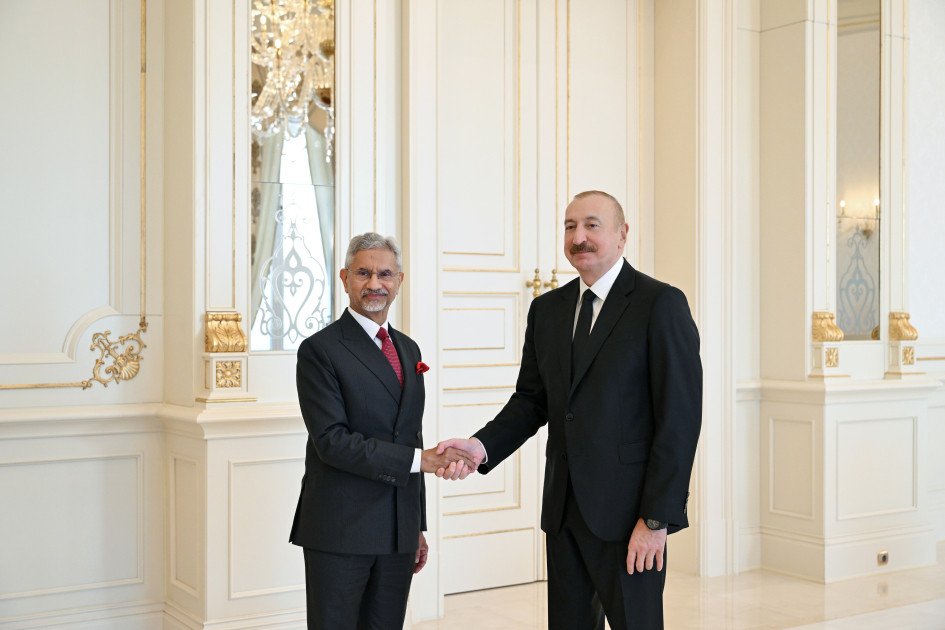
On October 23, Indian External Affairs Minister Subrahmanyam Jaishankar visited Baku, where he was received by Azerbaijani President Ilham Aliyev and held talks with Azerbaijani Foreign Minister Jeyhun Bayramov (The Azerbaijan State News Agency; Report, October 23). The trip was the first bilateral visit by an Indian foreign minister to Azerbaijan since then-Indian External Affairs Minister Sushma Swaraj traveled to Baku in April 2018 (APA, April 4, 2018). Jaishankar described his visit as “a continuation of the meeting between our leaders in Bishkek,” referring to the talks between Aliyev and Indian Prime Minister Narendra Modi on the sidelines of the Shanghai Cooperation Organization (SCO) summit on September 1 (APA, September 1, October 23). In his meeting with Aliyev, Jaishankar stressed that he had come to Baku on Modi’s instructions, and the two sides noted that Azerbaijan and India, as members of the Global South, share similar positions on a number of issues on the international agenda (The Azerbaijan State News Agency, October 23).
The visit follows more than a year of strained relations triggered by Baku’s stance on the India–Pakistan conflict. In May 2025, when India launched military strikes against Pakistan, Baku expressed solidarity with the people of Pakistan and condemned the attacks that killed and injured civilians (Azerbaijani Ministry of Foreign Affairs, May 7, 2025). The fallout was felt immediately in the economic sphere. Major Indian travel platforms removed Azerbaijan listings or advised against non-essential travel there, and the number of Indian visitors between May–August 2025 fell by 56 percent year-on-year (Business Today, October 19, 2025). The tensions then spilled over into multilateral diplomacy, with Baku accusing New Delhi of obstructing its application for full membership in the SCO. India maintained that the applications of Azerbaijan and Armenia were not discussed at the 2025 SCO summit in Tianjin, the People’s Republic of China, due to time constraints (Indian Ministry of External Affairs, September 5, 2025; The Wire, October 24).
The first signs of a thaw came in April, when Indian Secretary (West) Sibi George and Azerbaijani Deputy Foreign Minister Elnur Mammadov co-chaired the sixth round of foreign office consultations in Baku (Azerbaijani Ministry of Foreign Affairs, April 3). Aliyev and Modi then met on September 1, on the sidelines of the 26th SCO summit in Bishkek, Kyrgyzstan (APA, September 1). This encounter provided the political mandate for normalization, and newly appointed Indian Ambassador to Azerbaijan Abhay Kumar presented his credentials to Aliyev on October 16, a week before Jaishankar’s arrival (President of Azerbaijan, October 23).
The candor with which both sides addressed their past differences set the Baku talks apart. At the joint press conference, Bayramov did not avoid the difficult past, acknowledging that the two countries’ differences had affected both bilateral relations and their cooperation within international organizations. “Today, we discussed these issues openly and constructively. We will see the results of this discussion in a short period of time,” he said (APA, October 23). Jaishankar called the talks “very productive,” saying they had helped determine a “pathway forward” for relations, while noting that both are “independent-minded nations who make their own call on the important issues of the day” (The Wire, October 24). This formula can be read as a mutual recognition that neither side expects the other to abandon its existing partnerships as a precondition for cooperation. Security was also featured on the agenda. Jaishankar described terrorism, conflict, and instability as “our common enemies” and welcomed the peace agreement initialed by Azerbaijan and Armenia in August 2025. Bayramov briefed him on the normalization process and Baku’s expectations from Yerevan, including constitutional changes in Armenia (ThePrint, October 23; The Wire, October 24).
Economic interests, led by energy, provide the strongest foundation for the rapprochement. Bilateral trade reached approximately $600 million in the first nine months of this year, already well above the $401 million recorded for all of 2025, though still far below the 2022 peak of $1.88 billion (Report, October 23; Embassy of India in Baku, accessed October 30). Azerbaijan exported 524,338 tons of crude oil to India between January and September, a 4.9-fold increase compared with the same period last year (AzerNews, October 26). Bayramov nonetheless stressed that the current figures do not reflect the two countries’ potential and that the talks would lay a solid foundation for taking relations to a new level (AzerNews, October 23). More than 1,000 Indian companies operate in Azerbaijan (Prokerala, October 23). ONGC Videsh, India’s state-owned oil company, has invested over $1.2 billion and holds stakes of 2.925 percent in the Azeri–Chirag–Gunashli oil fields and 3.097 percent in the Baku–Tbilisi–Ceyhan pipeline (Embassy of India in Baku, accessed October 30). Jaishankar noted that Indian companies remain interested in Azerbaijan’s oil and gas sector, and Bayramov identified pharmaceuticals, agriculture, information technology, digital services, manufacturing, and energy as areas with potential for expansion (APA, October 23; Caucasus Watch, October 27). The ministers agreed to exchange trade delegations and bring their business communities together (APA, October 23; The Wire, October 24).
Connectivity gives both sides a shared strategic interest that extends beyond bilateral trade. During the expanded meeting, the Azerbaijani side highlighted the opportunities offered by Azerbaijan’s East–West and North–South transport corridors, the Baku–Tbilisi–Kars railway, the Port of Baku, and the Alat Free Economic Zone (APA, October 23). “Connectivity is very important in the global economy,” Jaishankar remarked, adding that discussions on the matter would continue (APA, October 23). The two sides also agreed to coordinate more closely on the International North–South Transport Corridor (INSTC) (The Wire, October 24). For India, Azerbaijan offers a gateway to the Caspian basin, Central Asia, and, via the Middle Corridor, Europe. For Azerbaijan, India represents a market of 1.4 billion people and a key component of its effort to diversify partnerships toward Asia. This year’s regional turbulence has underscored Azerbaijan’s value as a stable transit state.
People-to-people ties, which suffered most visibly from the 2025 tensions, are also recovering. Bayramov noted that about 500 Indian students joined Azerbaijani universities this year and that more than 30 Indian films have been shot in Azerbaijan in recent years (The Azerbaijan State News Agency, October 23). Jaishankar raised the prospect of increasing direct flights and proposed restoring Azerbaijan’s participation in the Indian Technical and Economic Cooperation (ITEC) program, New Delhi’s flagship initiative offering training and capacity-building courses to officials and professionals from partner countries (Caucasus Watch, October 27). Air connectivity is the most immediate lever. Azerbaijan Airlines operates 14 weekly flights from Delhi and Mumbai to Baku, while IndiGo has suspended its seven weekly Delhi–Baku flights amid the conflict in Iran, cutting total capacity on the route by a third (Indian Ministry of External Affairs, April). The number of Indian visitors to Azerbaijan fell by 31.5 percent, from 243,589 in 2024 to 166,944 in 2025, although India remained the fourth-largest source of tourists for the country (Embassy of India in Baku, accessed October 30). Restoring and expanding direct flights is one of the quickest ways to recover lost momentum.
The reset remains fragile, as sensitive issues continue to divide the two capitals. India’s defense supplies to Armenia remain a concern for Baku, particularly as the peace treaty awaits signing and ratification (see EDM, August 14, 2023; ThePrint, December 9, 2023). On Azerbaijan’s SCO bid, Indian Ministry of External Affairs Spokesperson Randhir Jaiswal declined to commit to a position, saying the matter has to be discussed within the organization (The Wire, October 24). Baku talks demonstrated that both sides are now prepared to compartmentalize their differences rather than allow them to define the entire relationship.
https://jamestown.org/jaishankars-baku-visit-opens-a-new-chapter-in-azerbaijan-india-relations/