Hörmətli nümayəndə heyətinin rəhbərləri, qonaqlar, xanımlar və cənablar,
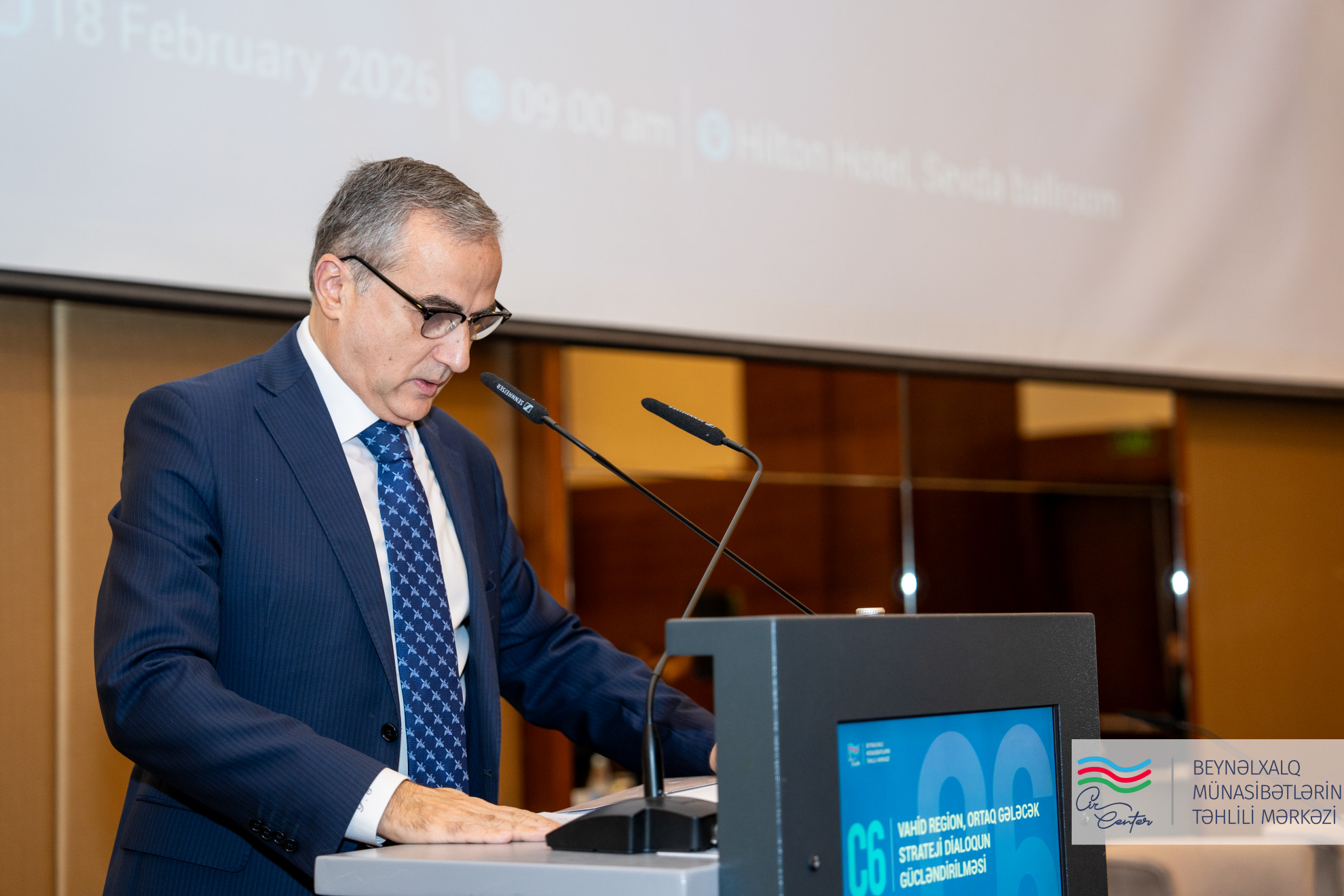
Beynəlxalq Münasibətlərin Təhlili Mərkəzi adından sizi Bakıya salamlamaqdan və “C6: Vahid Region, Ortaq Gələcək - Strateji Dialoqun Gücləndirilməsi” adlı beynəlxalq konfransı açmaqdan şərəf duyuram.
2025-ci ilin noyabr ayında Azərbaycan Mərkəzi Asiya Dövlət Başçılarının Məşvərət Görüşlərinin tamhüquqlu üzvü oldu və regional formatı C5 formatından C6 formatına çevirdi. Daşkənddə keçirilən 7-ci Məşvərət Görüşündə rəsmiləşdirilən bu addım regional əməkdaşlıqda böyük bir dəyişikliyi ifadə edir və Xəzər dənizi boyunca daha inteqrasiya olunmuş geoiqtisadi və geosiyasi məkan yaratmaq üçün Azərbaycanı Mərkəzi Asiya ölkələri ilə sıx birləşdirir.
Ladies and gentlemen,
Our meeting comes at a time when the global landscape is characterized by competition and volatility, including heightened rivalry between major powers, conflicts impacting energy and transportation routes, and disrupted supply chains. These developments serve as a reminder to our region that connectivity, diversification, and regional cooperation based on common interests are essential for strategic resilience.
Over the past six years, Azerbaijan’s foreign policy has reflected this reality. By working with Asian institutions and extending its strategic alliances, Azerbaijan has fortified its eastern vector while continuing to engage constructively with the United States and its European partners. This change in approach is intended to lessen vulnerability, increase opportunities, and establish new avenues for regional and national development.
In this regard, Central Asia is a natural partner rather than just a neighbor. Despite our shared history and culture, geoeconomics—energy, transportation, logistics, and infrastructure—is what makes our partnership unique today. Since the conventional presumptions of stability in the larger Eurasian space are no longer valid, these connections have taken on new significance.
Azerbaijan's President Mr. Ilham Aliyev's attendance as an Honorary Guest at the consultative summits of Central Asian leaders in September 2023 in Dushanbe and August 2024 in Kazakhstan showed the region's growing recognition of the South Caucasus and Central Asia as a single strategic region. But today, the conversation must evolve. Although Azerbaijan already engages with Central Asia, the question is whether we can create a more cohesive, institutionalized, and forward-looking framework that transforms collaboration into long-term capability. The C6 format must serve this function.
C6 is a practical idea: Kazakhstan, Uzbekistan, Turkmenistan, Kyrgyzstan and Tajikistan, together with Azerbaijan, can work through a six-state format that improves the region’s connectivity and strengthens its ability to act with greater independence.
In addition, this proposal is timely. Deeper cooperation among the Central Asian states themselves has made much of the momentum we see in the C5+1 format possible. Thus, in December 2022, Kazakhstan and Uzbekistan signed a significant cooperation agreement; in March 2025, Tajikistan and Kyrgyzstan settled their border dispute; and Turkmenistan, remaining neutral, has moved toward more active regional engagement. In other words, the region is increasingly ready for mechanisms that consolidate progress and translate it into sustained capacity.
Due to Azerbaijan's location on the western Caspian Sea and our existing transportation and maritime infrastructure, landlocked partners can increase their options, including deeper connections to Turkish and European markets via the Middle Corridor and trans-Caspian, as well as access to Black Sea and Mediterranean routes. To put it simply, C6 expands the range of options, and options are important in the modern environment.
However, C6 shouldn't be limited to just transit corridors. At a time when priorities are shifting due to the global energy transition, it can also act as a working platform for energy and investment. In the areas of renewable energy, technology sharing, and energy infrastructure modernization, where collaborative projects and shared planning can yield measurable benefits, there is a great deal of room for coordination.
The concept of cohesion is also crucial. The development of trilateral formats and consultative mechanisms within Central Asia is a positive trend. For instance, in January 2025, Azerbaijan, Uzbekistan, and Kazakhstan signed a memorandum of understanding to expand cooperation on energy transit, renewable energy development, and technological collaboration. Crucially, the focus is not limited to hydrocarbons: the partnership also prioritizes joint research on renewables and new investment in solar and wind capacity, supporting the region’s gradual shift toward a lower-carbon economy. This alignment strengthens regional energy security and helps position the emerging six-state format as a credible energy bridge between East and West.
C6 can support those initiatives by introducing a new anchor that increases resilience and reach without replicating existing ones.
C6 must be practical and inclusive to endure. Because of the diversity in our area, collaboration is most effective when it remains adaptable and results-oriented. A durable regional format is one that respects differences, is focused on deliverables, and is in line with shared strategic needs.
Turning proximity into partnership, geography into advantage, and shared challenges into solutions is the basic strategic logic reflected in C6. Investing in tangible mechanisms, collaborative projects, and infrastructure instead of symbolic investments will allow our six states to accomplish more than any one of us could on our own.
I wish you productive discussions and concrete outcomes. We welcome you to Baku.
Thank you.