What we seem to be witnessing now is a historically significant transformation in the South Caucasus. For years the region has been viewed in the context of unresolvable conflicts, military confrontation, geopolitical competition, and volatility. Now, for the first time since the early '90s, there is a genuine chance to gradually transition from conflict management to institutionalized peace and normalization of inter-state relations.
From this perspective, the signing of the Joint Declaration in Washington[5] and the signing of the Agreement on Establishment of Peace and Inter-State Relations between Azerbaijan and Armenia[6] are an important political/legal development. What makes this milestone significant is the fact that these documents contain some key principles for stable co-existence in the region.
Above all, the principle of recognition of sovereignty, territorial integrity, political independence, and inviolability of internationally recognized borders is stated directly in Article I of the Agreement. The next Article II of the document states that neither of the parties has territorial claims towards the other party and will not bring up such claims in the future.
This point is extremely important for stability in the region because without the recognition of border immutability, sustainable peace cannot be achieved. In this connection, the statement made in the Washington Declaration[7] about the commitment to the UN Charter[8] and the Almaty Declaration of 1991[9] becomes very important for the situation. The recognition that the administrative borders of the former Soviet republics became international interstate borders after gaining their independence is one of the main elements of the new regional order.
The consistency between international and national norms in terms of border recognition and other issues is also an important factor in the context of the long-term peace sustainability.
Another significant change that is captured in the Washington agenda is the gradual move beyond the previous conflict management model in terms of the OSCE Minsk Group process. For many years, the key regional tool for addressing regional challenges was oriented not towards providing favorable conditions for the settlement but rather to managing the ongoing instability. In the current stage, however, a completely new rationale becomes evident, namely interstate relations-oriented, bilateral and implementation-driven approach.
In such circumstances, the region does not need tools aimed at prolonged mediation anymore but rather mechanisms that could provide assistance in implementing the peace process, building confidence, coordinating ePorts and cooperation. This change is also indicative of the broader geopolitical trend witnessed in the South Caucasus after the Second Karabakh War in 2020.
The security situation in the South Caucasus is fundamentally different from what we have seen in previous decades. The emergence of the post-2020 reality has completely transformed the balance of power in the region. It has created new geopolitical circumstances that force the transatlantic community to rethink our approach to the South Caucasus. In this context, we should note that one of the most crucial aspects of the current peace process is connectivity.
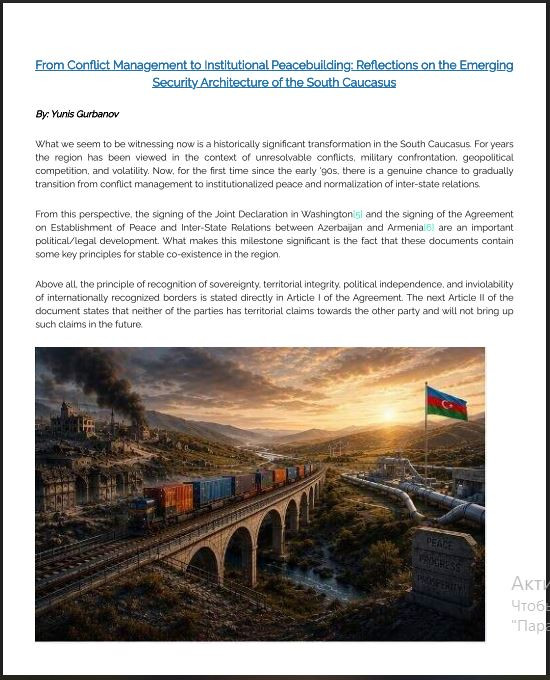
It is necessary to emphasize that Article X of the Washington Agreement opens the door to cooperation in such spheres as economics, transit, transportation, humanitarian activities, ecology, and culture. The Washington Declaration also draws special attention to communications and regional connectivity projects. This issue is critical because regional stability is now limited not only to the military component - security is increasingly becoming a matter of interdependence.
This transformation is particularly visible within the broader Eurasian geopolitical environment. The South Caucasus is increasingly becoming part of a larger Black Sea–Caspian strategic space linked to European energy diversification, the Middle Corridor, East-West logistics, and wider Eurasian connectivity initiatives.
This change is evident in the increasing relevance of the Middle Corridor. Over the past years, the political fragmentation of the globe, the challenges posed by the war in Ukraine, and increased uncertainty related to established trade corridors have stimulated the global community's interest in new corridors for East-West connectivity. Under these conditions, the South Caucasus region has been gaining importance not only as a transit region but also within a larger system linking Europe, Central Asia, and the Caspian basin.
In turn, the stability of the South Caucasus region has become a factor affecting Black Sea and broader European security. The significance of infrastructure, transportation networks, and communications passing through the South Caucasus goes beyond economics and is linked to resilience, diversification, and geopolitics.
However, sustainable peace is contingent on the development of confidence and regional ownership of both, the challenges and the opportunities faced by the South Caucasus nations. This idea is reflected in Article VII of the Washington Declaration, concerning security and confidence building measures, and Article IX regarding the missing persons and other humanitarian aspects of the conflict. This focus is relevant because the normalization of relations after a military conflict is a humanitarian and institutional task as well.
The region needs to slowly transition from an externally driven conflict to an internally driven stabilization process involving direct communications, border commissions, confidence building, humanitarian cooperation, and sustained interaction. Confidence building cannot be seen as an empty ritual. This is a strategic imperative to prevent future escalations and cycles of mistrust.
On the other hand, it is necessary to maintain realism about the difficulties that lie ahead. The most challenging phase in any peace process is not the drafting and signing of agreements; it is the implementation. Articles XIII to XV of the Washington Agreement are dedicated entirely to implementation issues, dispute resolution procedures, and the slow normalization of interstate relations.
This shows a vital truth: peace is not a single political moment; it is a lengthy process that involves politics, law, patience, and dialogue. The success of the process will not only depend on political pronouncements but also on the harmonization of laws and the gradual construction of an irretrievable trust relationship.
The broader geopolitical environment further complicates this process. The South Caucasus today exists within an increasingly fragmented international system characterized by geopolitical competition, competing connectivity projects, and growing strategic rivalry among major powers. Under such conditions, preserving regional stability requires careful balancing, pragmatic diplomacy, and avoidance of renewed geopolitical polarization.
The bigger geopolitical picture makes lasting peace in the South Caucasus harder to achieve but not impossible. Major powers are now competing more intensely in the region, and their overlapping connectivity plans just add to the complexity, especially with the world order splintering more than ever. Tensions between the U.S. and Iran have really shaken up the local security situation. Azerbaijan, right on Iran’s doorstep, has a lot at stake, is keen on keeping things from explosion. If the standoP between Washington and Tehran drags on, it will complicate the situation. Azerbaijan has always tried to keep good relationships with both the West and its neighbors, but a drawn-out conflict would make that much trickier.
These days, the European Union (EU) is becoming more important to Azerbaijan. Sure, there are still some political disagreements—especially on regional issues and state management but energy security, transportation, and the push for economic modernization keep drawing them closer together. After Europe decided to diversify its energy supplies in 2022, Azerbaijan’s reputation as a steady energy partner became a lot more valuable. That shift pushed both sides to work together even more.
From the Azerbaijani standpoint, the EU is able to make a valuable contribution to the peace-building process, mainly by means of economic collaboration, confidence-building measures, post-conflict reconstruction ePorts, and regional connectivity projects. At the same time, peace is impossible without direct negotiations and agreements between Azerbaijan and Armenia. In other words, external entities are capable of creating the right conditions for peace, but they cannot replace the willingness to do so on the part of the disputing parties. In such circumstances, ensuring stability in the region presupposes diplomatic pragmatism and caution.
Yet another important element in the picture is that the region enjoys a once-in-a-generation historic chance. For the first time in decades, there is a very real chance to replace geopolitical fragmentation with a sovereign, integrated, connected, and pragmatic order.
However, not implementing the agreement would be detrimental to the entire South Caucasus region. Without proper implementation, the South Caucasus would once again be subject to strategic uncertainty, militarization, and competition between outside actors in trying to establish their influence. Therefore, institutionalizing the process of peace is as crucial as the very signing of the peace agreement itself. Peace will not come by its own accord. Instead, political commitment, processes of implementation, and functioning institutions are essential to sustain a peaceful process and resolve any disputes peacefully.
In this light, one should think about establishing such institutions between Azerbaijan and Armenia as those of joint border delimitation and demarcation, transport projects cooperation, economic cooperation and consultations at different levels, including both political and technical. Through such institutions, misunderstanding can be minimized, and any possible escalation avoided. Moreover, with the help of these institutions, it becomes easier to create an atmosphere of cooperation between the two countries.
There are still issues left unresolved by the documents initialed in Washington, and there are still some differences left between the parties. But what matters is that these documents have set the legal-political groundwork for the gradual emergence of a more stable regional order.
What matters now is that the South Caucasus finds itself at an important crossroads. On the one hand, the region is on course for institutionalized normalization and connectivity-based regional cooperation. On the other hand, it might revert to geopolitical ambiguity and renewed confrontation.