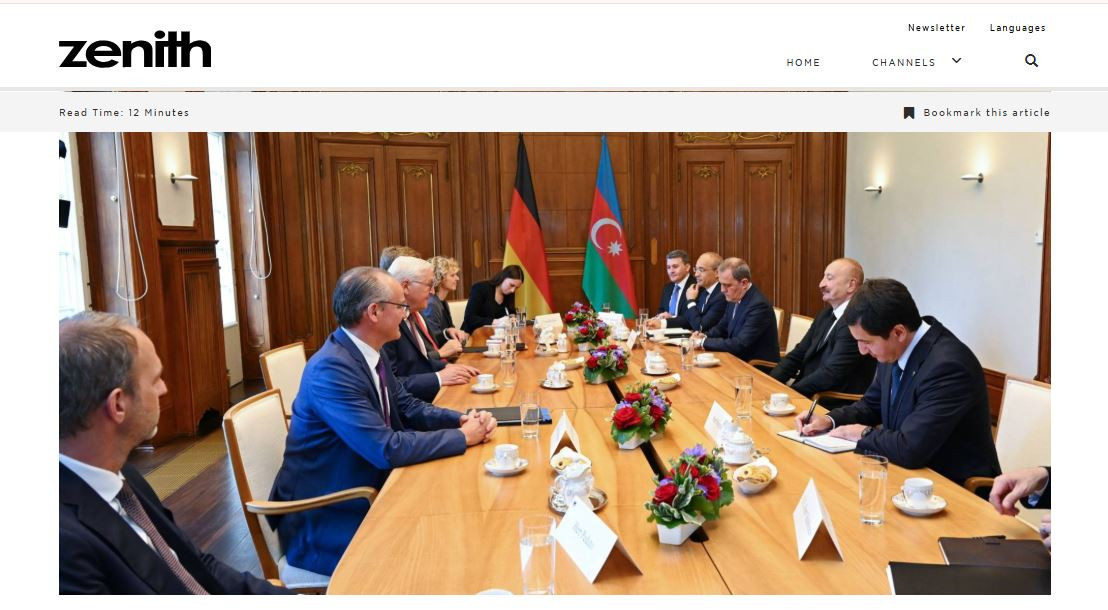
President Ilham Aliyev's two-day working visit to Berlin on July 20–21 produced the most institutionalized step yet in a bilateral relationship that has accelerated markedly since Russia's full-scale invasion of Ukraine. Aliyev received a formal welcome at Berlin Brandenburg Airport on July 20 and held talks with Michael Harms, chairman of the Eastern Committee of the German Economy, on energy, transport, agriculture and tourism cooperation, before holding one-on-one and expanded meetings with German President Frank-Walter Steinmeier and Chancellor Friedrich Merz on July 21. The visit culminated in the signing of a Joint Declaration on the Strategic Agenda for Bilateral Partnership between Azerbaijan and Germany, alongside an agreement to establish a Germany-Azerbaijan Economic Council. At the joint press conference that followed, Merz said the South Caucasus was “gaining increasing importance as a key connectivity hub linking Europe and Asia,” pointing to new transport and trade corridors as a source of economic potential both countries wanted to capture together.
The Berlin visit did not occur in isolation. It is the latest entry in an unusually crowded calendar of European engagement with Baku this year, following European Council President António Costa's March visit, European Commission President Ursula von der Leyen's July 1 tour of Baku and Yerevan, EU foreign policy chief Kaja Kallas's May visit, and bilateral trips by Italian Prime Minister Giorgia Meloni and Slovak President Peter Pellegrini. Aliyev has himself described the relationship with Brussels as having entered “an unprecedented phase of dynamism and activity,” noting that more than 40 percent of Azerbaijan's trade is now conducted with EU member states. Germany's turn in Berlin brings Europe's largest economy formally into a pattern that has been building for months: a recalibration that treats Baku less as a peripheral energy supplier and increasingly as a strategic partner in its own right.
That reorientation rests on a foundation more than three decades old. Germany recognized Azerbaijan's independence in January 1992 and established diplomatic relations the following month, and Baku's embassy in Berlin was its first in Western Europe. For most of the period since, ties remained anchored narrowly in energy, dating to Uniper's 2013 contract with the State Oil Company of Azerbaijan (SOCAR) for up to 1.5 billion cubic meters of gas annually through 2045. Political contact has intensified sharply of late: Aliyev has visited Germany five times since 2023, including two trips to Berlin at the invitation of former chancellor Olaf Scholz, while Steinmeier's April 2025 trip to Baku was the first-ever visit by a German head of state to Azerbaijan.
The relationship also carries a historical layer that both governments invoke on such occasions. German Swabian settlers founded colonies in Azerbaijan in 1818–1819 — Helenendorf, today Goygol, and Annenfeld, today Shamkir — and Baku marked the 200th anniversary of that settlement by presidential decree in 2017. The German Academic Exchange Service (DAAD) and a Goethe Center in Baku sustain that connection today, giving the modern partnership a civic and educational dimension alongside its commercial one.
Energy remains the relationship's structural core, though its shape has changed. Russia's 2022 invasion of Ukraine forced Berlin to replace pipeline gas with LNG and new long-term contracts, and Azerbaijan's Southern Gas Corridor fit that need precisely. The Uniper deal was joined in 2025 by a ten-year contract with SEFE (Securing Energy for Europe) that roughly doubles Germany-bound volumes to around 3 billion cubic meters a year, and in January 2026 Azerbaijani gas began flowing directly to Germany and Austria via the Trans Adriatic Pipeline for the first time — a milestone Aliyev himself cited at Tuesday’s press conference with Chancellor Merz, noting that gas supplies to Germany had begun “this year.” Azerbaijan exported roughly 25 billion cubic meters of gas worth some $8.8 billion in 2025, reaching 16 countries, 12 of them European, and Germany's own foreign ministry now lists Azerbaijan among its ten most important suppliers of crude oil.
What distinguishes the present moment is the shift beyond hydrocarbons. More than 250 German companies now operate in Azerbaijan, spanning manufacturing, construction, logistics and energy, and the relationship increasingly reflects Berlin's need for resilient supply chains as much as its hunt for gas. With exports accounting for roughly 43 percent of German GDP, Berlin has an acute interest in the Middle Corridor linking China and Central Asia to Europe via the Caspian, Azerbaijan, Georgia and Türkiye — a route that has gained urgency amid Red Sea disruptions and the effective closure of the northern route through Russia. Brussels has separately committed some €13 billion to Central Asian and Middle Corridor connectivity since 2024 through its own Global Gateway initiative, underscoring how central the route has become to the EU's own strategic calculus. Azerbaijan's investments in the Port of Baku, the Baku-Tbilisi-Kars railway and the Alat Free Economic Zone position the country as the logistical bridge connecting German exporters to Central Asian markets, including Kazakhstan's rare-earth minerals and Uzbekistan's industrial resources.
The bilateral trade figures reflect this broadening base, even if they remain modest by European standards. Turnover reached roughly €1.7 billion in 2025, and — unusually for German trade with a commodity exporter — the balance is fairly even: German exports are concentrated in machinery, equipment, electronics and vehicles, while Azerbaijani exports, still dominated by oil, are diversifying into wine, juices, fruit, hazelnuts and tea. Germany's only Chamber of Commerce abroad in the wider region is based in Baku.
Green energy supplies a further point of convergence. Germany aims to generate 80 percent of its electricity from renewables by 2030 and needs enormous investment in grid and hydrogen infrastructure; Azerbaijan is simultaneously developing solar and wind capacity with ambitions to become a regional exporter of clean electricity, including through the planned Black Sea Submarine Cable linking the South Caucasus to Southeastern Europe. At his press conference with German Chancellor on July 21, Aliyev said Azerbaijan was determined to deliver its green energy to Europe “in the future as well.” Baku is also building a high-voltage transmission line which will pass through the southern Armenia and extend an electricity link toward Türkiye, a step that would eventually link the South Caucasus grid with Türkiye and, further down the line, continental Europe. The two economies are hence markedly complementary: German capital, engineering and technology on one side, Azerbaijani geography, energy and renewable resources on the other.
Yet the scope for expanding these volumes further depends less on pipeline capacity or political will than on capital. At the same press conference, Aliyev acknowledged that gas supplies to Germany "can be increased," but identified financing as the binding constraint, noting that European banks have pulled back from supporting oil and gas projects under the pressure of the green agenda and urging them to reconsider that stance. Without fresh investment, Azerbaijan cannot increase its exports to Europe, however favorable the political climate between Baku and Berlin may be.
Underpinning all of this is a political dimension both governments now treat as inseparable from economics. Merz has repeatedly welcomed progress in the Armenia-Azerbaijan peace process, framing it as important for “regional stability.” That process has been reshaped by developments few would have predicted a decade ago. After Azerbaijan restored full sovereignty over Karabakh in 2023, Russia withdrew its peacekeeping contingent in April 2024, some eighteen months ahead of its original mandate — leaving Azerbaijan today the only post-Soviet country in the South Caucasus and Eastern Europe without any Russian military presence on its soil. The Armenia-Azerbaijan peace treaty itself, however, remains stuck at the initialing stage. Baku has made clear it will not proceed to signature until Armenia amends its constitution to remove territorial claims against Azerbaijan, and Aliyev has said the treaty could be signed "the very next day" once that amendment is adopted. With the required constitutional change tied to a referendum process in Armenia, the treaty's formal conclusion remains hostage to Yerevan's domestic politics rather than to any outstanding issue between the two governments.
The European Union has staked its own claim to a role in that settlement. At the inaugural European Political Community summit in Prague in October 2022, Armenia and Azerbaijan, mediated by French President Emmanuel Macron and European Council President Charles Michel, reaffirmed their commitment to the 1991 Alma-Ata Declaration, under which each recognizes the other's territorial integrity and sovereignty — the formula under which Karabakh is treated as part of Azerbaijan and which has since anchored the delimitation and peace talks. Von der Leyen built on that legacy during her July 1 visit to Baku, telling Aliyev that his initialing of the peace treaty was the most important regional development in decades and pledging up to €200 million in Global Gateway grants for South Caucasus connectivity.
Berlin's Joint Declaration with Baku also fits a wider pattern in German foreign economic policy. Days earlier, Merz signed an identically titled Joint Declaration on a Strategic Agenda for Bilateral Partnership with Algeria during President Abdelmadjid Tebboune's visit to Berlin, a document that reaffirmed both countries' commitment to a rules-based international order and set out cooperation across energy, hydrogen, industry, investment, innovation and security. Based on the substance of talks on July 21 — energy, connectivity, industrial investment and regional stability — the Azerbaijani version appears to formalize similar ground. The template reflects Germany's post-2022 search for a wider circle of reliable partners at a moment when its own economy — having contracted in both 2023 and 2024, its longest stagnation in decades — needs new export markets and resilient supply chains as much as new energy sources.
None of this makes the Berlin visit merely transactional. It formalizes a relationship that began, out of necessity, in the scramble to replace Russian gas after 2022 and has since matured into something considerably broader, spanning connectivity, green technology, industrial investment and, increasingly, shared assessments of regional stability. For Germany, Azerbaijan offers energy security, a logistics bridge to Central Asia and a market for its engineering exports at a moment of domestic economic strain. For Azerbaijan, the partnership offers capital, technology and a measure of Western validation at what is, by any reckoning, the moment of its greatest regional self-confidence since independence. Both sides have reason to call it, without much exaggeration, mutually beneficial.
https://magazine.zenith.me/en/business/azerbaijan-and-germany