Executive Summary:
-
On July 1, European Commission President Ursula von der Leyen arrived in Baku for the first leg of a two-day South Caucasus tour, meeting Azerbaijani President Ilham Aliyev to discuss energy cooperation, regional connectivity, and the Armenia–Azerbaijan peace process.
-
Von der Leyen announced a 200 million euro ($229 million) Global Gateway grant package for South Caucasus connectivity, projected to mobilize up to 2 billion euros ($2.29 billion) in combined public and private investment, alongside a proposed EU–Azerbaijan Connectivity Partnership.
-
The visit reflected a broader recalibration of EU–Azerbaijan relations, with Baku becoming a strategic partner in energy security and Middle Corridor connectivity while advancing negotiations on a new bilateral framework agreement to replace the 1999 Partnership and Cooperation Agreement
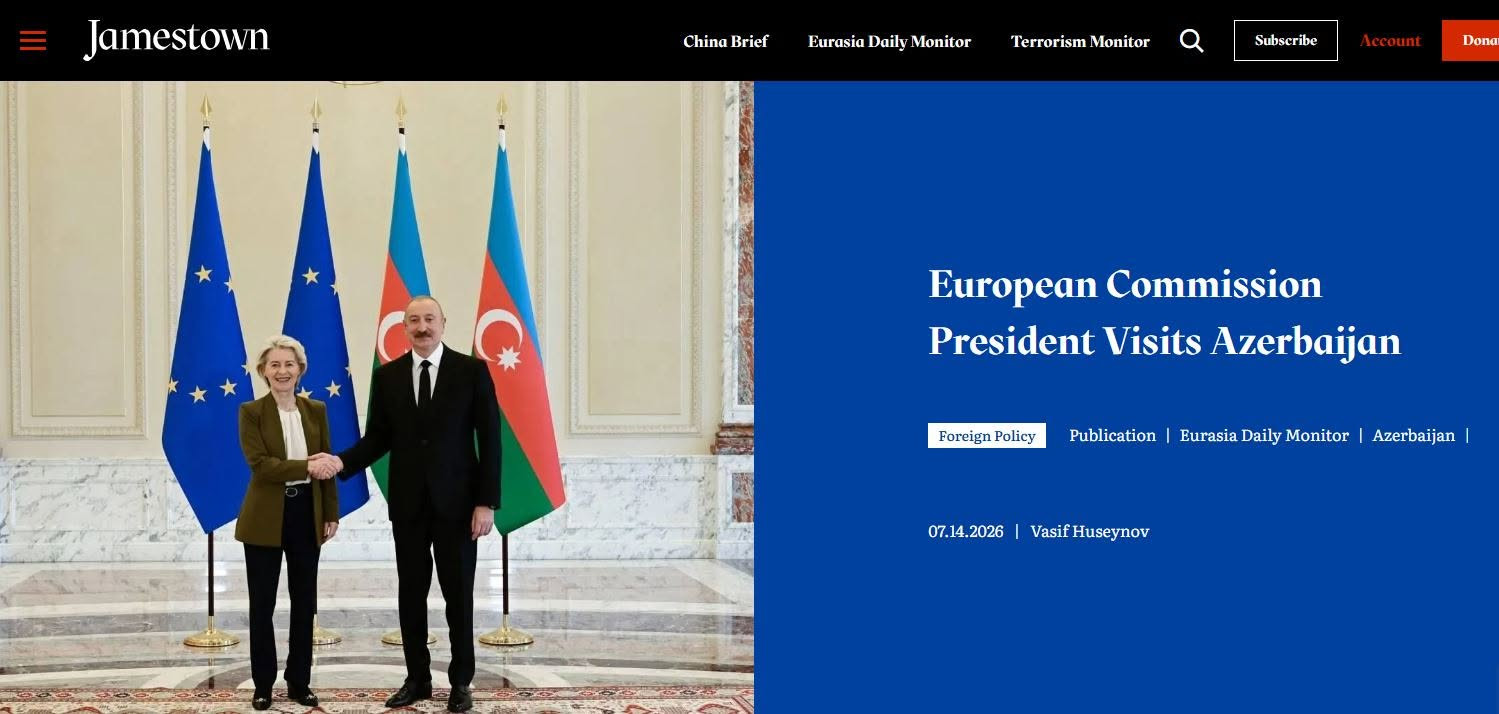
European Commission President Ursula von der Leyen touched down in Baku on July 1, opening a two-day tour of the South Caucasus that would take her to Yerevan the following morning. The European Commission billed the trip as centered on four priorities, including consolidating the Armenia–Azerbaijan peace process following last year’s initialing of a Washington-mediated agreement; deepening connectivity between Europe, the South Caucasus, and Central Asia; expanding the European Union’s economic partnership with the region; and, on the Armenian leg, shoring up Yerevan against what Brussels calls Russian economic coercion (European Commission, June 29). It was von der Leyen’s first visit to Baku since 2022, undertaken alongside Commissioner for Enlargement Marta Kos (see EDM, August 8, 2022).
At a joint press conference following expanded-format talks with Azerbaijani President Ilham Aliyev, von der Leyen opened with the topic of peace. She told Aliyev that his initialing of the Armenia accord was the most important regional development in decades and pledged that Brussels would help turn “peace on paper” into practice (European Commission, July 1). She then discussed energy cooperation, stating “Azerbaijan has proven to be a reliable and trustworthy energy partner for the European Union.” She added that Brussels had “not forgotten” that Baku “stepped in to help” when Russia weaponized gas supplies to Europe (APA, July 1). She credited the Southern Gas Corridor with strengthening European energy security and welcomed Azerbaijan’s offshore wind ambitions in the Caspian, highlighting the country’s potential to become “a hub for clean electricity” that fits Europe’s own clean-energy transition (Report.az, July 1). She also welcomed Baku’s plan for a Green Energy Corridor linking Azerbaijan to the EU grid and endorsed an accompanying electricity cable to Armenia, framing South Caucasus renewables as a way to reinforce peace alongside energy security (European Commission, July 1).
Aliyev characterized the relationship as having entered “an unprecedented phase of dynamism and activity.” He noted that more than 40 percent of Azerbaijan’s trade is now conducted with EU member states, which together receive roughly half of Azerbaijan’s gas exports (News.az, July 1; Caspian Post, July 2). Beyond gas, both leaders pointed to transport connectivity as a growing pillar of the relationship, with von der Leyen describing the South Caucasus as a strategic crossroads linking Europe, the Caspian, and Central Asia, and Aliyev highlighting Azerbaijan’s expanding east–west and north–south cargo corridors (Caspian Post, July 2).
During the trip, von der Leyen proposed a formal EU–Azerbaijan Connectivity Partnership spanning transport, energy, and digital infrastructure. Additionally, she proposed a High-Level Connectivity Dialogue and a future Regional Connectivity Investment Conference to be hosted in Baku. Aliyev and von der Leyen said this conference would take place by the end of 2026 and draw international financial institutions and private investors alongside South Caucasus and Central Asian governments (European Commission, July 1). Under the Global Gateway initiative, she announced up to 200 million euros ($229 million) in grants for South Caucasus connectivity projects, potentially unlocking 2 billion euros ($2.29 billion) in combined public and private financing, earmarked in part for a rail link to Nakhchivan—where the European Union, Azerbaijan, and the European Bank for Reconstruction and Development launched a feasibility study in January 2026—and expansion of the Port of Baku (Agence Europe, July 2). A separate 20 million euro ($22.9 million) program was announced to support demining, healthcare, rural development, and small and medium-sized enterprises tied to the peace process (Caspian Post, July 2).
The Baku meeting also unfolded against the backdrop of a potential winter energy crisis in Europe. Consultancy Wood Mackenzie forecasts EU storage facilities will end the April–October injection season only around 76 percent full, the lowest peak level since at least 2011, with average storage currently near 48 percent, well below the roughly 61 percent five-year norm for early July (Financial Times, June 29). The shortfall traces mainly to the recent U.S.–Israel–Iran conflict, which disrupted Gulf liquified natural gas (LNG) output and closed the Strait of Hormuz to shipping that normally carries about a fifth of the world’s LNG. Qatar and the United Arab Emirates have also experienced reduced LNG production, raising the prospect of higher winter energy prices for European households and businesses. The European Union’s own legislative timetable has complicated this situation. Under the REPowerEU Gas Regulation that entered into force in February, the European Union enacted a legally binding, permanent phase-out of Russian gas. Long-term LNG contracts must end by January 1, 2027, and long-term pipeline contracts by September 30 of the same year, or November 1 at the latest (Council of the EU, December 3, 2025). Azerbaijan already supplies just under 13 billion cubic meters of pipeline gas to Europe and agreed with the European Union in 2022 to double Southern Gas Corridor capacity to at least 20 billion cubic meters annually by 2027 (see EDM, August 8, 2022). Azerbaijan has only limited room to expand further in the near term. It is this gap that keeps drawing Brussels’ attention eastward to Azerbaijan, and potentially to Turkmenistan, if the complications regarding the Trans-Caspian Gas Pipeline finally get resolved.
The Baku leg of von der Leyen’s tour illustrated both the substance and the recalibration now underway in the EU–Azerbaijan relationship. Brussels arrived with concrete financial commitments and statements emphasizing its view of Azerbaijan as a reliable and indispensable partner central to Europe’s diversification away from Russian gas amid a newly reenergized Trans-Caspian agenda, and to the wider connectivity architecture taking shape around the Middle Corridor. That tone marks a shift from an earlier posture of the European Parliament, which has adopted more than a dozen resolutions critical of Azerbaijan since the 2020 Karabakh war. After the chamber passed resolutions viewed in Baku as anti-Azerbaijan on April 30, Azerbaijan’s Milli Majlis voted the next day to suspend all cooperation with the European Parliament and begin withdrawing from the Euronest Parliamentary Assembly (AZERTAC, May 3; Brussels Signal, May 4). Over the past year, however, the European Union’s executive branch and national leaders have described their engagement with Baku in warmer and more forward-looking terms, with Brussels transitioning to treating Azerbaijan as a strategic partner in energy security, connectivity, and regional peace rather than primarily as a subject of political conditionality.
That recalibration now has a concrete institutional expression. Since this past spring, Baku and Brussels have moved to resume long-dormant negotiations on a new bilateral framework intended to replace the 1999 Partnership and Cooperation Agreement, with successive rounds—most recently in Baku on June 2–3—provisionally agreeing a set of Partnership Priorities for 2026–2030 spanning political dialogue, connectivity, energy, trade, and digital cooperation, alongside continued work on the text of a new Comprehensive Agreement (Report.az, June 3; EU Neighbours East, June 4). Von der Leyen endorsed that track personally in Baku, describing the European Union as Azerbaijan’s largest trading partner and top investor and calling the resumption of comprehensive agreement talks a step that could open the door to still more bilateral trade (European Commission, July 1). Combined with the Global Gateway pledges made during von der Leyen’s visit, this points toward a relationship that, while still working out its precise terms and financing details, is no longer starting from the position of mutual suspicion that marked it only a year or two earlier. If the coming months bring the follow-through that Baku says it is still waiting for, the Baku leg of this tour may come to be remembered less as another round of declaratory friendship and more as a marker of the moment the EU–Azerbaijan partnership began to be rebuilt on steadier and more balanced ground.
https://jamestown.org/european-commission-president-visits-azerbaijan/