As the global transition toward sustainable energy gains momentum, cooperation between Azerbaijan and China in green energy technologies has emerged as a strategic partnership with far-reaching economic, environmental, and geopolitical implications. For Azerbaijan, this partnership is a key component of broader efforts to accelerate the green transition, enhance energy security, and diversify its energy mix beyond fossil fuels. For China, a global leader in renewable technologies, it provides an opportunity to play a pivotal role by transferring expertise, supplying advanced equipment, and extending financial support for Azerbaijan’s solar, wind, and hydropower projects. Bilateral agreements under COP29, the Belt and Road Initiative (BRI), and the Shanghai Cooperation Organization (SCO) provide the overarching framework for this cooperation, enabling Azerbaijan to attract Chinese investment and technical know-how while aligning with global sustainability goals. Through joint initiatives in renewable power generation, technology transfer, localized equipment production, and investment in sustainable infrastructure, both countries are positioning themselves as important contributors to a more resilient, diversified, and climate-friendly regional energy landscape. Beyond bilateral benefits, their partnership also carries wider regional implications: strengthening Europe’s access to alternative green energy sources, supporting Caspian energy diversification, and showcasing how cross-border collaboration can accelerate the global clean energy transition.
Technology Transfer Driving Renewable Energy Development
China’s role as a global leader in renewable energy technology has made it an ideal partner for Azerbaijan’s green transition. Technology transfer is occurring through both equipment supply and expertise sharing. Chinese companies are already key suppliers of solar and wind technology to Azerbaijani projects, providing photovoltaic panels, wind turbines, inverters, and digital solutions. For example, Chinese firms supplied critical components for the Garadagh solar plant, despite it being developed by the Emirati renewable company Masdar. Likewise, in a wind project led by Saudi Arabia’s ACWA Power, Chinese manufacturers provided turbines for what is now the largest and most sophisticated wind farm in the entire South Caucasus. These cases illustrate how Chinese technology is being embedded in Azerbaijan’s renewable infrastructure, effectively transferring know-how and enhancing project performance.
Beyond hardware, Chinese partners contribute valuable technical expertise and project management experience. According to Azerbaijan’s ambassador to China, Bunyad Huseynov, Chinese renewable technologies are already widely deployed in the country, with companies demonstrating strong professionalism in executing engineering, procurement, and construction (EPC) projects. Their expertise ranges from efficient solar farm design to large-scale wind project management, helping to build local capacity. Azerbaijan particularly values China’s experience in integrating renewables into national grids and managing intermittency challenges. Knowledge exchange is also advancing through joint working groups and training initiatives. Notably, discussions between the Azerbaijani Energy Ministry and China Energy Engineering Group have led to plans for a renewable energy R&D center in Azerbaijan. Such a center would serve as a hub for innovation and skills development, providing Azerbaijani engineers with direct access to cutting-edge green technologies.
Local production and manufacturing add another layer to this cooperation. Chinese companies have expressed readiness to establish renewable energy equipment production in Azerbaijan, a move that would accelerate technology diffusion. For example, China Energy Overseas Investment has signaled its willingness to produce wind turbine components locally and collaborate on an R&D center. Establishing assembly or manufacturing facilities for solar panels, turbine parts, or battery systems would both transfer industrial know-how and create domestic supply chains. This aligns with Azerbaijan’s interest in building a homegrown clean energy industry while giving Chinese firms new market opportunities. In the hydropower sector, where cooperation has so far been limited, China’s vast experience could be leveraged to modernize Azerbaijan’s existing plants or develop small and medium-sized stations. Knowledge-sharing on turbine upgrades, dam safety, and pumped-storage systems could significantly improve hydropower efficiency and integration with other renewables.
Overall, technology transfer from China is accelerating Azerbaijan’s renewable rollout by reducing costs and enhancing capabilities. Azerbaijani officials emphasize that China’s advanced technologies and expertise are especially vital as the country scales up solar and wind projects. This cooperation allows Azerbaijan to leapfrog in adopting modern systems without reinventing the technology domestically, while giving Chinese companies expanded business opportunities and demonstration platforms. The deepening of this exchange (through equipment supply, expertise transfer, and local manufacturing) is laying a solid foundation for Azerbaijan’s renewable energy sector to grow rapidly.
Green Energy Collaboration within the Broader Frameworks of the BRI, COP29, and the SCO
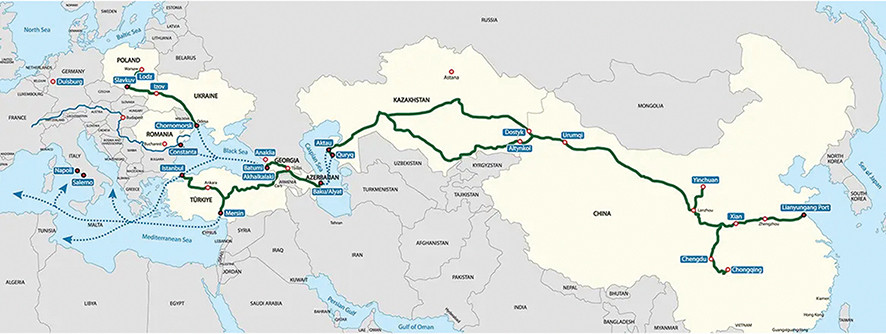
China’s Belt and Road Initiative (BRI) has become a powerful framework for energy cooperation with Azerbaijan, particularly in the renewable sector. As a formal member of the BRI, Azerbaijan occupies a strategically important position on the Middle Corridor, linking China and Europe through the Caspian Sea region. While early BRI projects focused primarily on transport infrastructure such as railways and ports, the scope has expanded to include energy initiatives aligned with sustainable development. This emphasis on connectivity and investment dovetails with Azerbaijan’s strategy of attracting foreign capital for renewables. In this way, Azerbaijan gains access to Chinese financing and expertise for its green energy ambitions, while China secures a reliable partner in the South Caucasus to advance its global infrastructure vision.
High-level engagements under the BRI umbrella have increasingly prioritized green energy. In October 2024, during the 3rd Belt and Road Ministerial Conference in China, Azerbaijan’s Energy Minister Parviz Shahbazov met with major Chinese vendors to discuss integrating more renewables into Azerbaijan’s grid. These talks focused on developing offshore wind in the Caspian Sea, localizing clean energy equipment production, and expanding investment in solar and wind farms. The minister also highlighted Azerbaijan’s proposal for “green energy corridors” across the Caspian to export renewable electricity to Europe, inviting Chinese companies to participate as investors and technology suppliers. This demonstrates that BRI cooperation is no longer limited to power generation but is evolving toward the creation of transnational green energy links, a modern extension of the Silk Road concept.
This momentum was reinforced at the COP29 Forum held in Baku in November 2024, where multiple agreements were signed. PowerChina Resources and TBEA concluded memoranda of understanding with Azerbaijan’s Energy Ministry covering a wide range of areas: solar and wind development, pumped hydro, battery storage, smart energy systems, green hydrogen, training, and know-how exchange. TBEA also pledged cooperation on equipment supply, local production of high-tech energy network equipment, and participation in green energy interconnection projects. In parallel, China Datang Co. Ltd. agreed with Azerbaijan’s Ministry of Energy to collaborate on feasibility studies, investment, and potentially the establishment of a renewable energy R&D center. The deals reached during COP29 in Baku serve as concrete examples of how cooperation under the Belt and Road Initiative is translated into tangible projects.
The bilateral upgrade to a comprehensive strategic partnership between Azerbaijan and China in April 2025 further deepened their cooperation, establishing a stronger institutional and political foundation for joint projects, facilitating greater investment flows, and opening new avenues for collaboration in renewable energy, digitalization, and regional connectivity. Both sides explicitly committed to strengthening collaboration in renewable energy, energy storage, and related fields. This political commitment, linked to the BRI framework, has opened the way for large-scale projects, including potential green hydrogen production and offshore wind farms. For Azerbaijan, which aims to generate 30 percent of its electricity from renewables by 2030 and cut greenhouse gas emissions by 40 percent by 2050, such initiatives are of strategic importance. For China, they represent a chance to demonstrate leadership in green infrastructure across Eurasia.
Azerbaijan’s role in the BRI also carries a geopolitical energy dimension. By collaborating on renewables, the two countries are integrating Azerbaijan into China’s vision of interconnected energy corridors. Its strategic location allows it to contribute to new transnational energy routes, such as a potential Caspian–Black Sea–Europe “Green Energy Corridor” for electricity exports. Chinese involvement in such projects—whether as investor or technology supplier—would extend BRI’s influence into European energy markets in a climate-friendly manner. This also aligns with Europe’s interest in diversifying energy sources, positioning BRI cooperation as mutually beneficial rather than competitive. Moreover, China’s experience enables it to export not only hardware but also standards and best practices, ensuring that these projects meet international sustainability benchmarks.
Building on this growing strategic synergy under the BRI framework, President Ilham Aliyev’s 2025 visits to China marked a significant deepening of bilateral cooperation, translating shared visions into tangible renewable energy initiatives. During his April 2025 visit, several landmark agreements were signed to advance renewable energy cooperation. These included a Chinese investment to build a 100 MW solar power plant in Gobustan (to be completed by 2026), a 2 GW offshore wind project in the Caspian Sea with PowerChina and China Datang, and a 100 MW floating solar farm on Lake Boyukshor paired with a 30 MW battery energy storage system. Other agreements covered a 160 MW ground-mounted solar plant and a pilot 100 MW solar station developed by Huantai Energy, which won Azerbaijan’s first renewables auction.
During President Ilham Aliyev’s visit to Beijing for the Shanghai Cooperation Organization (SCO) summit on August 31–September 1, 2025, Azerbaijan’s leadership effectively leveraged its dialogue partner status within the SCO to deepen energy cooperation. This engagement is viewed as a strategic avenue for diversifying export markets, attracting investment in energy infrastructure, and fostering innovation in emerging energy technologies. The discussions held in Tianjin following the SCO+ meetings further underscored that Azerbaijan–China collaboration is evolving beyond traditional project implementation toward forward-looking innovation. During his meeting with Xi Yinfen, Executive Vice President of PowerChina Group, on September 2, 2025, President Ilham Aliyev underscored the shared ambition to pursue new initiatives, including the construction of solar and wind power plants, integration of smart energy systems, and advancement of projects in green hydrogen and water treatment. The talks also emphasized training and knowledge exchange programs, reflecting a shift from mere infrastructure building to technology transfer and capacity development, pillars of Azerbaijan’s long-term green transformation strategy.
Moreover, China’s broader engagement strategy involves providing cost-effective solar modules and wind turbines, serving as turnkey EPC contractors, and participating in renewable energy auctions in Azerbaijan, all contributing to the country’s accelerating clean-energy transition. This bilateral progress resonates within the wider SCO framework, where energy cooperation has consistently remained a central theme. Discussions on energy security, unified energy systems, and joint development projects underscore the organization’s commitment to regional energy integration. As a dialogue partner, Azerbaijan plays a constructive role in these processes as both a dependable energy supplier and a crucial transit hub.
The most recent high-level engagement took place on September 26, 2025, between Azerbaijan’s Minister of Economy, Mikayil Jabbarov, and Zhong Haixiang, Chairman of PowerChina Resources Ltd. During the meeting, the parties emphasized the prospects for cooperation in applying modern technologies and innovative solutions, as well as the importance of diversifying their joint activities. They also discussed opportunities for investment in the renewable energy sector, enhancing export potential, and implementing projects for efficient water resource management and wastewater treatment through public–private partnerships. It is worth noting that PowerChina Resources Ltd. is one of China’s leading companies engaged in large-scale projects worldwide across the energy, infrastructure, and construction sectors. The company has extensive experience in electricity generation, renewable energy, hydropower, and the construction of wind and solar power plants, as well as in water management and major infrastructure development. Its global cooperation network—including projects carried out with partners such as SOCAR Green—contributes to strengthening regional energy security and advancing environmentally friendly technologies.
Collectively, these initiatives reflect a broader strategic convergence between Baku and Beijing, one that situates Azerbaijan not only as a recipient of investment but as an active co-architect of the emerging Eurasian green energy order. This momentum also paves the way for deeper engagement within multilateral mechanisms, such as COP29, the BRI Green Development Coalition, and the SCO Energy Club, where green finance, digital innovation, and sustainability governance are becoming the next frontiers of Azerbaijan–China cooperation.
Key Renewable Energy Projects and Initiatives
Several landmark solar, wind, and hydropower projects have emerged from Azerbaijan–China cooperation, each contributing to Azerbaijan’s sustainable energy transition. Together, they demonstrate how technology transfer and investment are materializing on the ground and highlight the role of Chinese companies in shaping the country’s green energy industry.
This growing role became especially clear with the launch of Azerbaijan’s first renewable energy auction in 2024, which showcased how Chinese firms could compete internationally while driving down costs. With technical assistance from the European Bank for Reconstruction and Development (EBRD), the auction was awarded to China’s Universal International Limited. The 100 MW Gobustan Solar Plant will be designed, built, and operated by the company and is scheduled to come online by 2027. Once operational, it is expected to generate about 260 million kWh annually, saving roughly 57 million cubic meters of natural gas and cutting carbon emissions by 124,000 tons per year. Beyond supporting Azerbaijan’s 2030 goal of 30 percent renewable power, the project demonstrates the cost advantages of Chinese technology and financing.
Building on this momentum, Chinese firms deepened their role under the COP29 agreements, marking a shift from individual projects to larger, strategically significant ventures. In late 2024, Azerbaijan’s Ministry of Energy, SOCAR Green LLC, and China Energy Overseas Investment Co. signed an executive agreement to construct a 160 MW solar plant in the Fuzuli district. Located in the Karabakh region (an area undergoing post-conflict reconstruction) the project will provide sustainable energy for local needs while symbolizing the role of renewables in regional recovery. The partnership, which combines Chinese investment with Azerbaijan’s state-owned energy company, ensures both technology transfer and shared ownership. It also aligns with Azerbaijan’s strategy to transform liberated territories into hubs of renewable energy.
At the same time, Azerbaijan’s renewable landscape also benefitted from trilateral and multilateral cooperation, where Chinese technology proved indispensable even when projects were led by other partners. The Garadagh 230 MW Solar Park offers another example of successful collaboration. Inaugurated in 2023, it was developed by Masdar (UAE) but relied heavily on Chinese technology. Dongfang Electric supplied a state-of-the-art monitoring and management system, while LONGi Solar provided high-performance panels. The facility, the largest solar plant in the CIS region, powers about 110,000 homes and reduces emissions by more than 200,000 tons annually. Beyond its technical output, the project set a precedent for multilateral cooperation—bringing together Middle Eastern developers, Chinese suppliers, and Azerbaijani operators—thus offering a model for future ventures.
This pattern extended beyond solar into wind energy, where Chinese participation once again lowered costs and accelerated project timelines. The Khizi–Absheron 240 MW Wind Farm, Azerbaijan’s first large-scale wind project, was developed by Saudi Arabia’s ACWA Power under a 2020 intergovernmental agreement. Chinese manufacturers supplied the turbines, lowering capital costs and speeding up deployment. Financed by the EBRD and the OPEC Fund with a $300 million syndicated loan, the project will generate around 1 billion kWh annually, enough to power 300,000 homes and prevent 400,000 tons of carbon dioxide emissions each year. Its successful implementation with Chinese equipment has given Azerbaijan valuable experience in integrating wind energy into the grid and laid the groundwork for future offshore wind projects in the Caspian, where Chinese firms are already potential partners in feasibility studies.
Recognizing this track record, Azerbaijan and China have begun to scale up their ambitions through broader, forward-looking frameworks. In mid-2023, Azerbaijan signed a memorandum of understanding with China Gezhouba Group to develop up to 2,000 MW of renewable capacity nationwide. The initiative envisions utility-scale solar farms, onshore wind parks, energy storage systems, and potentially green hydrogen production. While sites are still being evaluated, the MoU provides a blueprint for long-term cooperation and signals the entry of a major Chinese engineering conglomerate into Azerbaijan’s energy sector. If realized, this initiative would significantly expand Azerbaijan’s renewable portfolio and move the country closer to its target of 7 GW of new green capacity by 2030.
While solar and wind dominate current collaboration, hydropower remains an underexplored frontier where China’s expertise could prove equally transformative. Hydropower, though less prominent so far, also presents opportunities for collaboration. Chinese turbine manufacturers and engineering firms could play a role in modernizing Soviet-era hydroelectric stations, upgrading turbines, and enhancing dam safety. Such efforts would boost output from existing plants without the need for new dams. Discussions have also touched on pumped hydro storage as a way to balance solar and wind intermittency. Given China’s expertise in large-scale hydro, future cooperation may extend to designing pumped-storage solutions or developing small hydro facilities in rural areas.
Taken together, these projects are not just expanding Azerbaijan’s renewable capacity, they are building the foundation of a diversified and sustainable energy system. By pairing Chinese technology and investment with Azerbaijan’s resources and strategic vision, the two countries are advancing toward shared goals. For Azerbaijan, this cooperation helps achieve its pledge of 30 percent renewable power by 2030 and positions it as a potential net exporter of green energy. For China, it provides a platform to demonstrate its capabilities in BRI-aligned green infrastructure, strengthening its reputation as a global leader in clean energy.
Energy Diversification and Security Impacts
Cooperation with China in renewables is a linchpin of Azerbaijan’s strategy to diversify its energy mix beyond oil and gas. For decades, Azerbaijan’s economy and energy supply were dominated by hydrocarbons, but declining oil production and climate commitments have spurred a decisive pivot to renewables. By harnessing solar, wind, and hydro resources with Chinese support, Azerbaijan is reducing its overreliance on fossil fuels and strengthening energy self-sufficiency. Recent studies indicate that the country has the potential to install up to 7 GW of offshore wind power by 2040, making Chinese firms with extensive offshore experience ideal future partners. Each new megawatt of solar or wind capacity translates into greater domestic electricity generation without burning natural gas. For example, the Gobustan Solar Plant and Khizi–Absheron Wind Farm together will save 277 million cubic meters of gas annually — fuel that can be redirected for export or retained as strategic reserve. Developing wind power in regions like Absheron or offshore also complements solar output, creating a more stable supply. The result is a resilient and balanced energy system, less vulnerable to fluctuations in global oil and gas markets. By 2027, Azerbaijan aims to raise renewables to 33 percent of installed capacity, a step that will both meet domestic demand sustainably and free up hydrocarbons for export, a dual gain for energy security.
The Azerbaijan–China green partnership also has implications for regional energy stability. As Azerbaijan develops the capacity to export renewable electricity, whether via planned undersea cables to Europe or through integration with neighbors, both Baku and Beijing contribute to regional diversification efforts. Europe, eager to reduce reliance on Russian energy, views Caspian green power favorably. If Chinese investment accelerates Azerbaijan’s emergence as a green exporter, it indirectly supports European energy security and helps ease global supply tensions. Admittedly, some observers may worry about China’s growing role in critical infrastructure. Yet in the case of renewables, this role is largely welcomed because it aligns with global decarbonization goals. Azerbaijan’s multi-vector policy further ensures balance, as it works not only with China but also with the EU, Türkiye, and others, preventing overdependence on any single partner. This diversified approach guarantees that cooperation with China strengthens, rather than compromises, Azerbaijan’s energy security. For Beijing, it provides secure partnerships, showcases technological leadership, and extends its influence in Eurasian energy networks. Together, these efforts are building an interconnected system that favors sustainable sources and shared prosperity.
Conclusion
Technology transfer from China is accelerating Azerbaijan’s leap into renewable energy, driving the rapid development of solar, wind, and hydropower projects that underpin the country’s sustainability and diversification goals. Through the Belt and Road Initiative, the Shanghai Cooperation Organization and bilateral agreements under COP29, China has provided advanced equipment, investment, and expertise — from solar panels and wind turbines to grid integration know-how — that lower barriers to green energy adoption. In return, Azerbaijan offers China a strategic partner in the South Caucasus and an opportunity to demonstrate its commitment to a greener Belt and Road.
Beyond their bilateral value, these efforts carry broader significance. For Azerbaijan, they diversify the energy mix and external partnerships, strengthening both economic resilience and regional influence. For China, they extend a green footprint into the Caucasus, aligning infrastructure initiatives with climate goals while enhancing soft power. Both sides are also attentive to sustainability, working to minimize environmental impacts and build on China’s experience in managing large-scale renewable projects. Looking ahead, the emphasis will be on scaling up successes — completing projects on time, achieving 2030 renewable targets, and exploring new frontiers such as offshore wind and green hydrogen. Each milestone, from launching research centers to building gigawatt-scale plants, will reinforce the partnership between Baku and Beijing.
In essence, Azerbaijan–China cooperation in green energy is emerging as a model of how cross-border collaboration can accelerate the clean energy transition. It strengthens Azerbaijan’s energy security by reducing reliance on hydrocarbons and enhances China’s role as a global clean energy leader. Geopolitically, it illustrates how constructive international engagement can advance both national interests and global climate objectives. The trajectory ahead points toward a deepened alliance in which Azerbaijan evolves into a regional renewable hub — exporting both electricity and expertise — with China as a central collaborator. This win–win partnership not only advances national interests but also contributes to the global fight against climate change, setting a valuable precedent for sustainable development through international cooperation.
References
The European Geopolitical Forum, Advancing Azerbaijan-China Energy Cooperation within the SCO Framework (October 31, 2025).
The Ministry of Energy of the Republic of Azerbaijan (September 26, 2025), Meeting held with the Chairman of PowerChina Resources Ltd.
https://www.economy.gov.az/en/post/2935/powerchina-resources-ltd-sirketinin-sedri-ile-gorus-kecirlib
The Ministry of Energy of the Republic of Azerbaijan (April 23, 2025), 6 documents on green energy have been signed with Chinese companies. https://minenergy.gov.az/en/xeberler-arxivi/00515
The Official Website of the President of the Republic of Azerbaijan (September 2, 2025), Ilham Aliyev met with the Executive Vice President of PowerChina Group in Tianjin.
https://president.az/en/articles/view/70012/print
The Official Website of the President of the Republic of Azerbaijan (April 23, 2025), Azerbaijan and China signed Joint Statement on Establishment of Comprehensive Strategic Partnership.
https://president.az/en/articles/view/68634
Trend News Agency (October 2, 2024), Middle Corridor ships wind turbine parts for Azerbaijan’s vital renewable energy project (Exclusive). https://www.trend.az/business/transport/3951886.html
Global Times (November 25, 2024), China shares green technology with other nations, sets an example for the world: Azerbaijani Ambassador.
https://www.globaltimes.cn/page/202411/1323754.shtml
The Caspian Post (January 6, 2025), Azerbaijan and China: A New Chapter in Green Energy Collaboration.
https://caspianpost.com/opinion/azerbaijan-and-china-a-new-chapter-in-green-energy-collaboration
Interfax International Information Group (October 22, 2024), China Energy plans to increase investment in Azerbaijan, Huawei discussing building data center.
https://interfax.com/newsroom/top-stories/106931/
China Daily (January 24, 2024), Azerbaijan and China: cooperation for a sustainable energy future. https://global.chinadaily.com.cn/a/202401/24/WS65b06e25a3105f21a507e061.html
The Azerbaijan State News Agency (February 26, 2025), Expert: China views Azerbaijan as key partner in Belt and Road Initiative.
The Ministry of Energy of the Republic of Azerbaijan (October 22, 2024), Energy Minister met with PowerChina and TBEA companies in China.
https://minenergy.gov.az/en/xeberler-arxivi/00379
The Ministry of Energy of the Republic of Azerbaijan (November 18, 2024), Memorandum of Understanding signed with Chinese companies PowerChina and TBEA.
https://minenergy.gov.az/en/xeberler-arxivi/00415
Trend News Agency (November 14, 2024), Azerbaijan’s Ministry of Energy signs documents on cooperation in field of renewable energy with Chinese companies.
https://www.trend.az/business/green-economy/3970122.html
The Official Website of the President of the Republic of Azerbaijan (July 3, 2024), Joint Declaration of the Republic of Azerbaijan and the People’s Republic of China on the establishment of a strategic partnership was adopted in Astana.
https://president.az/en/articles/view/66389
The Official Website of the COP29 (2024), Azerbaijan’s Green Energy Transition Initiatives.
https://cop29.az/en/sustainability/energy-transition-initiatives
The Official Website of the State Council Information Office of the People’s Republic of China (August, 2024), China’s Energy Transition.
http://www.scio.gov.cn/zfbps/zfbps_2279/202408/t20240829_860523.html
The Official Website of the Embassy of the People’s Republic of China in the Republic of Azerbaijan (October 18, 2023), Building an Open, Inclusive and Interconnected World For Common Development.
http://az.china-embassy.gov.cn/eng/zgyw/202310/t20231018_11162854.htm
Caucasus Strategic Perspectives (2024), The Green Energy Corridor between the EU and the Caspian Sea: Potential and Challenges (Agha Bayramov).
https://cspjournal.az/uploads/files/CSP%20Summer%202024/7%20Agha%20Bayramov.pdf
The European Bank for Reconstruction and Development (November 21, 2024), Azerbaijan’s first renewables auction concludes at COP29 with EBRD support.
Interfax International Information Group (November 21, 2024), China’s Universal International Ltd to construct 100 MW solar power plant in Azerbaijan.
https://interfax.com/newsroom/top-stories/107931/
The Ministry of Energy of the Republic of Azerbaijan (November 14, 2024), Cooperation in the field of renewable energy was discussed with Chinese companies.
https://minenergy.gov.az/en/xeberler-arxivi/00402
The Ministry of Energy of the Republic of Azerbaijan (October 26, 2023), An official inauguration of the 230 MW Garadagh Solar PV Plant has been held.
https://minenergy.gov.az/en/xeberler-arxivi/00081
Azerbaijan Renewable Energy Agency under the Ministry of Energy of the Republic of Azerbaijan (October 26, 2023), 230 MW Garadagh Solar Power Plant.
https://area.gov.az/en/page/layiheler/cari-layiheler/230-mvt-gunes-elektrik-stansiyasi
Report Informasiya Agentliyi (June 16, 2022), “Masdar” və Çin şirkəti arasında “Qaradağ” GES-lə bağlı müqavilə imzalanıb.
https://report.az/energetika/masdar-ve-cin-sirketi-arasinda-qaradag-ges-le-bagli-muqavile-imzalanib/
Azerbaijan Renewable Energy Agency under the Ministry of Energy of the Republic of Azerbaijan (January 13, 2022), 240 MW Khizi-Absheron Wind Power Plant.
https://area.gov.az/en/page/layiheler/cari-layiheler/240-mvt-kulek-elektrikstansiyasi
Report News Agency (October 26, 2023), EBRD financing first wind power plant in Azerbaijan.
https://report.az/en/energy/ebrd-financing-first-wind-power-plant-in-azerbaijan/
Azerbaijan Renewable Energy Agency under the Ministry of Energy of the Republic of Azerbaijan (June 1, 2023), Memorandum of Understanding between Ministry of Energy and China Gezhouba Group Overseas Investment on the implementation of renewable energy projects with a capacity of 2 GW.
The Ministry of Energy of the Republic of Azerbaijan (June 1, 2023), Azerbaijan will cooperate with a Chinese company on 2 GW renewable energy projects.
The Ministry of Energy of the Republic of Azerbaijan (May 14, 2024), Development of Azerbaijan-China energy cooperation was discussed.
https://minenergy.gov.az/en/xeberler-arxivi/00252
World Bank Group (June 3, 2022), New Roadmap to Help Unlock 7GW of Offshore Wind Potential in Azerbaijan by 2040. https://www.worldbank.org/en/news/press-release/2022/06/03/new-roadmap-to-help-unlock-7gw-of-offshore-wind-potential-in-azerbaijan-by-2040
The Ministry of Energy of the Republic of Azerbaijan (November 21, 2024), The winner of the first renewable energy auction within the framework of COP29 has been announced.