As Baku recently hosted the 13th CICA Think Tank Forum (September 9–10) under the theme “Resonance of Development and Security: Regional Cooperation and Governance in the Institutional Transformation of CICA”—organized by the Center of Analysis of International Relations (AIR Center) in partnership with the Shanghai Institutes for International Studies (SIIS)—the Azerbaijani capital has become a hub for dialogue on some of the most pressing questions facing the Asian continent.
The gathering drew leading experts, policymakers, and scholars from across CICA’s membership, united by a shared interest in advancing practical solutions for regional cooperation and institutional reform. Far from being a routine academic exchange, the forum reflects Azerbaijan’s determination to transform CICA into a more effective instrument of multilateral governance at a time when Asia is undergoing profound geopolitical and economic shifts.
In his address to the participants of the 13th CICA Think Tank Forum, President Ilham Aliyev underscored the vital role of think tanks in shaping responses to global challenges such as security, economic development, technological change, and environmental issues. He stressed that cooperation among research institutions enhances mutual understanding and contributes to deeper regional integration across CICA’s diverse membership. At the same time, Aliyev drew attention to the underrepresentation of the Global South in international decision-making. Referring to Azerbaijan’s leadership of the Non-Aligned Movement and the outcomes of COP29—the so-called “Baku Breakthrough”—he reaffirmed Baku’s commitment to amplifying the voices of developing countries and called for reforms to the UN Security Council to ensure fairer representation.
This intellectual momentum coincides with a critical diplomatic milestone. In 2024, Azerbaijan assumed the chairmanship of the Conference on Interaction and Confidence-Building Measures in Asia (CICA), an event that formalized the country’s growing engagement with continental security and cooperation. For Azerbaijan, the chairmanship was not a ceremonial rotation but an opportunity to demonstrate leadership on issues that extend well beyond its borders. By taking on this role, Baku placed itself at the heart of an unfolding debate over how Asia can manage its diverse security challenges, ranging from interstate rivalries to emerging transnational threats. For a small state strategically located at the crossroads of Europe and Asia, this responsibility presents both remarkable opportunities and formidable challenges. The chairmanship offers Azerbaijan a platform to advance its own priorities, such as connectivity, energy security, and digital governance, while simultaneously reinforcing CICA’s relevance within the broader regional architecture. It also highlights the country’s foreign policy orientation, which balances pragmatism with ambition, projects soft power through diplomacy and connectivity, and leverages multilateral platforms to amplify its global influence.
CICA is no ordinary regional organization. Conceived in 1992 as Kazakhstan’s vision for a pan-Asian security framework, it has since grown into a unique gathering of 28 states stretching from East Asia to the Middle East and parts of North Africa. In a continent lacking an OSCE-style collective security structure, CICA stands out as Asia’s most inclusive forum devoted to confidence-building. Its catalogue of measures spans counterterrorism, economic cooperation, environmental protection, and humanitarian engagement. Yet despite this promise, CICA has long struggled with limited institutional weight. Its consensus-driven nature, diverse membership, and voluntary commitments have made it more of a platform for dialogue than a driver of concrete outcomes. Now, as great power rivalries sharpen, regional conflicts simmer, and new threats—from cyberattacks to climate insecurity—multiply, CICA’s ability to adapt will determine whether it remains relevant or fades into diplomatic obscurity. This is the moment Azerbaijan inherits the gavel. Its chairmanship, running until 2026, coincides with efforts to transform CICA into a more structured international organization. That transition will not be easy, but Baku’s track record in multilateral diplomacy suggests it may be the right country at the right time.
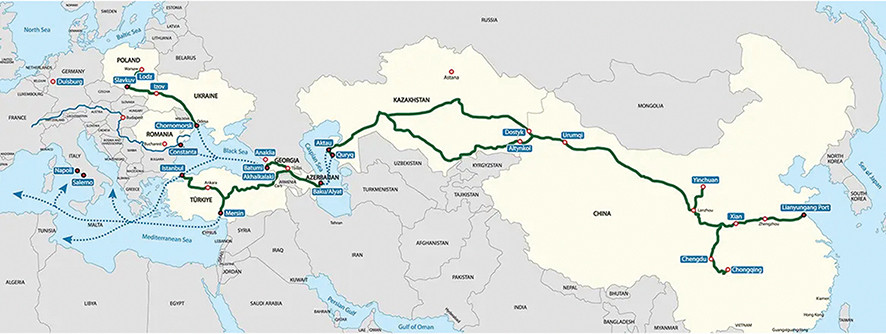
Azerbaijan’s role within CICA is not accidental. Since joining in 1999, Baku has consistently emphasized transportation corridors, connectivity, and security cooperation, areas where it holds both practical experience and geographic leverage. Sitting at the intersection of Europe and Asia, Azerbaijan has emerged as a bridge state, linking Central Asia’s landlocked economies with European markets through the Trans-Caspian International Transport Route, also known as the Middle Corridor. This infrastructure-driven diplomacy extends beyond trade. Energy pipelines, digital projects like the “Digital Silkway,” and the newly announced Caspian Green Energy Corridor give Azerbaijan tangible assets to offer its Asian partners. In a region where economic interdependence is increasingly seen as a hedge against conflict, such initiatives enhance Baku’s credibility as a promoter of stability.
Equally important is Azerbaijan’s accumulated multilateral experience. Having chaired the Non-Aligned Movement (NAM) since 2019 and hosted the COP29 climate summit in 2024, Baku has honed a style of leadership that blends activism with pragmatism. It has demonstrated the ability to elevate relatively quiet platforms, inject them with new ideas, and align them with global debates. If applied effectively, this skill set could help CICA transition from a dialogue club into a body with sharper institutional tools. Still, the environment in which Azerbaijan must operate is fraught with challenges. The Sino-Indian rivalry continues to cast a long shadow over Asian regionalism, frequently spilling into CICA discussions. India-Pakistan tensions—now exacerbated by disputes over water treaties and Kashmir—risk paralyzing multilateral initiatives. Meanwhile, external pressures ranging from Western sanctions on Russia to U.S.–China competition further complicate CICA’s ability to act with a unified voice. Added to this are nontraditional threats: climate change is intensifying water scarcity in Central Asia, cyberattacks are escalating as states digitize their economies, and terrorism remains an enduring concern from Afghanistan to the Middle East. These shared challenges underscore the value of confidence-building measures, but they also demand more than rhetorical commitments. Without mechanisms for implementation, CICA risks being overshadowed by nimbler groupings like the Shanghai Cooperation Organization (SCO). For Azerbaijan, the task is to keep CICA relevant by focusing on “low politics” areas such as transportation, trade, digital governance, and environmental security, where consensus is more attainable. By steering clear of divisive geopolitical debates, Baku can maximize the forum’s utility while gradually building the institutional foundations for deeper cooperation.
Baku has outlined several priorities that reflect both its national interests and CICA’s broader needs. First among them is connectivity. By championing transcontinental transport corridors, Azerbaijan can position CICA as a facilitator of economic interdependence. As Secretary General Kairat Sarybay has noted, “a better connected Asia is a better connected globe”—a message that resonates beyond the region. Second, Azerbaijan has emphasized energy cooperation, including green transition projects. The Caspian Green Energy Corridor, launched with Kazakhstan and Uzbekistan, exemplifies how shared infrastructure can bind countries together in mutually beneficial ways. Extending this vision to CICA could help embed environmental sustainability into the organization’s agenda. Third, digitalization offers fertile ground. Azerbaijan’s “Digital Silkway” initiative is not just about cables and data centers; it is about creating a new layer of interdependence across Eurasia. Promoting digital security as part of CICA’s confidence-building measures could enhance the organization’s relevance in a world increasingly shaped by cyber risks. Finally, Azerbaijan has introduced humanitarian themes such as demining into CICA’s discussions. For a country emerging from conflict, this is both a domestic priority and a noncontroversial issue that resonates with other members facing similar challenges. It is a way to project soft power while reinforcing CICA’s practical value.
Azerbaijan’s multilateral playbook draws heavily on its experiences in other organizations. Within the Organization of Turkic States, Baku has promoted institutionalization and connectivity projects that transformed the group from a loose consultation format into a more cohesive body. As NAM chair, Azerbaijan created youth and parliamentary networks that revitalized a once-dormant movement. And at COP29, Baku introduced climate–peace linkages that captured global attention. These precedents suggest that Azerbaijan’s leadership style is not about imposing grand visions but about building workable frameworks, often around youth, digital tools, and inclusive dialogue. Applying similar tactics to CICA could accelerate its transformation while avoiding the pitfalls of overreach.
Yet expectations must remain realistic. CICA is not destined to become an Asian NATO or OSCE, nor should it try. Its strength lies in being a forum for dialogue among diverse states, including adversaries, that would otherwise lack a structured platform to meet. For Azerbaijan, the risk is overloading the agenda with ambitious reforms that stall amid rivalries. Success will require patience, incrementalism, and the ability to mediate between conflicting interests. Still, even modest achievements can carry outsized significance. Expanding youth engagement through programs like a Model CICA, institutionalizing training for young diplomats, and enhancing digital platforms for cooperation may sound procedural, but they can lay the groundwork for deeper integration over time. If Azerbaijan can shepherd CICA toward adopting a formal charter by 2026, it will have left a legacy of institutional consolidation.
The significance of Azerbaijan’s chairmanship extends beyond Asia. At a time when global governance is under strain and Western-led institutions face legitimacy crises, non-Western platforms like CICA are gaining prominence. They may lack the power of enforcement, but they reflect the multipolar reality of international politics. For Azerbaijan, a state that has long navigated between East and West, the ability to give voice to this emerging order enhances its international profile and diversifies its partnerships. In the end, the measure of success will not be whether CICA resolves Asia’s conflicts—no single forum can—but whether it evolves into a more credible, coherent, and constructive actor in regional governance. If Azerbaijan can use its chairmanship to advance that cause, it will have demonstrated that even small states can shape the architecture of continental security.