Key Takeaways:
-
The article argues that Azerbaijan’s restoration of territorial integrity through the 2020 Second Garabagh War and the 2023 dismantling of separatist entities has consolidated its sovereignty and enabled a more independent, proactive foreign policy free of external patronage.
-
President Ilham Aliyev’s October 2026 speech is presented as outlining the need for continued military and ideological strength in an unstable international system, while highlighting Azerbaijan’s strategic partnerships with both the United States and China and its growing role in platforms such as the Organization of Turkic States.
-
Having moved beyond the constraints of the Armenia conflict, Azerbaijan is described as expanding its geopolitical identity across Europe, Asia, the Middle East, and the Black Sea region while remaining a consistent advocate of international law and a potential role model for other small states.
A state’s approach to its foreign policy stems from a combination of several factors. This includes its national interests, its geographic, historic and cultural characteristics, which can be referred to as its geopolitical identity and the broader status quo in the international system. With today’s system of inter-state relations experiencing real turbulence and undergoing a profound transformation, a state’s conviction in the underlying factors which determine its foreign policy activity is increasingly viewed as a major long-term strategic advantage. With the current international status quo often described through the Gramscian concept of an ‘interregnum’, whereby the older order is collapsing but a new one is yet to be formulated, national resilience and ‘geopolitical clarity’ are vital for any state aspiring for an effective foreign policy in line with its national interests.
Within this logic, the case of Azerbaijan stands out. Despite being territorially classified as a ‘small state’, Azerbaijan has acquired a substantial amount of geopolitical influence. This enables it to participate in regional and international processes in a highly active and increasingly decisive way. In recent years, this ascendancy has, naturally, prompted analysts to inquire into the country’s trajectory and assess the causes of the country’s geopolitical ascendancy. Despite the uniqueness and complexity of Azerbaijan’s individual path as a state, which includes enduring occupation and devastation, the explanation for the efficacy of its foreign policy approach lies in referring to simple, yet fundamental concepts for inter-state relations. As a country that placed the restoration of its sovereignty and territorial integrity as its undeniable priority, the complete fulfilment of this objective (first through victory in the Second Garabagh War in 2020 and later through dismantling separatist entities on its territory in 2023) has helped the country consolidate its vision of itself in an increasingly complex world.
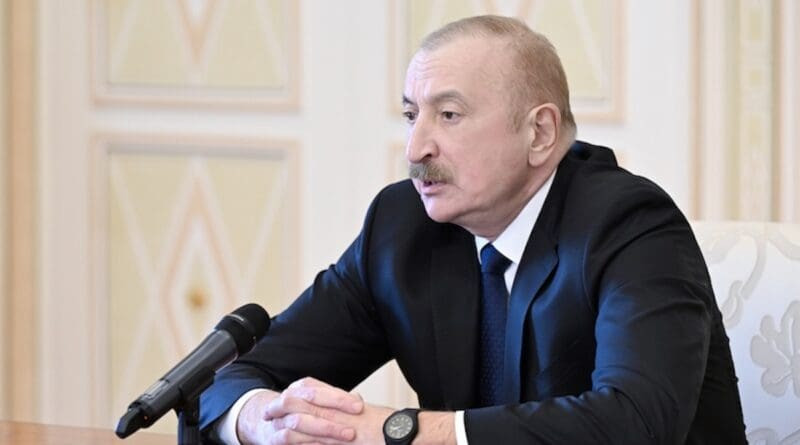
Most crucially, the end of the conflict with Armenia, which Azerbaijan had to resolve by military force, has granted the country long-term stimulus to continue the path which it has set for itself and its foreign policy. Within this context, President Ilham Aliyev’s latest speech at the 8th Congress of the New Azerbaijan Party sheds essential light on Azerbaijan’s vision for an essential question: what comes next? This concerns its place in the international system, the threats it faces, and the various steps needed for these threats to be mitigated. Most importantly, it demonstrates one of Azerbaijan’s most significant achievements – the country has managed to adhere to the fundamental principles of international law despite being the victim of military aggression and being surrounded by a uniquely complex geopolitical environment.
Azerbaijan’s path: from hardship to strength and sovereignty
Before delving into President Ilham Aliyev’s outline of Azerbaijan’s foreign policy and geopolitical priorities, it is crucial to take note of the process which has led the country to its current position. This particularly concerns its experiences in the aftermath of its independence from the Soviet Union in 1991. Occupation of around 20% of Azerbaijan’s internationally recognized territory by Armenia delivered a major blow for the country, its people, and its development, something which the President emphasized during his speech. As a consequence of the military aggression by its neighbour, Azerbaijan faced an extremely complex political and socio-economic situation, with more than a million Azerbaijanis forced to leave their homes. As noted by the President, this had almost immediate international consequences for Azerbaijan, with the country essentially forced into a period of “international isolation”. For precisely this reason, the restoration of sovereignty and territorial integrity was, in the words of the President, “the first of many goals” facing the Azerbaijani government.
Here, the role of former President and National Leader of Azerbaijan Heydar Aliyev is incontestable. Heydar Aliyev’s courageous political personality and his diplomatic mastery enabled him to withstand the various kinds of pressure facing Azerbaijan and its future as a state, reversing some of the failures of previous administrations. Through resolve and conviction in the righteousness of Azerbaijan’s position, Heydar Aliyev initiated a long but ultimately rewarding path during which Azerbaijan pursued, on all fronts possible, the restoration of its sovereignty and territorial integrity. This included economic development through the attraction of international investment, the strengthening of the country’s military strength and the fostering of national unity. This cause, which, as explained during the speech, was Azerbaijan’s ultimate and national objective, was fully accomplished in 2023. Although the country remains well aware of the past, with some consequences of the conflict still being felt on a daily basis, Azerbaijan’s military victory set the foundation for a new future – one of strength, stability, growth and prosperity. Hence, without forgetting the past and the suffering endured, the country is now looking forward and embracing a new reality.
For this reason, President Aliyev’s October 2026 speech can be characterized as a fundamental ‘stepping stone’ for the long-term trajectory of Azerbaijan and its development. Having elaborated on the historic significance of Azerbaijan’s victory, the President stressed the importance of remaining alert in the face of the challenges which every state in the international system faces today. In outlining “the tasks that lie ahead”, President Aliyev underlined the continued importance of strength, both military and ideological. In today’s world, one simply cannot afford to show any kind of weakness in those crucial areas. This is particularly applicable to states which find themselves in complex regional environments, which evidently applies to Azerbaijan. Conflicts to the country’s north and south, persisting uncertainties vis-à-vis the political direction of neighbouring Armenia, as well as clear ideological threats which are intensifying and broadening in nature, leave Azerbaijan with no choice other than to further strengthen the power which it has already acquired.
In earlier remarks, President Ilham Aliyev already emphasized the unparalleled importance of strength and power in contemporary international affairs. In fact, in an interview earlier this year, the President labelled the current period of international affairs as one increasingly governed by the ‘rule of strength’. This message also resonates in the latest speech and serves as an important message for states which may be considered as similar (in territory and size) to Azerbaijan.
It is no coincidence that the President described Azerbaijan as a ‘role model’ for countries around the world. The attention being received from abroad for Azerbaijan’s handling of its foreign policy is both clear and revealing. The ability to develop comprehensive strategic partnerships with the international system’s two major players, namely the United States and China, whilst maintaining neutrality is an important feat. Cooperation with several other actors, including strategic partnerships with 10 European countries (with the United Kingdom soon to join this list) and numerous multilateral platforms, highlights Baku’s ability to engage with actors in pursuit of concrete and mutually beneficial outcomes.
Most importantly, Azerbaijan’s activities in such settings increasingly influence and even shape outcomes. Participation in the Consultative Meetings of the Heads of State of Central Asia and the assumption of greater responsibility in the Organization of Turkic States (OTS) reflect this reality. By consistently avoiding alignment with a particular geopolitical camp or superpower, the country ensures complete control over the implementation of its national interests.
The concept of having ‘powerful backers’, as explained by President Aliyev, does not apply to Azerbaijan. It is independent in the decisions it makes, both domestically and in terms of its external relations. In contemporary international affairs, this is an indispensable trait to possess and one which is not earned lightly. In the words of President Aliyev, acting independently in the status of a small state is a feat reachable by few. However, once achieved, one’s ability to confront existing risks and ensure stability is significantly greater in comparison to those states that do not have complete control over their foreign policies.
Geopolitical identity
President Ilham Aliyev’s diagnosis of the dynamics which define contemporary international affairs revolves around one underlying concept – the indispensability of strength to guarantee long-term security. In Azerbaijan’s case, the liberation of its territories and the ongoing peace agenda with Armenia, which Baku initiated, have already guaranteed the country some degree of stability and certainty. However, and as hinted by President Aliyev, this cannot be a cause for relaxation. Azerbaijan’s foreign policy must continue evolving in line with the spirit which has characterized it since the resolution of the decades-long conflict with Armenia – proactiveness.
To a considerable extent, this is already at the heart of Azerbaijan’s engagement with various regions. As explained by Hikmet Hajiyev, Assistant to the President of the Republic of Azerbaijan, the period when Azerbaijan’s international outlook was determined by a concrete ‘geopolitical framework’ is over. During the conflict with Armenia, significant efforts were directed at countering harmful narratives against Azerbaijan and raising awareness of the illegal occupation, both in bilateral engagements with other states but also on multilateral platforms.
Moreover, given the deadlock which emerged in the South Caucasus as a result of the conflict, Azerbaijan was unable to maximize its unique geographic position, widely acknowledged as a major strategic advantage. With the conflict now over and necessary steps being implemented to ensure lasting stability, Azerbaijan has arrived at a point at which it is able to actively widen its ‘geopolitical identity’. This concept does not have a sole definition in literature but can be explained as the way a country views itself and its role in the world.
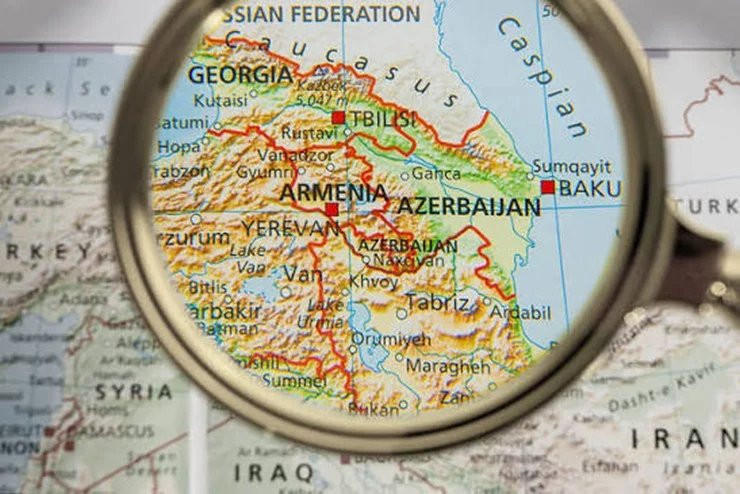
A combination of a country’s geographic position, its history, culture and positions on political issues all determine this vision. Azerbaijan has already overcome the period in its history when its identity was constrained by certain factors. Today, the country is in a position to pursue a multifaceted geopolitical identity. In addition to an affiliation to its immediate region, Azerbaijan’s influence is increasingly felt across Europe, Asia, the Middle East and Black Sea regions.
Increasingly, the country is also viewed as a reliable mediator in complex relationships, highlighting its growing strategic weight beyond its immediate region. This underlines the trust the country has already acquired on the international stage. The backbone of this, undoubtedly, remains its ‘independence in action’, a trait which Azerbaijan and its government developed through years of resistance, strategic planning and implementation.
Conclusion: an invaluable lesson
President Aliyev’s speech can be interpreted as an important message to the international community. This message emphasizes the importance of the balance which the country has managed to achieve in its foreign policy in recent years. The country is a relentless advocate of international law, as shown by its approach to more than one ongoing conflict in its wider neighbourhood. It has historically supported peace and restraint, even though it was left with no choice but to rely on military force given the inability of international mechanisms to force the end of the occupation of its territory.
However, at the same time, Azerbaijan’s assessment of current realities is extremely realistic and pragmatic. The country recognizes the risks that it faces and is prepared to act proactively in their mitigation. This is among the main takeaways from President Aliyev’s speech – Azerbaijan is fully independent and can resolve its own issues by itself, without ‘patronage’ or ‘backing’. This includes ongoing efforts to discredit the country’s image, with European Parliament resolutions and forces in specific countries working tirelessly toward this objective.
These efforts, however, fail to recognize what President Aliyev’s speech demonstrates so flawlessly: Azerbaijan has developed the perfect arsenal any (territorially) ‘small state’ must possess in today’s international system if its goal is survival on its own terms, long-term prosperity and development. It possesses ideological and geopolitical clarity, the foundation of which is its restored sovereignty and territorial integrity. Paradoxically, in a system of international relations where fundamental principles are often overlooked and implemented inconsistently, the states that most relentlessly support their implementation will emerge as the most stable and successful. Azerbaijan’s experience in recent years supports this hypothesis.
https://www.eurasiareview.com/18102026-azerbaijan-overcoming-the-past-embracing-the-future-oped/