Executive Summary:
-
Azerbaijan connected the 100-megawatt Gobustan solar plant to the grid on September 16, adding to a rapidly expanding renewable sector that Baku says will reduce domestic gas consumption and support its electricity and gas exports.The renewable build-out builds on Azerbaijan’s gas-based energy strategy, with the United Arab Emirates’ Masdar, Saudi Arabia’s ACWA Power, the People’s Republic of China’s Universal Energy, and SOCAR Green developing major solar and wind projects.
Baku’s green energy strategy aims to meet rising domestic electricity demand, export renewable electricity, and free up natural gas for export, with new generation capacity and planned connections to Türkiye and Europe designed to advance all three objectives.
On September 20, Azerbaijan marked the thirty-second anniversary of the 1994 “Contract of the Century,” the $7.4 billion production-sharing agreement that brought eleven international oil companies from seven countries into Baku to develop the Azeri–Chirag–Gunashli fields (President of Azerbaijan, accessed September 28). Signed under former Azerbaijani President Heydar Aliyev just under three years after Azerbaijan regained independence, the agreement anchored the country’s modern oil strategy and eventually turned it into a major supplier of gas to Europe through the Southern Gas Corridor. Four days earlier, on September 16, Azerbaijani President Ilham Aliyev inaugurated the Gobustan solar power plant, indicating a new chapter in Baku’s energy strategy over the next decades.
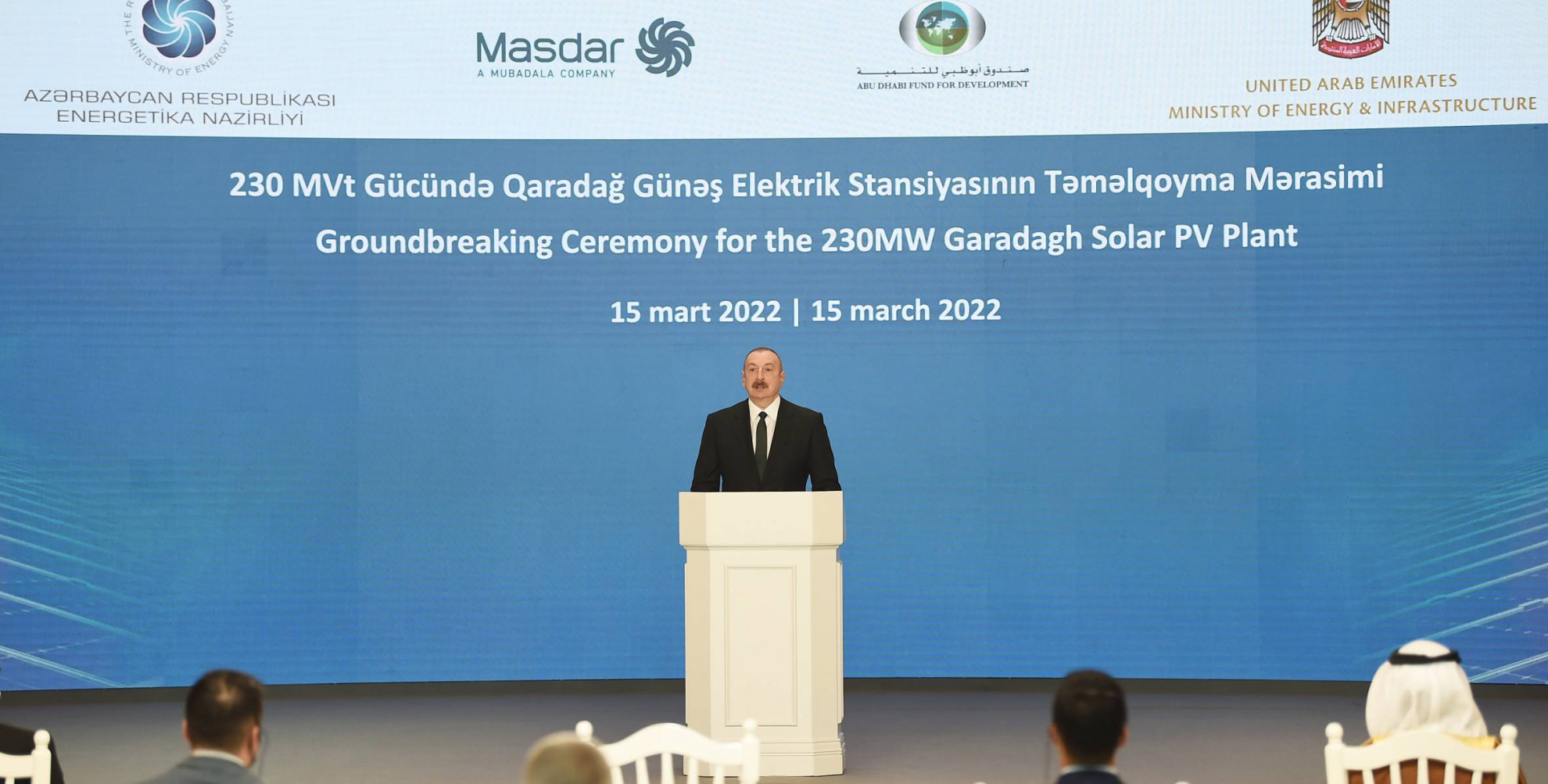
Azerbaijan connected the new 100-megawatt (MW) Gobustan solar power plant, built on 300 hectares in the Garadagh district outside Baku, to its grid on September 16. The Ministry of Energy projects it will generate about 260 million kilowatt-hours a year, saving 57 million cubic meters of natural gas annually and cutting carbon emissions by 124,000 tons (Azerbaijani Ministry of Energy, September 17). The plant was developed by the People’s Republic of China’s (PRC’s) Universal International Holdings Limited, the winner of Azerbaijan’s first renewable energy project auction in 2024 (Trend.az, September 18). According to Azerbaijan’s Ministry of Energy, its commissioning brought the country’s total installed renewable capacity to 2,170 MW across 85 plants, which is about 21.5 percent of Azerbaijan’s total generation capacity (Azerbaijani Ministry of Energy, September 17). Baku intends its green energy program to cover rising domestic electricity demand, export renewable power, and free up natural gas for export rather than burning it at home.The logic connecting these three goals is straightforward. Azerbaijan’s power sector has historically run almost entirely on gas. Every MW-hour produced by a solar or wind plant is a MW-hour of gas that does not have to be consumed domestically and can instead be sold abroad. Gas exports to Europe totaled 12.8 billion cubic meters in 2025, Azerbaijan’s Energy Ministry says, against a standing target of 20 billion cubic meters a year by 2027. Aliyev describes this as Baku’s “commitment” to the European Union (President of Azerbaijan, July 19, 2024; AZERTAC, January 12). When Aliyev broke ground on the Garadagh solar plant in 2022, he said that Azerbaijan has “great potential in terms of electricity exports” (President of Azerbaijan, March 15, 2022). Every new renewable MW built since has strengthened that argument, giving Azerbaijan’s green energy push economic, strategic, and environmental benefits.Baku’s investment in renewables is considerable. Beyond Gobustan, the United Arab Emirates’ Masdar has operated the 230-MW Garadagh solar plant in Azerbaijan since October 2023, the country’s first foreign-invested independent solar project. At the plant’s inauguration, Aliyev called Masdar’s involvement an “outstanding contribution to the development of Azerbaijan” (President of Azerbaijan, October 26, 2023). Masdar’s broader “Mega” project with the State Oil Company of the Republic of Azerbaijan (SOCAR) Green, the company’s renewable energy subsidiary established in 2024, now covers a further 445 MW of solar capacity at Bilasuvar, 315 MW at Neftchala, and 240 MW of wind at Absheron and Garadagh (Trend.az, April 7, 2025). Financing for these projects closed at COP29 in November 2024, and construction began with the installation of the first solar panel at Bilasuvar in October 2025 (Azerbaijani Ministry of Energy, November 16, 2024, September 22). Saudi Arabia’s ACWA Power, present in the market since 2019, commissioned its own 240-MW Khizi-Absheron wind farm on January 8, which it expects to generate about a billion kilowatt-hours a year (Trend.az, January 8).With hydropower still accounting for most of Azerbaijan’s installed renewable capacity and an economic renewable energy potential the energy ministry puts at 27 gigawatts (GW), including 23,000 MW of solar, Azerbaijan is working toward a target of raising renewables to at least 30 percent of the energy mix by 2030 and reducing emissions by 40 percent by 2050 (Azerbaijani Ministry of Energy, September 17). The ministry has set a target of commissioning more than 2 GW of green energy capacity as part of a first development phase running through 2027. Beyond Gulf-backed mega-projects, this initiative includes smaller ventures such as the 25-MW Shams 1 and 25-MW Garbi Ufug solar plants agreed for Nakhchivan in February with CEI Nakhchivan LLC and Enerso LLC. Both companies are outside the Masdar–ACWA–SOCAR Green circle (Azerbaijani Ministry of Energy, September 17). A separate green energy framework covers the Karabakh and East Zangezur regions (Azerbaijani Ministry of Energy, September 17). Within it, 38 hydropower plants with a combined 307 MW are already operating, with 11 more totaling 48.5 MW under construction, alongside more than eight MW of rooftop solar installed across some 2,500 homes and public buildings (Azerbaijani Ministry of Energy, September 17). In the Jabrayil district, solar capacity, including the 240-MW Shafag plant, has reached a combined 340-MW capacity (Azerbaijani Ministry of Energy, September 17). SOCAR Green functions as the domestic anchor across the largest of these ventures, pairing Masdar and ACWA Power’s capital and technology with local infrastructure and regulatory access.Azerbaijani and Turkish officials describe three parallel projects now moving through implementation, each intended to give Europe access to carbon-neutral electricity from the Caspian region (Trend.az; AZERTAC; Anadolu Agency, September 11). The first would integrate Nakhchivan’s grid with Türkiye, eventually linking through to mainland Azerbaijan via the Trump Route for International Peace and Prosperity (TRIPP) in southern Armenia (Trend.az, September 11; Anadolu Ajansı, September 11; Azerbaijani Ministry of Energy, September 17). The second is a four-country green corridor connecting Azerbaijan, Georgia, Türkiye, and Bulgaria. A founding memorandum was signed in April 2025, and officials now hope to crown it with a full intergovernmental agreement at COP31 in Antalya this November (Trend.az; APA, September 11). The third and most ambitious is the Black Sea Energy Corridor, a 1,195-kilometer (743-mile) submarine cable linking Azerbaijan and Georgia to Romania and onward to Hungary, initially rated at 1,000 MW with capacity envisaged to rise in phases to as much as 3.9 GW by 2032 (Trend.az, March 3, June 1). Agreed among the four governments in Bucharest in December 2022, the project has been included in the European transmission operators’ Ten-Year Network Development Plan for 2026, with a cost-benefit assessment due by year’s end. Together, these three projects would make Azerbaijan a renewable electricity exporter to Europe in much the same way it is already a gas exporter.In 1994, foreign capital arrived to build an oil industry that did not yet exist in Azerbaijan. Today, Gulf partners such as Masdar and ACWA Power, alongside developers from the PRC such as Universal Energy, are financing most of the renewable build-out. Western companies, with the partial exception of BP’s stake in the 240-MW Shafag solar plant in Jabrayil, have so far stayed largely on the sidelines despite years of dialogue through forums such as the Azerbaijan–U.S. Green Energy Forum (Azerbaijani Ministry of Energy, March 31, 2023; President of Azerbaijan, May 9). Their involvement will impact the standards and governance of an energy corridor that will mainly benefit Europe.
https://jamestown.org/azerbaijan-expands-green-energy-production/