Key Takeaways
-
Azerbaijan and Germany elevated ties to a strategic partnership during President Aliyev’s July 2026 Berlin visit. The signed Joint Declaration covers politics, energy, security, trade, connectivity, defense, education and culture, moving beyond traditional energy links.
-
Energy and the Middle Corridor form the core of the upgraded relationship. Azerbaijan supplies gas and potential green electricity to Germany, while its Caspian position offers Europe a resilient transport route bypassing Russia.
-
The partnership reflects wider European diversification needs. Amid the Ukraine war and shifting Eurasian geopolitics, Azerbaijan gains as a reliable energy and connectivity partner, with Germany providing technology, investment and EU leverage.
President Ilham Aliyev’s official visit to Germany on 20-21 July 2026 marked an important milestone in Azerbaijan-Germany relations. Taking place amid a rapidly changing geopolitical environment in Europe and across wider Eurasia, the visit demonstrated that relations between Baku and Berlin are moving beyond their traditional economic and energy foundations towards a broader strategic partnership.
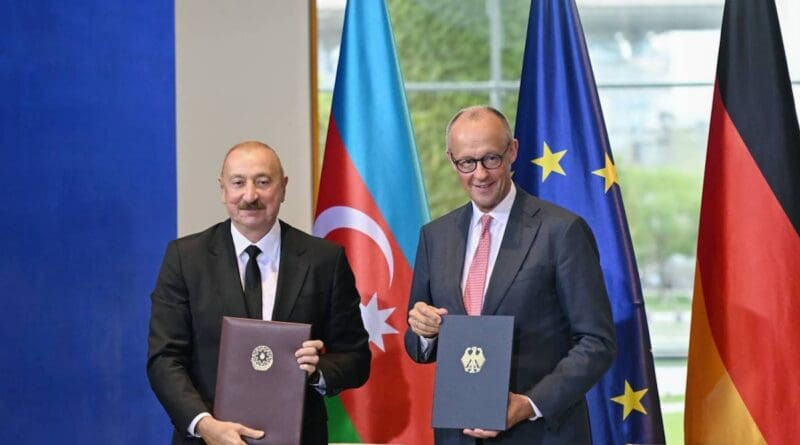
The most tangible outcome of the visit was the signing by President Ilham Aliyev and Federal Chancellor Friedrich Merz of the Joint Declaration on a Strategic Agenda for the Bilateral Partnership between the Republic of Azerbaijan and the Federal Republic of Germany. The declaration establishes a comprehensive framework for cooperation across political and diplomatic, economic and trade, security and defense, cultural and educational, and scientific and technological fields. It envisages regular consultations and high-level political dialogue, while placing particular emphasis on trade and investment, green energy and hydrogen, energy efficiency, connectivity and infrastructure, and natural gas supplies. The agenda also extends to defense-industry cooperation, mine action, digital transformation and industrial modernization, as well as culture, education, academic exchanges and people-to-people contacts. Taken together, these areas demonstrate an effort to broaden Azerbaijan-Germany relations beyond their traditional economic and energy foundations and place them on a more diversified and institutionalized footing. A second document, the Joint Declaration on the Establishment of the Azerbaijan-Germany Business Council, adds a practical economic mechanism to this broader strategic framework. The Council is expected to serve as a permanent platform for dialogue between state institutions and business representatives, promote investment projects, facilitate the resolution of issues of mutual interest and identify new areas of cooperation. It could also encourage greater participation by German companies in economic projects in Azerbaijan while helping Azerbaijani businesses strengthen their presence in the German market.
The foundations of Azerbaijan-Germany relations reach back more than two centuries. In 1818–1819, German settlers established some of their earliest communities in Azerbaijan, including Helenendorf, present-day Goygol, and Annenfeld, present-day Shamkir. In 2017, Azerbaijan marked the 200th anniversary of German settlement in the South Caucasus by presidential decree. Economic contacts have similarly deep roots. During the nineteenth century, the Siemens brothers became involved in copper mining in Gadabay, bringing German technology and industrial expertise to Azerbaijan decades before modern diplomatic relations emerged.
Following the restoration of Azerbaijan’s independence, Germany recognized the country in January 1992, with diplomatic relations established the following month. President Heydar Aliyev’s first official visit to Germany in 1996 marked an important milestone in the development of bilateral ties. His successor, President Ilham Aliyev, made his first official visit in 2004, and since then high-level contacts between the two countries have steadily intensified. Significantly, his July 2026 visit took place 30 years after President Heydar Aliyev’s first official visit to Germany, underscoring the continuity of high-level political dialogue between Baku and Berlin.
It is important to note that energy has been one of the strongest pillars of this relationship. Azerbaijan has long supplied crude oil to Germany, while cooperation subsequently expanded into natural gas. A significant milestone came in 2013, when SOCAR and German energy company Uniper concluded a long-term gas supply contract. Under the agreement, Uniper can receive up to 1.5 billion cubic meters of Azerbaijani gas annually through the Southern Gas Corridor, with the contract running until 2045. Russia’s war against Ukraine significantly increased the strategic value of this cooperation. Diversification of suppliers has become not merely an economic preference for Europe but a strategic necessity. Azerbaijan exported approximately 25 billion cubic meters of natural gas in 2025, roughly half of which went to European Union countries. The expanding geography of these exports has strengthened Azerbaijan’s role as an important supplier contributing to European energy security. During the Berlin visit, Chancellor Merz explicitly stressed Germany’s interest in diversifying its energy imports and identified Azerbaijan as an attractive partner for German energy security. This reflects a broader transformation in perceptions of Azerbaijan: the country is increasingly viewed not simply as a hydrocarbon producer but as a reliable component of Europe’s long-term energy architecture.
The future of bilateral energy relations may also increasingly extend beyond hydrocarbons. Azerbaijan possesses considerable renewable-energy potential, particularly offshore wind resources in the Caspian Sea, and aims to become an exporter of green electricity. Projects connecting the Caspian with European electricity markets could eventually create opportunities for Azerbaijani renewable energy to reach Germany. Germany’s technological expertise and its own energy transition provide scope for cooperation in renewable electricity, green hydrogen and related infrastructure.
Energy is embedded within a broader economic relationship. Azerbaijan is Germany’s largest economic partner in the South Caucasus, with bilateral trade turnover reaching approximately €1.7 billion in 2025. Azerbaijan primarily exports crude oil and other energy products to Germany, while German exports include machinery, vehicles, industrial equipment, electrical products and pharmaceuticals. This structure highlights the complementary nature of the two economies: Germany brings advanced technology, industrial expertise and investment capacity, while Azerbaijan offers energy resources, expanding commercial opportunities and a strategically important position in the South Caucasus. The institutional foundation is already well established. The German-Azerbaijani Chamber of Commerce (AHK Azerbaijan) is the only German Chamber of Commerce Abroad in the South Caucasus, while the new Business Council envisaged by the signed declaration could further encourage investment and business-to-business cooperation.
Alongside energy, connectivity is emerging as another strategic pillar of the relationship. Azerbaijan occupies a central position along the Middle Corridor linking Central Asia across the Caspian Sea with Türkiye and European markets. Years of investment in ports, railways, highways and logistics infrastructure are acquiring greater geopolitical value as Europe seeks more resilient and diversified trade routes. For Germany, the importance of this corridor has grown amid the Russia-Ukraine war, which has undermined the reliability of traditional northern routes through Russia, while continuing instability in the Middle East has highlighted the vulnerabilities of other major trade arteries. The Middle Corridor therefore offers an increasingly important alternative that bypasses Russia and connects Europe with the markets and resources of Central Asia. As Chancellor Friedrich Merz noted during President Aliyev’s visit, “The importance of the South Caucasus as a bridge between Europe and Asia is also growing. New transport and trade corridors create economic potential that we want to utilize jointly.” This German interest forms part of a broader European shift towards greater connectivity with Central Asia through the South Caucasus. During European Commission President Ursula von der Leyen’s recent visit to Baku, the European Union announced its “Peace through Connectivity Package,” providing up to €200 million in grant funding and aiming to leverage up to €2 billion in investments to enhance regional connectivity, signaling growing European interest in transport links through the South Caucasus. The Middle Corridor thus creates a convergence between Germany’s interest in resilient supply chains and Azerbaijan’s ambition to consolidate its position as a Eurasian transport and logistics hub. Azerbaijan’s importance for Germany and Europe is therefore becoming multidimensional. The country can simultaneously contribute to European energy diversification and East-West connectivity, two priorities that have become considerably more important in the present geopolitical environment.
Bilateral relations nevertheless extend beyond economics. The German Academic Exchange Service (DAAD) has long provided opportunities for Azerbaijani students, academics and researchers, while German-language education and activities associated with the Goethe-Institut have contributed to cultural interaction. Further university partnerships and scientific exchanges can strengthen the societal foundations of the emerging strategic partnership.
Regional peace is another area where Azerbaijani and German interests increasingly converge. Germany has supported the normalization process between Azerbaijan and Armenia and contributed to diplomatic efforts by hosting negotiations between the two countries at the level of foreign ministers. During his visit to Berlin, President Aliyev specifically expressed appreciation for Germany’s contribution to the peace process and highlighted the practical steps that have followed the progress achieved between Baku and Yerevan. For both Azerbaijan and Germany, sustainable peace in the South Caucasus would not only strengthen regional stability but also create more favorable conditions for investment, trade and connectivity between Europe and the wider Caspian and Central Asian region.
From an international-relations perspective, the partnership also reflects the growing importance of geoeconomics and strategic diversification. Energy supplies, transport corridors, investment and technology are no longer purely commercial matters but increasingly instruments of strategic resilience and geopolitical influence. Germany seeks to reduce excessive dependence on individual energy suppliers and transport corridors. Azerbaijan, meanwhile, demonstrates how a rising middle power can translate geographic position, energy resources and connectivity into wider political influence. Security in this context is increasingly pursued not only through military capabilities but also through resilient supply chains and diversified economic partnerships.
These dynamics are part of a broader geopolitical transformation. Russia’s war against Ukraine has reshaped Europe’s security and energy environment, tensions in the Middle East have increased concerns about energy and transport routes, and Central Asia is acquiring greater weight in European calculations. Together, these developments are increasing the strategic importance of the South Caucasus. Within this changing landscape, Azerbaijan combines several assets increasingly relevant to Europe: energy resources, infrastructure connecting the Caspian with European markets, a central position on the Middle Corridor and growing regional political weight. Germany, in turn, offers Azerbaijan investment, advanced technology, industrial expertise and access to Europe’s largest economy. Moreover, as one of the EU’s leading powers, Germany can also contribute to the further development of Azerbaijan’s relations with the European Union.
President Aliyev’s Berlin visit should therefore be viewed as more than another episode in bilateral diplomacy. The two declarations signed in Berlin brought several strands of cooperation developed over decades under a broader strategic framework. The next challenge is implementation: expanding conventional and green-energy cooperation, attracting German investment, strengthening participation in the Middle Corridor and deepening technological, educational and scientific ties. As Europe searches for diversified energy supplies, resilient transport corridors and reliable partners, Azerbaijan’s importance is growing accordingly. The Strategic Agenda gives Baku and Berlin an opportunity to turn this convergence of interests into a durable partnership. If effectively implemented, Azerbaijan-Germany relations may be entering their most consequential period since the establishment of diplomatic relations.