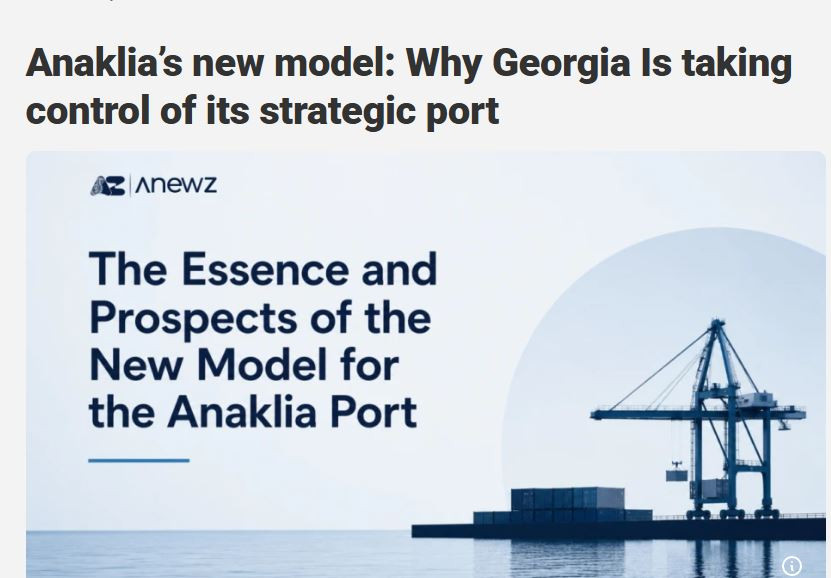
The Anaklia deep-sea port project has returned to Georgia's strategic agenda under a fundamentally different model. The move reflects the growing importance of Georgia's role in the Middle Corridor following Russia's full-scale invasion of Ukraine.
The project was first awarded to the Georgian-American Anaklia Development Consortium in 2016, but the government terminated the agreement in 2020 after years of delays and disputes.
In 2024, a Chinese-Singaporean consortium was identified as the preferred private partner, while the Belgian company Jan De Nul secured the contract for dredging and breakwater construction. However, the final investment agreement with the consortium was never signed. The government has now abandoned a structure centred on a single dominant investor.
On 6 July, Economy Minister Mariam Kvrivishvili announced that the Georgian state would develop and retain ownership of Anaklia under a landlord port model. International companies and partner countries will be invited to participate as terminal operators and commercial partners, but they will not acquire ownership of the port's core infrastructure.
The decision follows a review commissioned in April 2026 from Port Consultant Rotterdam, which examined alternatives to the existing master plan, including full state implementation. Georgia has now chosen the state-led option.
What the landlord model changes
Under the landlord port model, the state owns the land, breakwater, access channel and other core maritime infrastructure. It also provides the road and railway connections needed to integrate the port into the national transport system. Private operators invest in, equip and manage individual terminals under long-term agreements.
his separation is significant. It allows Georgia to retain control of strategic infrastructure while attracting capital, expertise and cargo from multiple international partners. Rather than tying Anaklia's future to a single shareholder, the government can work simultaneously with operators and cargo owners from China, Azerbaijan, Kazakhstan, Uzbekistan and other Middle Corridor countries.
The model could also strengthen Anaklia's commercial prospects. Ports do not succeed simply because concrete is poured or cranes are installed. They succeed when cargo owners, shipping lines, rail operators and terminal companies have a lasting commercial reason to use them. A broader partnership structure may give more countries a direct interest in moving freight through Anaklia.
The approach is well established. Variations of the landlord port model are used at major ports including Rotterdam, Antwerp-Bruges, Hamburg and Houston. Public authorities retain control of strategic assets, while specialised companies compete to operate terminals and provide services.
Why Anaklia matters to the Middle Corridor
The Anaklia project has become increasingly important as Eurasian trade routes adapt to war, sanctions and wider disruption. The Middle Corridor links China and Central Asia with Europe through the Caspian Sea, Azerbaijan, Georgia and Türkiye. Its appeal has grown because it provides an alternative to routes passing through Russia.
Georgia's Black Sea ports are the corridor's western gateway. Anaklia's deep-water capacity could enable the country to handle larger vessels and greater cargo volumes than its existing ports can accommodate. However, the port will only fulfil that role if it is efficiently connected to Georgia's railways, highways and onward maritime routes.
The government says it plans to invest around $7 billion in strategic transport infrastructure by 2032. The programme includes Anaklia, the modernisation of Georgian Railways and the completion of major highways. This wider investment is critical because a port cannot function as an isolated asset. Its value depends on the speed and reliability of the transport network behind it.
The government has specifically welcomed investment from Azerbaijan, Kazakhstan, Uzbekistan and China. Their involvement would be commercially significant, as these countries are not only potential investors but also major sources of cargo and regional connectivity. Bringing them into the operating structure could help transform Anaklia from a national construction project into a shared regional logistics hub.
What remains unchanged
The overall investment estimate for the port remains about $1.1 billion, although the allocation of responsibilities is changing. The state will continue to finance and oversee the breakwater, dredging, railway connection and access highway. International and private investors will be expected to develop container, bulk and other terminal facilities.
The government has also stated that shares in the port will not be sold. International companies will participate through terminal management and operating agreements rather than equity ownership in the core port company.
Marine construction is already under way. Georgia originally signed a contract worth about $203.9 million with Jan De Nul for dredging and breakwater works. In 2026, the government announced that renegotiation had reduced the cost by approximately $52.5 million without changing the stated technical specifications of the project.
Under the previous framework, the state was expected to hold a 51% stake in the project, while the private investor would own 49%. The new structure replaces that joint ownership arrangement with full state ownership of the strategic infrastructure and private participation at terminal level.
Why the government changed course
The shift reflects both economic experience and geopolitical caution. Previous development models placed heavy responsibility on a single private consortium. When financing, political relations or contractual negotiations stalled, the entire project stalled with them.
A landlord port model spreads that risk. The state provides the core infrastructure and strategic direction, while multiple operators can participate across different commercial segments. If one negotiation fails, it need not halt the entire project.
The model also addresses a broader question: who controls infrastructure that may shape Georgia's economic and geopolitical position for decades? By retaining ownership, the state can protect national interests, regulate access and avoid dependence on a single foreign shareholder.
However, state ownership is not in itself a guarantee of success. While public control can protect sovereignty, it can also expose a project to budget pressures, procurement delays, political interference and weak commercial discipline. The decisive factor will not simply be ownership, but governance.
Anaklia will require transparent procurement, professional port management, predictable rules for investors and credible long-term commitments from successive governments. Without those safeguards, the landlord port model could become another administrative framework surrounding an unfinished project.
A strategic test for Georgia
Anaklia is no longer simply a port construction project. It is a test of whether Georgia can combine state control with international participation, and national strategy with commercial logic.
The new model gives Tbilisi greater flexibility to balance competing interests. It can welcome Chinese investment without handing the entire project to a Chinese-led consortium. It can invite Azerbaijan and Central Asian partners to support the port as cargo owners and operators, while also preserving opportunities for European and other international companies.
That flexibility may prove to be the model's greatest strength. The Middle Corridor is not owned by any single country, and Anaklia should not depend on a single partner. Its future lies in becoming a platform where several countries and companies share a common interest in reliable transit.
The government has chosen a model designed to protect strategic ownership while broadening commercial participation. Whether it succeeds will depend on implementation: financing the infrastructure, completing the transport links, securing credible operators and attracting sustained cargo volumes.
If Georgia can meet those tests, Anaklia could strengthen not only its own position as a transit hub but also the wider Middle Corridor. If it cannot, the change in model will amount to little more than another chapter in the port's long history of delays.
https://anewz.tv/opinion/news/21875/anaklia-adopts-new-state-led-port-model/news