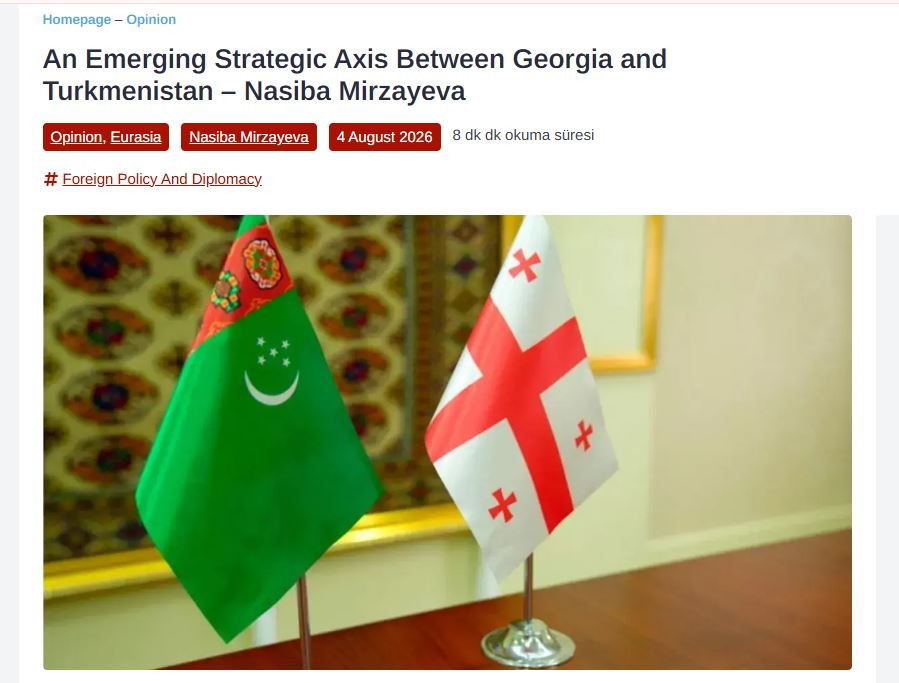
Relations between Tbilisi and Ashgabat are taking on new geopolitical content against the backdrop of Irakli Kobakhidze’s recent visits to Ashgabat. The Georgia-Turkmenistan Business Forum, organized jointly by the Georgian Chamber of Commerce and Industry and the Chamber of Commerce and Industry of Turkmenistan, was held in Tbilisi, coinciding with the 35th anniversary of the establishment of diplomatic relations between the two nations in July. During the bilateral meetings, the parties explored new avenues for cooperation, exchanged institutional expertise, and discussed the prospects of executing joint investment and commercial projects. The forum placed a strong emphasis on strengthening economic ties, highlighting various facets of trade, such as the exchange of manufactured goods. Furthermore, the discussions addressed the strategic significance of developing the “Middle Corridor,” a vital transport route connecting Asia and Europe, and the potential to attract additional cargo flows through this network.
To deepen economic and technological cooperation, Georgia and Turkmenistan signed a bilateral memorandum of understanding (MoU). This agreement outlines the future advancement of industrial cooperation between the Ministry of Economy and Sustainable Development of Georgia and the Ministry of Industry and Construction Operations of Turkmenistan. According to an official statement by the Ministry, the document aims to cultivate partnerships in the construction industry, high technologies, research and development (R&D), innovation, and technical regulation. Alongside this, a memorandum of cooperation in the field of healthcare was signed during the visit. As reported by the Ministry of Health, this document facilitates the exchange of knowledge and expertise in medical sciences, while also planning joint projects in medical education and healthcare tourism.
Georgia and Turkmenistan also reached an agreement on the mutually beneficial utilization of their respective Black Sea and Caspian Sea port infrastructures, as well as the further development of the “TRACECA” and “Lapis Lazuli” transit corridors. During a joint briefing with Prime Minister Irakli Kobakhidze, the President of Turkmenistan, Serdar Berdimuhamedov, who was making his first official visit to Georgia, stated that the bilateral logistics portfolio encompasses highly promising projects. He noted that in addition to the transport sector, both nations intend to deepen partnerships in energy, telecommunications, textiles, and construction.
Notably, Prime Minister Kobakhidze visited Turkmenistan three times last year. He emphasized that the newly concluded agreements will further fortify the existing ties between Georgia and Turkmenistan. Broadly speaking, Central Asia represents a region of particular interest for Georgia, within which Turkmenistan is viewed as a reliable partner and a friendly state.
Bilateral Economic Relations
Since the inception of diplomatic relations, significant strides have been made between the two nations based on mutual interest and practical cooperation. Turkmenistan is keenly interested in integrating into regional trade networks through cargo transit across Georgian territory and the development of warehousing infrastructure. Consequently, the priority areas of mutual engagement focus on implementing large-scale regional and international transport and energy projects.
Georgia’s primary exports to Turkmenistan include poultry, pharmaceuticals, automobiles, and alcoholic beverages. Conversely, key imports from Turkmenistan comprise petroleum and petroleum products, coke, fertilizers, gypsum-based products, and cargo trucks. The enhancement of bilateral ties in the tourism sector also remains a focal point. Speaking at an event in Ashgabat dedicated to the 34th anniversary of Georgia’s independence, the Georgian Ambassador to Turkmenistan, Konstantin Sabiashvili, expressed Georgia’s readiness to expand tourism cooperation with Turkmenistan. He highlighted the ambition to establish direct flights, underscoring that Turkmenistan represents a vital tourism market for Georgia. The favorable geographic positions and shared attributes of both countries create highly conducive conditions for bolstering ties in this domain.
The Turkmenistan-Georgia Intergovernmental Commission on Economic Cooperation plays a pivotal role in intensifying this partnership. During the commission’s 2023 session in Tbilisi, the parties identified energy, transport, agriculture, and trade-economic ties as priority tracks for strengthening cooperation. They evaluated opportunities to expand investment collaboration and implement joint projects focused on transport, logistics, and energy infrastructure. Additionally, the Intergovernmental Commission designated further development in science, education, and tourism as key priorities.
Developments in the Logistics Sector
Active efforts are underway through the joint initiatives of Georgia, Turkmenistan, and other regional partners to revive the Great Silk Road. The Afghanistan-Turkmenistan-Azerbaijan-Georgia-Turkey transport corridor serves as a cornerstone for addressing several pressing economic challenges in Central Asia. Similarly, the agreement on the creation and implementation of the Caspian Sea and Black Sea International Transit and Transport Corridor, involving Turkmenistan, Azerbaijan, Georgia, and Romania, is poised to play an instrumental role in advancing economic partnerships, manufacturing and energy cooperation, trade, and investment.
It is no coincidence that during the first official visit of Turkmen President Gurbanguly Berdimuhamedov to Georgia on July 2-3, 2015, energy projects involving the potential transit of Turkmen gas to Europe via the Southern Corridor were at the top of the agenda. The joint statement issued by the two presidents highlighted the significance of Turkmenistan’s balanced policy aimed at diversifying the supply routes of its natural gas to world markets. During Georgian Prime Minister Irakli Garibashvili’s visit to Ashgabat in 2022, representatives from Georgia and Turkmenistan signed a transport cooperation agreement, which paved the way for establishing aerial connectivity between the two nations. This agreement enabled the initiation of direct flights to Ashgabat. During the negotiations with the Turkmen side, the removal of trade barriers for Georgian products destined for Turkmenistan was also heavily emphasized.
Since October 2023, the Georgian carrier Geosky Georgian International Airlines has been operating regular cargo flights along a route connecting Tbilisi in Georgia, Zhengzhou in China, Turkmenabat in Turkmenistan, and Zaragoza in Spain. Georgia actively supports new projects designed to transit Turkmen gas through its territory to Turkey and stands ready to provide the necessary assistance. This was articulated by the Georgian Ambassador to Ashgabat, Konstantin Sabiashvili, in an article commemorating the 33rd anniversary of the restoration of Georgia’s state independence. Sabiashvili noted that as a reliable transit partner, Georgia will continue to contribute to the execution and enhancement of transport initiatives. Among these, he highlighted landmark projects such as the Baku-Tbilisi-Kars railway, the Black Sea and Caspian Sea transport route, the Lapis Lazuli transport corridor, and the Green Ports project.
In 2024, Turkmenistan, Azerbaijan, Georgia, and Romania signed a four-way intergovernmental agreement in Bucharest to establish the Caspian Sea and Black Sea International Transport Route. This route leverages the strategic capabilities of the maritime ports of Constanța in Romania, Poti in Georgia, Baku in Azerbaijan, and Turkmenbashi in Turkmenistan. It relies on direct connectivity between the Port of Constanța and the Danube River, extending further into inland rivers and canals across Europe, thereby unlocking direct access to Central and Northern Europe. Furthermore, the launch of cargo flights by Georgia Airways in July 2024 along the route encompassing Tbilisi, Meilan, and Turkmenabat marked another significant milestone in consolidating trade and economic cooperation between Turkmenistan and Georgia. On March 7, 2025, within the framework of the official visit of Georgian Prime Minister Irakli Kobakhidze, extensive negotiations between members of the Turkmen and Georgian governments culminated in the signing of an Agreement on Cooperation and Mutual Administrative Assistance in Customs Matters. This document establishes a robust legal framework for future practical interaction between the customs authorities of both nations. Pursuant to the agreement, the parties will cooperate and exchange institutional experience across a broad spectrum of issues, including combating customs offenses and smuggling, electronically exchanging data on goods and vehicles crossing borders, analyzing customs statistics, and managing customs risks.
These initiatives collectively aim to enhance the efficiency of cargo transit between Asia and Europe via the Caspian and Black Seas. Ultimately, both nations possess ample potential to elevate their bilateral cooperation to a new paradigm that addresses tangible opportunities and strategic needs.
Conclusion
Bilateral cooperation between Georgia and Turkmenistan has evolved significantly in recent years, acquiring new substance and dynamic momentum. The signed agreements and ongoing joint ventures indicate that these relations possess substantial room for deeper integration in the future. Georgia’s role as a pivotal transit country in the South Caucasus, coupled with Turkmenistan’s burgeoning potential in energy and cargo logistics, renders this partnership increasingly vital. Georgia’s access to Black Sea ports and Turkmenistan’s strategic position on the Caspian coast, further augmented by its vast energy reserves and transport-logistics capabilities, elevate these ties to broader regional significance. Simultaneously, Azerbaijan acts as a critical strategic bridge in this equation, enabling Turkmenistan’s access to Europe via the combined territories of Azerbaijan and Georgia. International initiatives such as the Baku-Tbilisi-Kars railway, the Southern Gas Corridor, the Caspian Sea and Black Sea transport routes, and the Lapis Lazuli corridor provide alternative and stable pathways for Turkmenistan, while simultaneously reinforcing the roles of Georgia and Azerbaijan as regional transport and energy hubs. Turkmenistan’s proactive foreign policy in recent years, its focus on the tourism sector, and its structural reforms in customs and logistics translate its engagements with the South Caucasus from a purely economic dimension into a geopolitical one.
Taking all these factors into account, Georgia-Turkmenistan relations can be appraised not merely within a bilateral framework, but as a strategic platform that plays an instrumental role in ensuring regional cooperation and long-term stability.