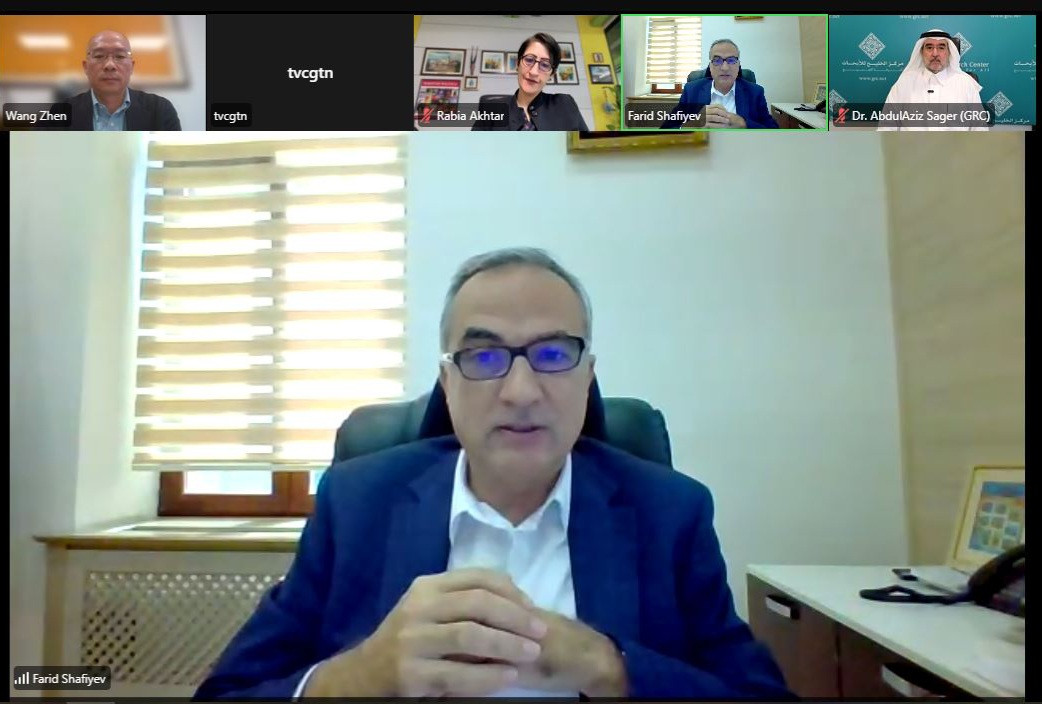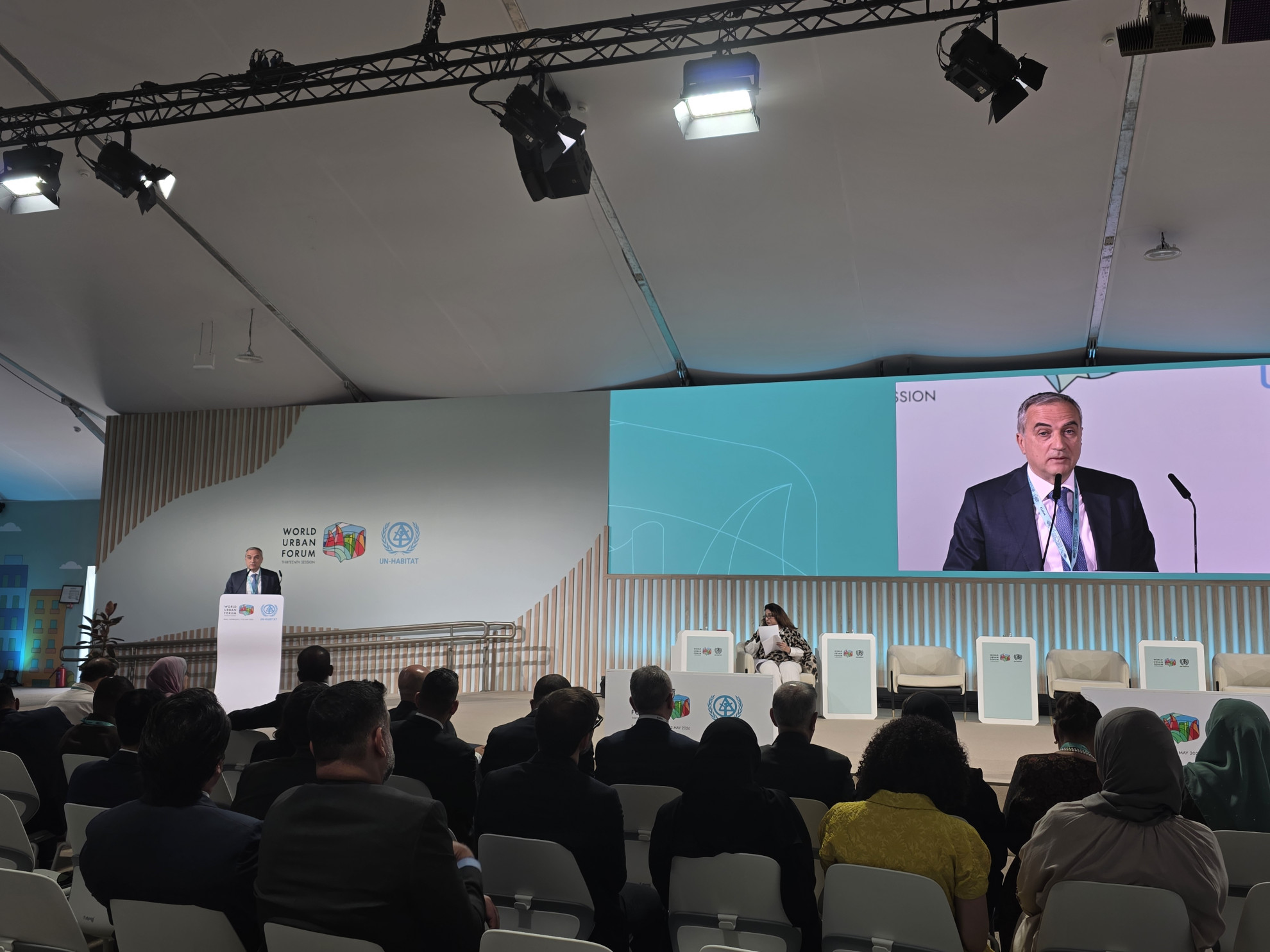
The Chairman of the Board of the Center of Analysis of International Relations (AIR Center), Farid Shafiyev, delivered speeches as a panelist at two sessions held within the framework of the 13th Session of the World Urban Forum (WUF13) on May 21, 2026.
He first participated in a panel discussion on “The Middle East Crisis and Its Impacts on Global Housing and Urban Development,” organized by UN-Habitat with the support of the Nizami Ganjavi International Center.
During his speech, Farid Shafiyev highlighted Azerbaijan’s experience in post-conflict reconstruction and restoration processes. He emphasized that Azerbaijan has significant experience and expertise to offer in the field of post-conflict reconstruction. He noted that the country is currently undertaking a large-scale reconstruction program in the Karabakh and Eastern Zangezur regions - territories devastated by decades of conflict and comparable in size to Lebanon. Farid Shafiyev stated that regional developments continue to influence Azerbaijan’s reconstruction efforts. Since 2020, Azerbaijan has allocated more than $14 billion toward rebuilding the liberated territories, including the construction of roads, airports, schools, hospitals, and residential settlements.
The second event was a panel session titled “Lachin and Kalbajar: The Road from Urbicide to Post-Conflict Reconstruction.”
Speaking at the panel discussion, Farid Shafiyev addressed the phenomena of urbicide and ecocide affecting Azerbaijan, modern scientific and theoretical approaches to these concepts, as well as restoration and reconstruction work undertaken in the liberated territories, along with sustainable urban planning approaches:
“In the context of violent events in Eastern Europe and the Middle East, scholars and experts are paying greater attention to urbicide as a phenomenon of both warfare and systematic cultural eradication. Although the scholarly literature on urbicide initially, in the 1960s, focused on this phenomenon within the context of urban development, the issue of armed conflict and warfare also resides within the contemporary approach. Scholars have explored this topic during the Balkan Wars, particularly in relation to the siege of Sarajevo. However, different types of urbicide have been observed in the Middle East and Eastern Europe, and these involve more complex issues surrounding urban destruction. In recent incidents cities faced scorched-earth tactic, for example, in Mariupol. In Aleppo, Syria, the civil war with complex web of sectarian, religious ideologically driven violence supported by different geopolitical and regional actors, the city faced profound destruction.
But the cities in Karabakh during the Armenian occupation faced different types of urbicide the destruction happened after the military actions. Thus, the Armenian side, besides aiming at erasing each city’s cultural attribution as well as preventing the future rehabilitation and return of the pre-war population.
There are a number of terms used within the study of urbicide - “place annihilation,” “rubbleization,” “warchitecture,” etc.
Civil and ethno-nationalist conflicts demonstrate that violence is organized around controlling, redefining, or erasing space. Thus, while urban warfare refers to military combat conducted in cities involving armies with heavy weapons and street fighting, urbicide aims at the deliberate destruction of the urban environment, often implemented as a political or ideological act to erase identity, displace a population, or destroy the social fabric. Martin Coward (2009) suggests that the starting point of urbicide is a deliberate action.
The evidence obtained by the OSCE Fact-Finding Mission in 2005 and some other journalistic reports from the area attest that several regions and cities, such as Aghdam, Jebrayil, Fuzuli, and Zangilan, and partially Gubadly, Lachin, and Kelbajar, were destroyed and looted.
“The town of Jebrail is totally uninhabited and in complete ruins. There are no other major towns in the district,” the OSCE report highlighted (OSCE, 2005, p. 8). “In the countryside, there are very few people - mostly shepherds, scavengers, and a handful of farmers - but almost no habitable houses. There was significant evidence of the extraction of construction materials, firewood, metals of all kinds.” Similar observations were made in other occupied regions, including Aghdam, “which has been completely destroyed and is void of almost all life.” (p. 8)
The main objective of conducting urbicide is to ruin the city for the implementation of distinct purposes beyond military necessity (urban warfare).
Three markers of urbicide:
First, physical destruction (purpose in case of Karabakh was to create “sanitized or buffer zone” between Azerbaijani and Armenian positions.
The second important marker of urbicide is ethnic cleansing in order to alter the demographic conditions within the region.
The third important element of urbicide is the erasure or deliberate change of the city’s cultural identity.
Lachin and Kalbajar bear special significance for Armenia as these two regions lie between Karabakh and Armenia. Thus, Armenia used them for both military and other types of logistics. Therefore, Armenia singled out these two regions with the plan to keep it under the occupation. Armenia with the help of mediators (France, Russia and the US) proposed the formula of negotiation bargain as 5+2 in terms of the return of regions occupied outside of the former Nagorno-Karabakh autonomy. In reality, Armenia wanted to keep Lachin and Kalbajar permanently under control and annex to Armenia along with former Nagorno-Karabakh.
They treated it differently, moving people from Armenia and the Middle East to those regions. Limited construction was conducted in the city centers – Lachin and Kalbajar.
Urbicide was also accompanied by ecocide committed by the Armenians.
The urbicide in Karabakh prior to the Second Karabakh War can provide a new case study in the destruction of urban places and potentially propose a new criterion for urbicide once it has been investigated in detail.
In sum, urbicide in Karabakh demonstrate that civil and ethno-nationalist conflicts reveal urbicide as both a spatial and political project: the deliberate destruction of cities becomes a means to erase plural urban identities, reshape demographic realities, and dismantle the infrastructures that bear symbolism. Violence is mapped onto space with precision - targeting homes, cultural institutions, administrative centers, and symbolic sites in order to destroy collective life and assert new forms of territorial and political control. Urbicide thus emerges not as collateral damage but as a governance strategy: by eliminating the urban condition, belligerents create the spatial vacuum necessary to impose new authority or advance territorial claims.
In the liberated territories, cities and villages must be rebuilt almost from zero. In existing urban centers, especially Baku, the long presence of displaced populations has increased pressure on housing, services and affordability. The urban poor face particular risks such as rising rents and reduced residual income for housing, higher exposure to transport and utility costs.
State interventions began with the Great Return program, which was officially approved in November 2022.
A major priority is mine clearance before housing reconstruction. UNDP emphasizes that explosive remnants continue to threaten civilians, aid workers and construction teams after conflict ends, and that clearance must come before rebuilding.
Housing must be linked with jobs, schools, healthcare, transport, water, electricity, digital services and local governance. Otherwise, return may be physically possible but socially and economically unsustainable.
Azerbaijan embarked on not isolated housing blocks but on building complete neighborhoods, prioritizing former IDPs living in difficult temporary conditions. Furthermore it is necessary to connect housing allocation with employment and livelihood support. New reconstruction methods include green-energy and low-cost heating solutions in new settlements, subsidizing utilities and transport during the early return period.
The State Committee for Refugees and IDPs has noted that appeals from citizens include return procedures, employment, temporary settlement conditions, utilities, allowances and other social issues, which shows that housing security is inseparable from broader living conditions.
Policy responses should operate at three levels: emergency response, reconstruction policy and long-term urban development.
Urgent needs:
- mine clearance, unexploded ordnance disposal and debris removal;
- temporary housing support for families waiting to return;
- protection of vulnerable IDPs from rising utilities, food, energy and transport costs;
- implement master plans for liberated cities with clear affordability targets;
- use public-private partnerships while keeping social housing obligations;
The main lesson from Azerbaijan is that post-conflict housing recovery must address urbicide as a structural problem. Rebuilding homes is not enough when whole cities, neighborhoods, roads, schools, hospitals, water systems and cultural memory have been destroyed.
-
Housing recovery must start with safety: demining, debris removal and infrastructure assessment.
-
Return must be voluntary, safe, dignified and economically sustainable;
-
Reconstruction should restore community life, not only physical buildings;
-
Housing policy must be linked to regional development and employment;
-
Affordability must be protected during reconstruction, especially for IDPs, low-income families and the urban poor;"