Azerbaijan’s victory in the 44-day Patriotic War stands as one of the most significant examples in modern military history of the interplay between military strategy, operational planning and personnel combat readiness. In 2020, the Azerbaijani Army broke through the enemy’s echeloned defence system, which had been built over approximately 30 years, and liberated a significant part of the occupied territories.
However, it would be incorrect to attribute the outcome of the war solely to technological superiority. The victory was the result of a long-term state strategy, the political and military leadership of the Commander-in-Chief, the professionalism of the military command and the heroism of Azerbaijani soldiers. In this respect, the 44-day Patriotic War is particularly significant as an example of how strategic preparation can be translated into operational superiority, and operational superiority into a decisive military-political outcome in modern warfare.
Building military potential
Following the occupation of Azerbaijani territories in the early 1990s, the Armenian armed forces established an echeloned defence system based on fortified positions, engineering fortifications and the natural advantages of mountainous terrain.
This system was designed on the assumption that the attacking side would suffer heavy losses and that the pace of its operations would gradually slow.
Breaking through such a defence system required Azerbaijan not only to secure military-technical superiority but also to develop its military potential through long-term strategic preparation and in line with the requirements of modern warfare.
Taking this strategic necessity into account, Azerbaijan purposefully transformed its economic potential into military power and did not limit the development of its defence capabilities to the modernisation of armaments.
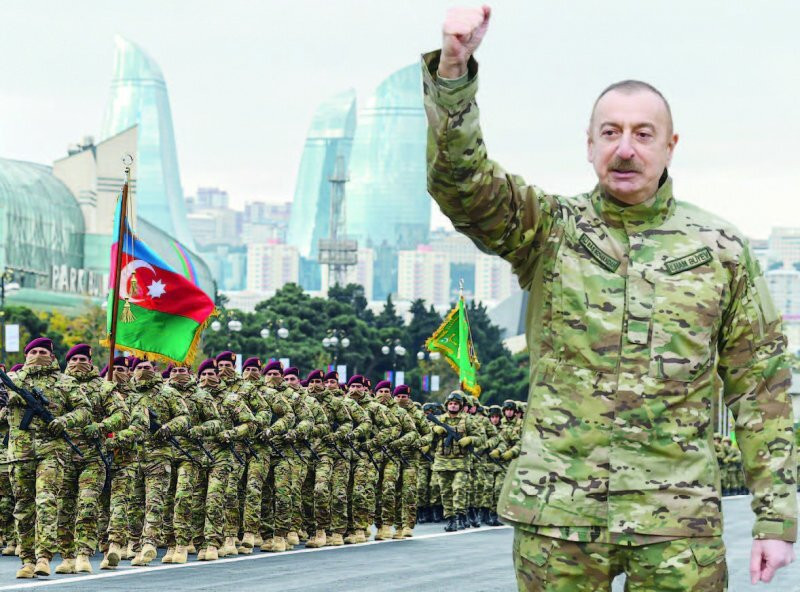
The army-building policy initiated by National Leader Heydar Aliyev was continued under President Ilham Aliyev through systematic reforms aimed at expanding the operational capabilities of the Armed Forces.
Improving the command-and-control system, strengthening coordination between intelligence and fire-support assets, enhancing the combat readiness of special forces units and raising the professional standards of military personnel became essential components of a unified military strategy.
The main advantage of this process was the establishment of a military system capable of ensuring coordinated operations among different branches of the armed forces and adapting flexibly to changing operational conditions.
In particular, shortening the time between decision-making and implementation, encouraging commanders’ initiative and improving the ability to concentrate forces in decisive directions had a significant impact on operational effectiveness.
It should be noted that, from a strategic perspective, the most important result of this process was Azerbaijan’s ability to transform long-term military preparation into real operational superiority.
The leadership of the Commander-in-Chief, public support for the army and the high morale and psychological readiness of personnel were also important factors in ensuring the sustainability of military operations.
Breaking through the defences: New approaches and operational initiative
During the initial stage of military operations, which began on 27 September 2020, the Azerbaijani Army prioritised the neutralisation of the enemy’s air defence systems, artillery, armoured vehicles and military logistics facilities.
The coordinated use of precision-strike weapons, guided by intelligence information, significantly weakened the defensive capabilities of Armenian forces.
In particular, the use of An-2 aircraft as decoy aerial targets became an example of the application of unconventional tactical approaches.
It should be noted that the integration of technological capabilities with ground-force operations became a decisive feature of the combat operations.
Successive advances in the Jabrayil, Fuzuli, Zangilan and Gubadli directions disrupted the integrity of the Armenian forces’ defence system and enabled Azerbaijani units to reach more favourable operational positions.
An analysis of the operations shows that the Azerbaijani command prioritised not merely capturing the enemy’s frontline positions but also undermining the overall resilience of its defence system.
The flexible concentration of forces along the main axes of attack, maintaining the pace of the offensive and rapidly exploiting gains limited the ability of Armenian forces to deploy reserves in time and establish new defensive lines.
In this respect, the main operational outcome of the combat operations was that the enemy lost the initiative and was forced to react to the actions of the Azerbaijani Army.
The war demonstrated that decisive superiority in modern combat is achieved not only by inflicting greater losses on the opposing side but also by systematically restricting its command-and-control, logistical support and manoeuvring capabilities.
It should be noted that Azerbaijan’s military experience during the 44-day Patriotic War has also attracted considerable attention in studies conducted by international experts.
At a book presentation held in Baku on 3 November, American military experts Liam Collins and John Spencer once again confirmed that it would be incorrect to explain the victory solely by the use of modern weapons systems, particularly unmanned aerial vehicles.
Collins attributed the victory primarily to a consistent military strategy pursued over more than 20 years, army-building efforts and the systematic development of the Armed Forces’ combat capabilities.
Spencer, meanwhile, stated that the decisive factor determining the outcome of the war was not technology but the human factor, particularly the ability to make the right decisions under complex combat conditions.
This approach is especially relevant when analysing the Hadrut and Shusha operations.
Hadrut and Shusha: Transforming tactical skill into strategic results
The battles for Hadrut demonstrated the Azerbaijani Army’s ability to conduct offensive operations in complex mountainous terrain.
The coordinated activities of special forces and other units, the seizure of strategically important heights and pressure on enemy defensive positions from different directions ensured the success of the operation.
The liberation of Hadrut weakened the resilience of the Armenian forces’ defensive system in the southern direction and created favourable conditions for the Azerbaijani Army to advance towards the interior of Karabakh.
The Shusha operation, meanwhile, became one of the most remarkable military achievements of the 44-day war.
The city’s complex mountainous terrain and surrounding steep cliffs provided significant advantages to the defending side.
Nevertheless, small, highly trained and mobile combat groups of the Azerbaijani Army’s Special Forces overcame difficult routes, bypassed enemy defensive positions and approached the city from unexpected directions.
It should be noted that the professionalism, high combat readiness and heroism of Azerbaijani soldiers played a decisive role in conditions in which the use of UAVs was limited by foggy weather, while the deployment of heavy military equipment was restricted by the difficult mountainous terrain.
The ability of small units to make independent decisions, adapt flexibly to combat conditions and maintain the initiative in close-quarters fighting became key factors in determining the success of the operation.
The liberation of Shusha became a clear example of tactical success being transformed into a strategic result.
The restoration of control over the city seriously weakened the operational positions of Armenian forces, changed the military-political prospects for continuing the war and created the conditions that led to the signing of the 10 November Statement.
A comparative analysis of the Hadrut and Shusha operations shows that one of the main conditions for military success is selecting a tactical approach appropriate to the operational objective.
While the Hadrut operation emphasised the steady development of the offensive and the securing of control over important positions, the Shusha operation placed greater emphasis on the high mobility of small combat groups and the element of tactical surprise.
After the victory: Preserving military superiority
The results of the 44-day war, followed by Azerbaijan’s full restoration of sovereign control over the Karabakh region in September 2023, demonstrated that the country had achieved its principal military-strategic objective.
Nevertheless, this remarkable victory did not mark the end of the army-building process but rather the beginning of a new stage in the development of the Armed Forces.
In the post-war period, systematic reforms continued in line with the strategic priorities established by the country’s leadership. These included optimising the organisational and staffing structure of the Armed Forces, establishing commando units, improving the quality of combat training for personnel and expanding the capabilities of the national defence industry.
It should be noted that integrating the practical experience gained during the war into the military training system became an important feature of this stage.
In particular, enhancing the independent operational capabilities of small units, improving coordination mechanisms among different branches of the armed forces and developing training methods adapted to complex operational conditions are important for preserving the combat potential of the Armed Forces and strengthening deterrence capabilities aimed at preventing future threats.
The military-strategic legacy of victory
In conclusion, it should be emphasised that the 8 November Victory was the historic result of Azerbaijan’s long-term state and army-building strategy, the leadership of the Commander-in-Chief, the unity of the leader, the people and the army, and the combat proficiency of military personnel.
The military experience of the 44-day war demonstrated that, although modern technologies create military superiority in contemporary armed conflicts, the outcome of a war is ultimately determined by the human factor, the decisions of military command and the fighting spirit of personnel.
The most important lesson of Azerbaijan’s military experience is that strategic victory is achieved not merely through superior weapons but through the actions of a command capable of directing these capabilities towards a unified operational objective, a professional army and soldiers with high morale and fighting spirit.
It was precisely the combination of these factors that enabled the Azerbaijani Army to end the 30-year occupation and fundamentally transform the military-strategic realities of the South Caucasus.
https://news.az/news/8-november-strategic-int-elligence-fighting-spirit-and-historic-victory