


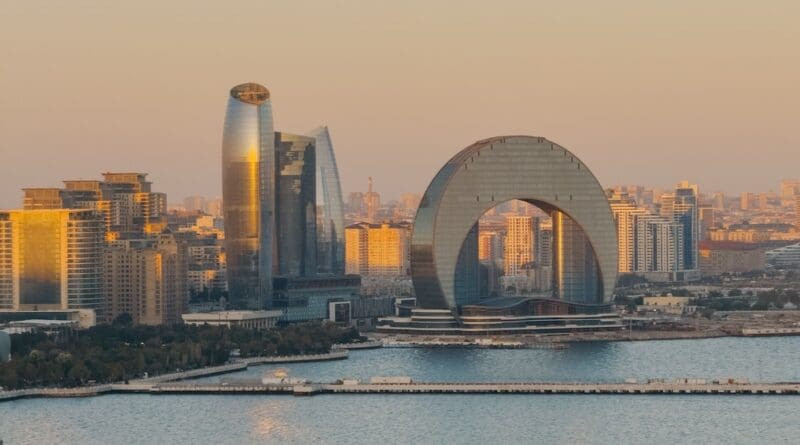
The thirteenth session of the United Nations World Urban Forum (WUF13), held in Baku, is not merely a high-level international gathering; it is also a clear manifestation of Azerbaijan’s growing position within the global agenda on urban development and human settlements. Convened from 17 to 22 May 2026 under the theme “Housing the World: Safe and Resilient Cities and Communities,” the Forum attracted remarkable international participation. According to official data, by 16 May more than 40,000 participants from 182 countries had registered, while over 21,000 delegates from 162 countries were present in Baku on the opening day alone. (1)
UN-Habitat has characterized WUF13 as the second largest international event in Azerbaijan’s history after COP29. Consequently, within only two years, Azerbaijan has become a principal venue first for global climate policy discussions and now for global urban policy debates. This continuity demonstrates that Azerbaijan’s role as a host country for international forums has evolved from episodic engagement into an institutionalized dimension of its foreign policy and global governance profile.
It should also be emphasized that the World Urban Forum was established by the United Nations in 2001 as one of the highest-level global platforms dedicated to sustainable urbanization. According to its official description, WUF is the “premier global conference on sustainable urbanization,” bringing together a broad spectrum of actors ranging from governments and academic institutions to businesses, local communities, and civil society organizations. The WUF13 programme included more than 470 events and a multilateral consultation process culminating in the adoption of the outcome document entitled the “Baku Call to Action.” These facts confirm that WUF13 was not simply a symbolic showcase event, but rather a normative and practical platform where discussions on the global housing crisis, urban resilience, and the implementation of the New Urban Agenda were translated into policy-oriented outcomes.
Overall, several substantial factors explain why such a prestigious global event was entrusted to Azerbaijan. First and foremost is the country’s growing international credibility and its recognition as a reliable partner. The official WUF13 website describes the decision to hold the Forum in Baku as “evidence of Azerbaijan’s contribution to international urbanization processes and the trust it has earned as a dependable partner”. (2) This trust did not emerge spontaneously. In 2023, Baku hosted the global observance of World Habitat Day organized by UN-Habitat, attended by approximately 1,000 participants from 108 countries. (3) Subsequently, Baku was selected as the host city for WUF13 in 2026, while Azerbaijan also assumed the co-chairmanship of the UN-Habitat Intergovernmental Working Group on “Adequate Housing for All” in 2025. These developments indicate that Azerbaijan is no longer merely a provider of logistical infrastructure for international events; rather, it is increasingly becoming an institutional participant in the global urban governance agenda promoted by the United Nations.
The thirteenth session of the United Nations World Urban Forum (WUF13), held in Baku, is not merely a high-level international gathering; it is also a clear manifestation of Azerbaijan’s growing position within the global agenda on urban development and human settlements. Convened from 17 to 22 May 2026 under the theme “Housing the World: Safe and Resilient Cities and Communities,” the Forum attracted remarkable international participation. According to official data, by 16 May more than 40,000 participants from 182 countries had registered, while over 21,000 delegates from 162 countries were present in Baku on the opening day alone. (1)
UN-Habitat has characterized WUF13 as the second largest international event in Azerbaijan’s history after COP29. Consequently, within only two years, Azerbaijan has become a principal venue first for global climate policy discussions and now for global urban policy debates. This continuity demonstrates that Azerbaijan’s role as a host country for international forums has evolved from episodic engagement into an institutionalized dimension of its foreign policy and global governance profile.
It should also be emphasized that the World Urban Forum was established by the United Nations in 2001 as one of the highest-level global platforms dedicated to sustainable urbanization. According to its official description, WUF is the “premier global conference on sustainable urbanization,” bringing together a broad spectrum of actors ranging from governments and academic institutions to businesses, local communities, and civil society organizations. The WUF13 programme included more than 470 events and a multilateral consultation process culminating in the adoption of the outcome document entitled the “Baku Call to Action.” These facts confirm that WUF13 was not simply a symbolic showcase event, but rather a normative and practical platform where discussions on the global housing crisis, urban resilience, and the implementation of the New Urban Agenda were translated into policy-oriented outcomes.
Overall, several substantial factors explain why such a prestigious global event was entrusted to Azerbaijan. First and foremost is the country’s growing international credibility and its recognition as a reliable partner. The official WUF13 website describes the decision to hold the Forum in Baku as “evidence of Azerbaijan’s contribution to international urbanization processes and the trust it has earned as a dependable partner”. (2) This trust did not emerge spontaneously. In 2023, Baku hosted the global observance of World Habitat Day organized by UN-Habitat, attended by approximately 1,000 participants from 108 countries. (3) Subsequently, Baku was selected as the host city for WUF13 in 2026, while Azerbaijan also assumed the co-chairmanship of the UN-Habitat Intergovernmental Working Group on “Adequate Housing for All” in 2025. These developments indicate that Azerbaijan is no longer merely a provider of logistical infrastructure for international events; rather, it is increasingly becoming an institutional participant in the global urban governance agenda promoted by the United Nations.
At the current stage, Azerbaijan’s principal approach is not merely to restore the destroyed territories to their previous condition, but to reconstruct them in accordance with contemporary principles of sustainable development. According to the state-led “Great Return” platform, twelve specialized working groups are engaged in activities ranging from urban planning and environmental protection to energy supply, transportation, mine clearance, and population resettlement. (8) The distinguishing feature of this strategy is its integration of “green” and “smart” development paradigms. UNEP notes that the government’s reconstruction vision prioritizes a “green recovery” approach, including ambitious objectives such as achieving “zero emissions” and “zero waste” in the conflict-affected region by 2050, while new settlements are being designed according to “smart city” and “smart village” concepts. (9)
For this reason, WUF13 generates significant discursive capital for Azerbaijan. Official information released on the Forum’s opening day noted that participants emphasized the devastating effects of wars, conflicts, and disasters on cities, housing stock, infrastructure, and essential services, while Azerbaijan’s post-conflict reconstruction experience was presented as a “noteworthy example” that could serve as a reference point for countries facing similar challenges. Ministerial discussions held during WUF13 further highlighted the necessity of considering housing policy in conjunction with land governance, infrastructure, transportation, public services, employment, and climate resilience. This approach corresponds closely with the methodological foundation of reconstruction efforts in Karabakh and Eastern Zangezur, namely an integrated planning model. (10)
The multilateral process surrounding the “Baku Call to Action” further strengthens the global dissemination of this experience. UN-Habitat has stated that the zero draft of the outcome document was prepared prior to the Forum through contributions from more than 2,000 participants representing eleven stakeholder groups and was subsequently enriched through discussions held during over 400 events throughout Forum week. In this sense, Baku functions not merely as a physical venue, but as a global platform through which Azerbaijan presents its post-conflict reconstruction, housing, resource resilience, and local governance experiences within a multilateral framework. Accordingly, WUF13 should be viewed not only as a consequence of Azerbaijan’s growing international prestige, but also as a mechanism for deepening and consolidating that prestige. (11)
The principal lesson that other states may derive from this experience is that post-conflict reconstruction should not be reduced to the rebuilding of destroyed structures alone. First, mine clearance, environmental assessment, and urban planning must be approached simultaneously; in the Azerbaijani case, these are not separate sectors, but mutually interdependent processes. Second, initiatives such as “green energy zones,” “smart villages,” integrated park systems, and social-service networks demonstrate that the sustainability of return processes cannot be measured solely through housing provision, but also through quality of life and economic opportunity. Third, as UNEP has warned, the ecological implications of rapid reconstruction must be continuously monitored. Consequently, the Azerbaijani model may be particularly instructive for countries interested in the intersection of recovery, stability, and green transformation, although its adaptation inevitably depends upon local governance capacities and financial resources.
İt should also be noted that on 20 May 2026, the Center of Analysis of International Relations (AIR Center) organized a special discussion within the framework of WUF13 dedicated to the broader implications of sustainable urbanization, post-conflict recovery, and international cooperation in urban governance. The event brought together experts, policymakers, and scholars to examine the relationship between urban resilience, reconstruction policies, and the socio-political dimensions of sustainable development in post-conflict environments. Particular attention was devoted to the challenges of rebuilding destroyed urban spaces, strengthening institutional governance capacities, and integrating environmental sustainability into long-term reconstruction strategies. Discussions also emphasized the growing importance of multilateral dialogue and knowledge-sharing mechanisms under platforms such as the World Urban Forum for addressing contemporary urban challenges. The significance of the event stemmed from its contribution to connecting Azerbaijan’s post-conflict reconstruction experience with broader global debates on sustainable urban development, while simultaneously positioning the country as an active participant in international policy discussions concerning resilient and inclusive cities.
In conclusion, the organization of WUF13 in Baku represents the logical continuation of Azerbaijan’s hosting of two major global events within the span of two years-first COP29 and subsequently WUF13. This role rests upon three principal foundations: international trust and partnership capital, the stability necessary for the secure and uninterrupted organization of large-scale events, and an extensive infrastructure base encompassing air transportation, hospitality, and urban mobility. Simultaneously, the reconstruction processes underway in Karabakh and Eastern Zangezur-against the backdrop of urbicide, environmental destruction, and cultural heritage devastation resulting from the Armenian occupation-directly resonate with the thematic focus of WUF13. The issue at stake is not simply the elimination of ruins; rather, it concerns the construction of a new model of settlement that is safe, inclusive, sustainable, and climate-sensitive. For precisely this reason, WUF13 should be regarded not only as a reflection of Azerbaijan’s international prestige, but also as a strategic platform through which the country presents its post-conflict urban development experience to the wider world.
Footnotes:
https://wuf.unhabitat.org/
https://wuf13.az/en/
https://urbanoctober.unhabitat.org/world-habitat-day-2023-building-resilient-urban-economies
https://airport.az/en/press-release/heydar-aliyev-international-airport-2024-achievements-and-results/
https://www.taylorfrancis.com/books/mono/10.4324/9780203890639/urbicide-martin-coward
https://oic-iphrc.org/pdf/rebort/Azerbaijan%20Visit%20Report%20EV.pdf
https://eco.gov.az/frq-content/plugins/pages_v1/entry/20221223145000_59496900.pdf
https://president.az/en/greatreturn
https://eco.gov.az/frq-content/plugins/pages_v1/entry/20221223145000_59496900.pdf
https://wuf13.az/en/media/news/0729/First-Day-of-WUF13-Marked-by-Ministerial-Meeting-Flag-Raising-Ceremony-and-Assembly-Sessions
https://wuf.unhabitat.org/news/wuf13-discussions-shape-final-baku-call-action


