


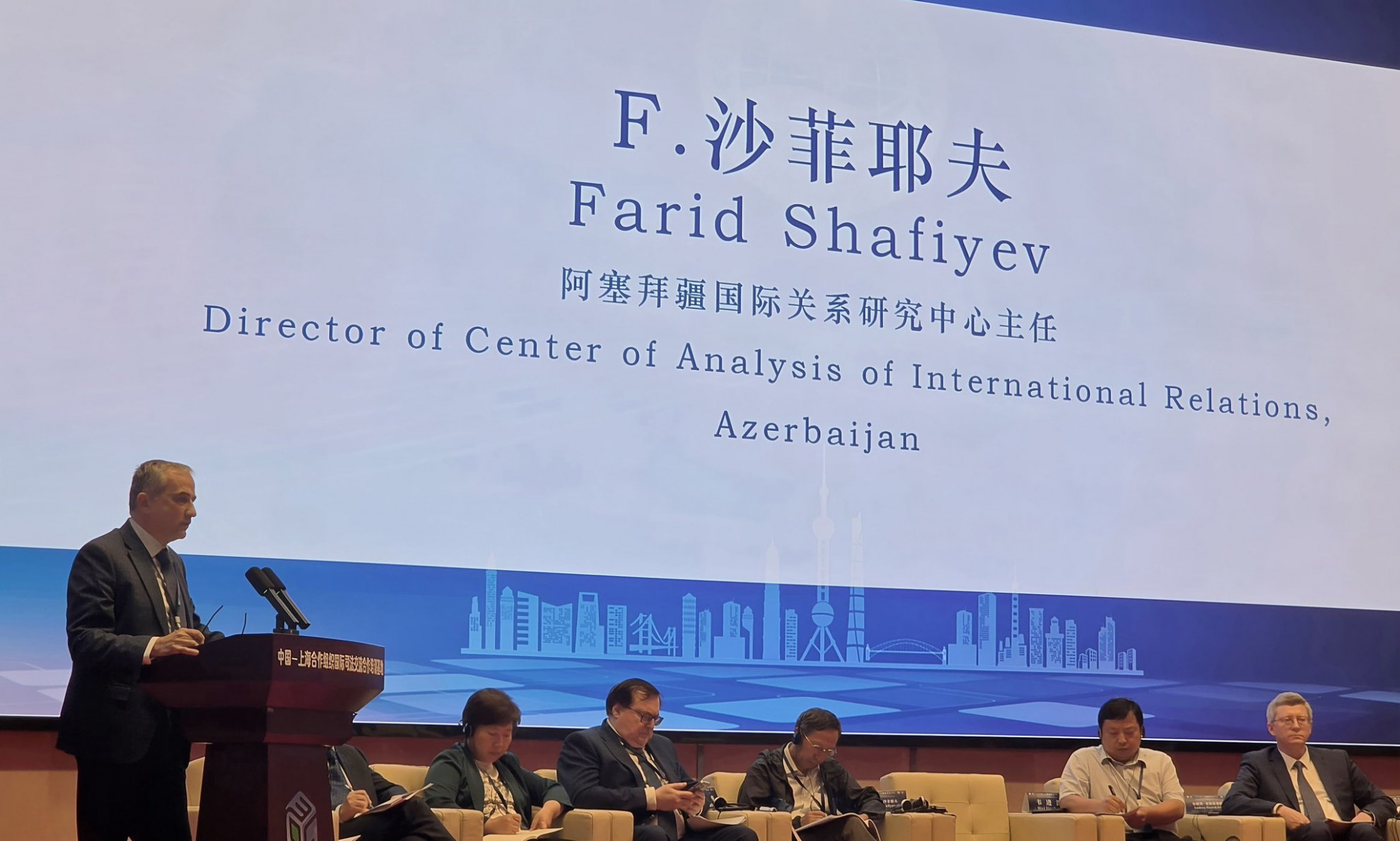
First of I would like to express appreciation to the Shanghai Institute for the organization and hospitality.
The international system is changing, which compels countries to adapt accordingly to remain relevant. Power is no longer concentrated primarily in Western countries because more nations and regions are challenging the traditional setup as they seek to become more involved in global politics and trade. Countries have realized the essence of joining regional groupings to protect their interests. When they join regional groups, they can better take care of their security, business, and diplomatic affairs. The Shanghai Cooperation Organization (SCO) has multiple objectives, among them working together to boost trade, education, the energy infrastructure, culture, and protect the environment. Over time, it has grown in influence within the Eurasia region and on the global stage. Azerbaijan is a partner of this organization. Its geographic location and strategy require it to balance relations with multiple actors within the SCO.
Before contemplating about the future of the SCO, allow me very briefly comment on its past development and expansion. One of the main steps was SCO’s transition from an informal dialogue platform into a structured regional organization. For more than a decade, the organization was limited only to six members. This changed in 2017 when India and Pakistan were admitted as full members, expanding the organization's geographic scope and population coverage. The expansion continued in 2023 with Iran’s accession as a full member. Beyond full membership, SCO introduced additional forms of participation including observer states, dialogue partners and thus expanding its influence in diplomacy and region. Thus, being formed as a narrow mechanism in 2001, the SCO has evolved into one of the largest regional organizations in the world.
Its historical trajectory reflects a gradual shift from border security and military trust building toward a more comprehensive agenda that includes security cooperation, economic coordination and cultural exchange across Eurasian region. As the China leader Xi Jinping emphasized, the SCO has now become more focused on economic cooperation and expanding to become the largest regional organization in the world simultaneously.
Beyond Eurasian affairs, the SCO reaches out to many global agenda items, such as the Global South. This emergence point of the SCO is especially important for the multilateral mechanism to work more favorably and provide equal opportunities for Global South and prioritize the countries of the region.
On the other side, the expansion comes at the cost, as it is getting harder to consensus. For example, the desire of Azerbaijan to upgrade its partner status is blocked by one state.
Nevertheless, despite the fact that internal tensions and rivalries among its member states that hinder occasionally a unified action, it creates important platform for more concerted efforts to tackle regional and global issues.
Apparently, the SCO needs to elaborate new mechanisms to advance issues which are important for cooperation among the member states, including internal rules and regulations. By embracing adaptable mechanisms, the SCO can remain responsive to evolving regional and global realities. While consensus remains a valuable principle that reflects equality among member states, the SCO should seek ways to prevent situations in which a single member can indefinitely block initiatives supported by the majority. As the organization expands, the risk of paralysis resulting from divergent national interests may increase. Therefore, exploring procedural mechanisms that encourage constructive compromise, consultations, and alternative forms of cooperation could help maintain the effectiveness of the organization while preserving its inclusive nature.
While many pundits and policy-makers speak bout the crisis of multilateralism, the wars and conflicts manifested the urgency of diplomacy and multilateralism.
The future of the SCO will largely depend on its ability to strengthen and promote effective multilateralism in an increasingly complex international environment. As a platform that brings together countries with diverse political systems, economic interests, and foreign policy priorities, the SCO has demonstrated the value of dialogue, mutual respect, and cooperation. In an era marked by geopolitical tensions, economic uncertainty, and transnational challenges, the organization can continue to serve as an important mechanism for fostering regional stability, connectivity, and collective responses to common concerns. Strengthening multilateral cooperation will enable member states to address security, economic, environmental, and technological challenges more effectively.
Looking ahead, the SCO's long-term relevance will depend on its ability to balance unity with diversity, consensus with efficiency, and principles with pragmatism. By reinforcing multilateral cooperation, adopting flexible forms of engagement, and ensuring that decision-making processes remain effective, the organization can strengthen its role as a major regional and international platform. Such an evolution would enable the SCO to contribute more effectively to peace, development, and cooperation across Eurasia and beyond.
In conclusion, I would like to emphasize that the SCO membership offers a set of benefits including economic, political and other strategic opportunities that align with Azerbaijan’s multi-vector foreign policy.


