


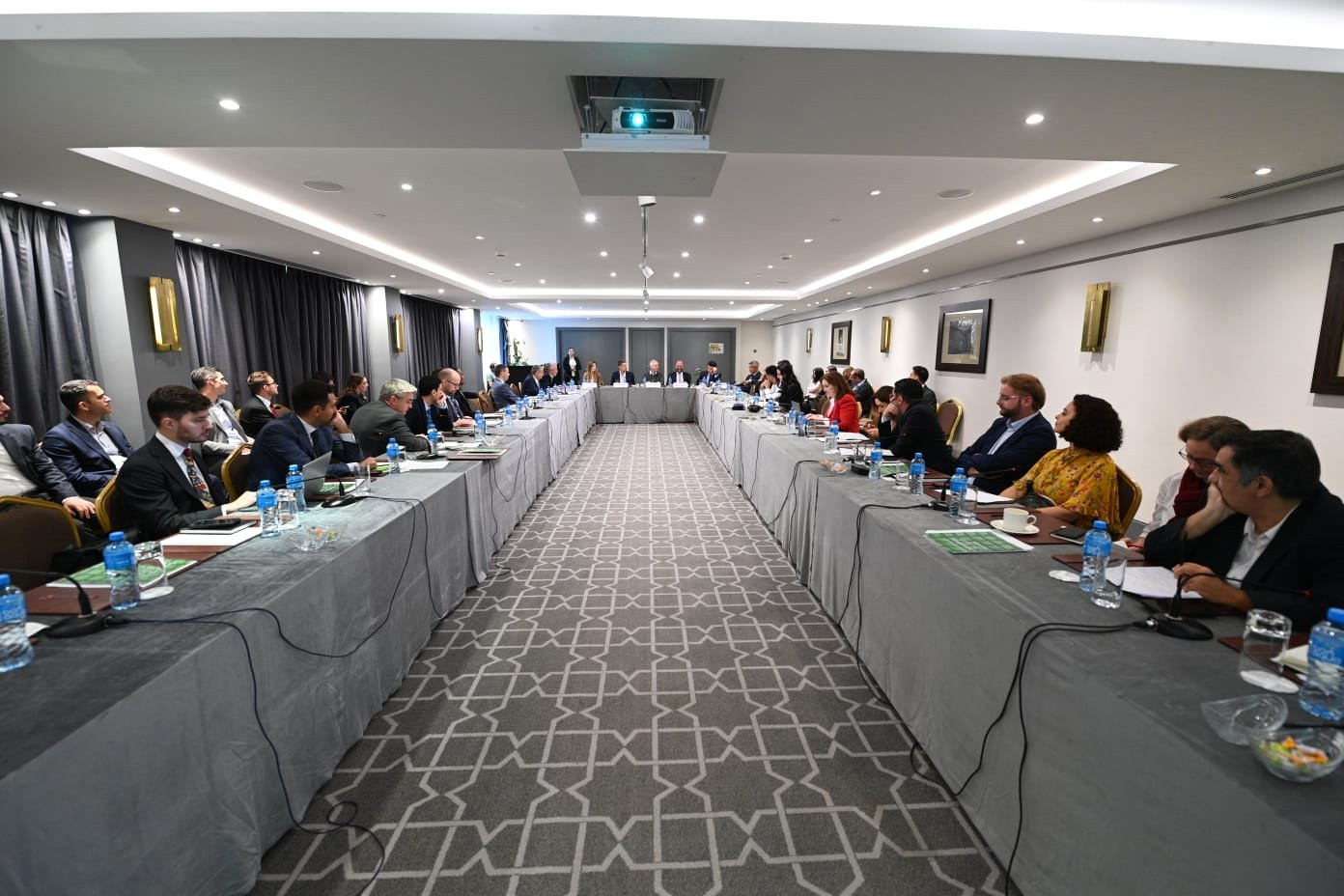
The Center for Analysis of International Relations and Multiculturalism and the Center for Governance and Culture in Europe (GCE-HSG) at the University of St. Gallen, Switzerland, co-organized the international conference titled “Security and Cooperation in the South Caucasus.”
The two-day conference brought together academics, policymakers, and international experts to discuss the future of security and cooperation in the South Caucasus. The discussions addressed the new geopolitical realities that have emerged in the region following the 44-day war, the normalization of Azerbaijani-Armenian relations, the development of regional transport and communication links, emerging infrastructure projects, economic integration, the TRIPP project, potential external risks, and the role of the European Union in promoting sustainable cooperation and connectivity in the region.
Speaking at the opening ceremony, Farid Shafiyev, AIR Center’s Chairman of the Board, highlighted the new geopolitical realities emerging in the South Caucasus and emphasized that the region is currently facing a number of important opportunities to strengthen peace, normalize relations, and advance regional cooperation.
According to him, developments in the wider neighborhood have further increased the importance of ensuring peace and stability in the South Caucasus. In particular, the ongoing Russia-Ukraine war to the north, as well as tensions involving Iran, the United States, and Israel to the south, underscore the strategic importance of maintaining stability in the region.
Addressing the growing involvement of the United States in developments in the South Caucasus, including through the TRIPP project, Farid Shafiyev emphasized the increasing importance of transport and logistics connectivity. In this context, he highlighted the strategic significance of the Middle Corridor and its potential to strengthen regional and transcontinental connectivity. He also drew attention to Azerbaijan’s expanding relations with the countries of Central Asia and its participation in the C6 format.
AIR Center Chairman further noted that these developments are creating new opportunities for cooperation in the energy and transport sectors and could contribute to a new phase in the development of the South Caucasus based on peace, stability, and regional cooperation.
He also stressed the importance of studying and understanding the South Caucasus beyond established Soviet-era and Orientalist frameworks and stereotypes.
“"Today's discussion has important academic dimension to look at the South Caucasus as the region on its own merits. For many years, the South Caucasus was viewed through the lens of the Russian Empire and the Soviet Union. This perspective has shaped much of the academic and political discourse about the region. But 30 years after the collapse of the Soviet Union, we have an entirely new generation that has never experienced the Soviet Union. It is therefore time to look at the South Caucasus on its own terms, with an understanding of its own peculiarities, dynamics, and historical experiences. The problem with an Orientalist perspective is that, when it comes to Azerbaijan, it can sometimes reinforce pro-Armenian narratives in European media and academic circles. Today's discussion can contribute to moving beyond these established stigmas and stereotypes.,” Shafiyev said.
Ulrich Schmid, the member of the Academic Council of the Center for Governance and Culture in Europe, noted that developments in the South Caucasus, the opportunities for regional cooperation created by the emerging peace process between Azerbaijan and Armenia, and the potential implications of these developments for Russia’s position in the region have attracted growing attention from international academic and expert communities.
Schmid further emphasized that the strategic importance of the South Caucasus has increased considerably in recent years, transforming the region into an increasingly significant geopolitical space with substantial economic and security implications. He noted that the rapid pace of political and geopolitical developments in the region makes it increasingly important to develop a deeper understanding of the emerging realities of the South Caucasus.
The conference provided a platform for exchanging academic and policy perspectives on the evolving regional order and for examining prospects for greater connectivity, economic cooperation, and sustainable peace in the South Caucasus. The discussions underscored the importance of approaching the region on the basis of its contemporary political, economic, and social dynamics, while recognizing its growing significance within the broader Eurasian geopolitical landscape.
He particularly drew attention to developments in Azerbaijan and the emerging peace process, emphasizing the importance of examining the potential implications of these developments for Azerbaijan, the South Caucasus as a whole, and the wider region.
Guy Bonvin, Deputy Head of the Regional Cooperation Division at the Embassy of Switzerland in Azerbaijan and Turkmenistan, noted that the geographical position of the South Caucasus makes the region an important connectivity hub linking Europe, the Black Sea, and Central Asia.
Highlighting Azerbaijan’s important role in these developments, the diplomat emphasized the country’s transformation over the past 30 years and the significant expansion of its regional and international connections.
In this context, Bonvin identified Azerbaijan’s hosting of COP29 in Baku as an important example of the country’s growing international role:
“I consider the hosting of COP29 in Baku an important example in this regard. As a member of the Swiss delegation, I participated in COP29, and I regard Azerbaijan’s hosting of such an important international platform as a significant development.”
The diplomat also noted that, within the framework of Switzerland’s cooperation programme, efforts are being undertaken to support the development of financial and digital services, promote open banking, and strengthen mutual trust within the financial sector.
He further emphasized the importance of developing central bank-level cooperation between Azerbaijan and the countries of Central Asia, particularly Kazakhstan and Uzbekistan, as well as with Georgia. According to Bonvin, strengthening such institutional links can contribute to greater regional connectivity and cooperation in the financial and digital sectors.
The first panel of the international conference, titled “The South Caucasus After the Second Karabakh War: A New Regional Order?”, brought together experts to examine Azerbaijan’s evolving geopolitical role, its foreign policy priorities, the concept of regional ownership, and its approach to non-alignment amid competing regional dynamics. Moderated by Alexander Meienberger, Director of the Center for Governance and Culture in Europe (GCE-HSG) and an expert in governance, regional politics, and socio-political transformation, the panel featured presentations by Jordi Xuclà, a Spanish lawyer, academic, and politician from Catalonia and former member of the Congress of Deputies and the Senate of Spain, who discussed Azerbaijan’s renewed geopolitical role in the South Caucasus and the European Union’s strategic turn; Michaël Levystone, Co-founder of the Observatory of New Eurasia (ONE) and an expert on Central Asia and Russia’s foreign policy toward Asia, who examined Azerbaijan’s foreign policy since the end of the Second Karabakh War in 2020; and Anar Valiyev, Associate Professor of Public Administration at ADA University, whose research focuses on post-Soviet public policy, governance, democracy, and urban development, who explored Azerbaijan’s approach to non-alignment and the challenges of balancing among competing regionalisms in the South Caucasus. The discussions focused on the transformation of the regional order following the Second Karabakh War and Azerbaijan’s increasingly prominent role in shaping the emerging political and geopolitical landscape of the South Caucasus.
The second panel of the international conference, titled “The Armenia-Azerbaijan Peace Process and Economic Normalization,” examined the ongoing peace process between Azerbaijan and Armenia and explored the role of information, cultural and academic engagement, civil society interactions, and broader geopolitical dynamics in advancing peace and regional cooperation. Moderated by Vasif Huseynov, Head of Department at the Center for Analysis of International Relations (AIR Center), the panel featured presentations by Sophie Harper, Research Associate at the Center for Governance and Culture in Europe (GCE-HSG), whose work focuses on governance and political studies, and Julius Schulte, a researcher at the University of St. Gallen specializing in machine learning and AI system evaluation and founder of Aurora Intelligence. Their presentation, titled “Whose Sources Feed the Machines? Azerbaijan Through the Eyes of AI Search Engines,” examined how information sources shape the representation of Azerbaijan in AI-powered search and information systems. Ansgar Jödicke, Senior Researcher in the Social Sciences Department at the University of Fribourg, Switzerland, explored whether cultural, academic, and civil society encounters can contribute to peace between Azerbaijan and Armenia. Damjan Krnjević, Professor of Practice at ADA University and a specialist in international relations, geopolitics, strategic studies, and foreign policy, addressed the geopolitical implications of the Armenia-Azerbaijan peace process and economic normalization. Overall, the panel highlighted the importance of reliable and balanced information, people-to-people engagement, and economic normalization as complementary dimensions of a sustainable peace process between Azerbaijan and Armenia.
The third panel of the international conference, titled “The Middle Corridor and South Caucasus Connectivity Architecture,” examined the evolving connectivity landscape of the South Caucasus, with particular attention to the Middle Corridor, the TRIPP initiative, the role of the United States, and prospects for developing an integrated regional connectivity system. Moderated by Ulrich Schmid, Professor of Russian and East European Studies at the University of St. Gallen and a specialist in political culture and media in Eastern Europe, the panel brought together experts from academia, policy, and the media. Andrew D’Anieri, Associate Director of the Atlantic Council’s Eurasia Center, discussed “TRIPP + TITR and U.S. Involvement in Advancing Connectivity Architecture,” examining the role of the United States in supporting emerging connectivity initiatives across the wider Eurasian space. Silvia Stöber, Foreign Correspondent for ARD/Tagesschau specializing in Russia, the South Caucasus, and European neighborhood politics, addressed the “Prospects for an Integrated South Caucasus Connectivity System Linking Azerbaijan, Armenia, Georgia, and Türkiye,” focusing on the potential for greater regional integration through enhanced transport and infrastructure links. Jeffrey Mankoff, Senior Associate with the Russia and Eurasia Program at the Center for Strategic and International Studies (CSIS), examined “The Middle Corridor: Prospects, Obstacles, and the Way Ahead,” highlighting the strategic significance of the route as well as the challenges that could affect its further development. Vusal Guliyev, Leading Advisor and Indo-Pacific & Eurasian Affairs Analyst at the AIR Center, presented “Southern Branch of Middle Corridor Gains Eurasian Connectivity Momentum,” focusing on the growing importance of the corridor’s southern route and its broader implications for Eurasian connectivity. Overall, the panel highlighted the strategic importance of the Middle Corridor and the emerging connectivity architecture of the South Caucasus, while exploring the opportunities and challenges associated with strengthening regional integration, infrastructure development, and economic cooperation.
The fourth panel of the international conference, titled “Energy Corridors, Economic Integration, and the Geopolitics of Connectivity,” brought together experts to examine the evolving dynamics of connectivity across the South Caucasus and the wider Eurasian region. Moderated by Deena Saleh Shahin, Assistant Professor of Economics and Finance at Bahçeşehir University, the panel addressed the economic, infrastructural, and geopolitical dimensions of regional connectivity. Guy Bonvin, Deputy Head of Regional Cooperation at the Embassy of Switzerland in Azerbaijan and Turkmenistan, discussed the economic and logistical dimensions of connectivity, with particular attention to the role of water-related issues in regional cooperation and development. Felix Hans Breiteneicher, Research Associate at the Center for Governance and Culture in Europe (GCE-HSG), examined Germany’s role in the South Caucasus within the framework of the European Union’s Global Gateway initiative, focusing on the broader implications of European engagement in regional infrastructure and connectivity. Theresa Fallon, Founder and Director of the Centre for Russia Europe Asia Studies (CREAS), explored the geopolitics of energy connectivity through Azerbaijan and its significance for regional and wider Eurasian energy networks. Overall, the panel highlighted the growing interdependence of energy corridors, trade routes, infrastructure, water resources, and economic integration, emphasizing their collective role in shaping regional cooperation and the broader geopolitics of Eurasian connectivity.
As a continuation of the conference programme, an info-tour is scheduled to take place from September 9 to 11, providing participants with an opportunity to conduct field research in the Karabakh and East Zangazur economic regions and to gain first-hand insight into the destruction caused in these territories during the period of Armenia’s occupation, as well as the large-scale reconstruction and development efforts currently underway across the region.
As part of the info-tour, visits are planned to Aghdam, Jabrayil, Fuzuli, Shusha, and Lachin, where participants will have the opportunity to observe the ongoing reconstruction process and examine developments in the region on the ground.


