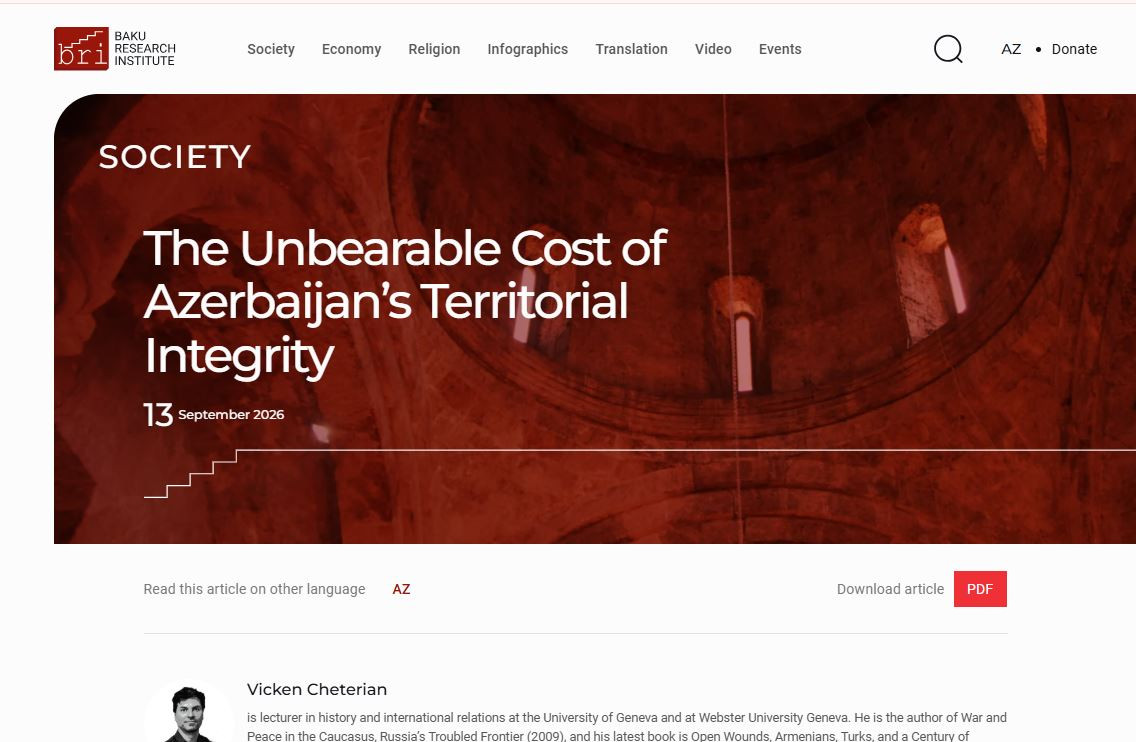
The article titled “The Unbearable Cost of Azerbaijan’s Territorial Integrity”, published on the Baku Research Institute website, or, more precisely, this piece of scribbling, can confidently be regarded as a repetition of the one-sided, biased and unfounded narratives that radical Armenian political and information circles have been circulating for many years.
First and foremost, this piece can be considered highly problematic from an academic standpoint. More precisely, the article’s central problem is that it systematically distorts the causes and consequences of the former conflict. The facts that Azerbaijan’s internationally recognised territories remained under occupation for nearly three decades, that hundreds of thousands of Azerbaijanis were expelled from their native lands, that Armenian armed forces maintained an unlawful presence on Azerbaijani territory, that crimes were committed against Azerbaijani civilians on ethnic grounds, and that settlements were destroyed during the period of occupation are almost entirely excluded from the analytical framework.
Instead, Azerbaijan is portrayed not as a party that restored its sovereignty and territorial integrity, but as a state that allegedly and systematically prioritised violence throughout the conflict. Such an approach, naturally, conforms neither to historical truth nor to the basic principle of analytical balance. Distorting and generalising the actions of only one side of the conflict while “overlooking” the other side’s policies of occupation, ethnic cleansing, forced displacement and military control cannot be regarded as scholarly or objective analysis.
The article’s treatment of the events of 2020 and 2023, in particular, is striking for the way they are taken out of context. As a result of the occupation, Azerbaijan lost control over a significant part of its internationally recognised territory in the early 1990s, and despite the relevant resolutions of the UN Security Council, this situation persisted for decades. To disregard this fundamental reality and turn Azerbaijan’s restoration of its territorial integrity into supposed evidence supporting predetermined theses about “militarism”, “ethnic cleansing” or “authoritarian consolidation” is, to put it mildly, nothing short of extreme bias.
The language used by the author also creates the impression that the article was written from a predetermined political position. Controversial allegations that require substantial legal evidence are presented as though they were undisputed facts, while legal, historical and security arguments explaining Azerbaijan’s position are either ignored or discredited. As a result, the piece reads less like research and more like an attempt to construct a false political narrative.
One of the most absurd aspects of the article is that Azerbaijan’s restoration of its territorial integrity is itself presented as a problem. Azerbaijan’s sovereignty and territorial integrity are not concepts invented by any political government; they are realities recognised under international law. To portray the Azerbaijani people’s support for the liberation of their territories from occupation as the “social base of authoritarianism” is to disregard the fate of millions affected by forced displacement, the trauma of war and three decades of fruitless negotiations.
At the same time, the most regrettable aspect of the matter is that such a one-sided, biased, anti-Azerbaijani text — one that effectively disregards the state’s legal and political position — was published on a platform bearing the name “Baku Research Institute”. The minimum one would expect from a platform using the name Baku and the term “research” is a comparative presentation of facts, consideration of conflicting viewpoints and adherence to analytical integrity rather than ideological judgement. This article falls far short of those standards.
The article’s selection of facts and terminology, as well as its construction of cause-and-effect relationships, bear a striking resemblance to theses that have been employed for years in radical and revanchist Armenian political discourse. The ease with which the history of Azerbaijan’s occupation and the experience of forced displacement endured by Azerbaijanis are erased, while the restoration of the country’s sovereignty is portrayed almost entirely as a negative political development, is not merely regrettable; it also provokes serious indignation and revulsion. Most painful of all is the fact that such an article, replete with slander against our people and our state, was published on a platform whose authors are predominantly Azerbaijani. Gentlemen, whose mill are you pouring water onto?!
Instead of enriching public debate, such writings deepen mutual mistrust, reopen the wounds of war and undermine fragile hopes for peace in the region. Peace cannot be built by rendering the suffering of one side invisible, selectively presenting and distorting historical facts, or belittling the legitimate security concerns of Azerbaijani society. On the contrary, genuine reconciliation requires an honest reckoning with the past, mutual responsibility and a conscientious approach to events.
In our view, articles of this kind published by the Baku Research Institute serve not peace but rather renewed escalation and the rekindling of the conflict. The direction of the text and its chosen political framework raise serious suspicions that it was written at the behest of circles standing behind the BRI; in this regard, it is difficult to regard its publication as accidental. It appears that the objective is to obstruct the peace process and shape negative international public opinion towards Azerbaijan.